
Scientists found that bending a simple piece of ice releases electricity powerful enough to spark a lightning bolt
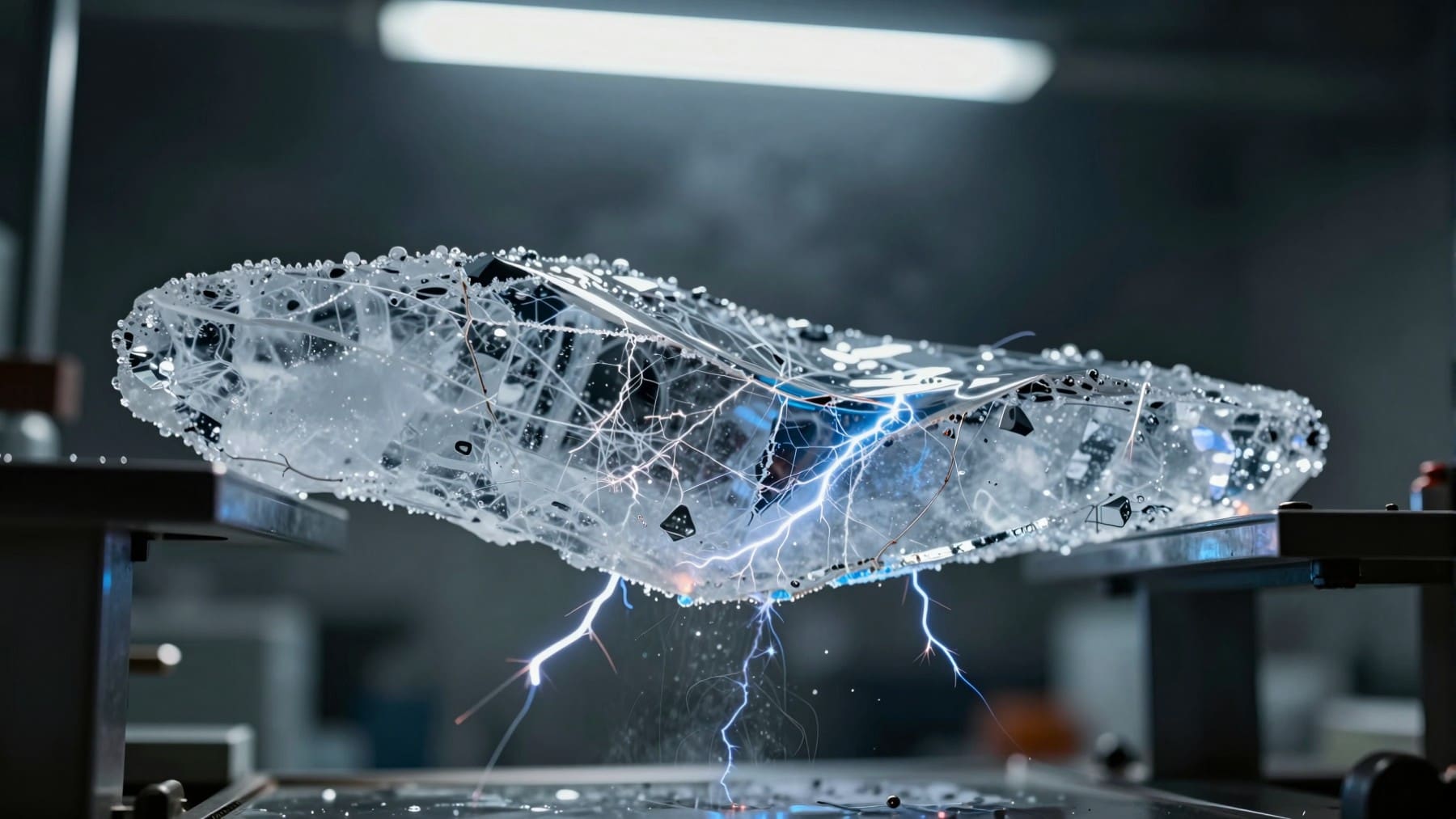 AI-made
Ice is one of the most ordinary things on Earth — it forms in your freezer, coats mountain peaks, and drifts through the upper atmosphere inside storm clouds. Scientists have studied it for centuries. Yet a new study published by the Universitat Autònoma de Barcelona via ScienceDaily suggests it has been hiding an electrical secret the whole time.
Inside a thunderstorm, ice particles collide constantly — and somehow, those collisions build up enough charge to unleash a lightning bolt. How that happens has never been fully explained. Researchers may now have found the answer hiding in the ice itself.
A familiar material with an unfamiliar talent
Most people know that some materials generate electricity when squeezed. That property — piezoelectricity — powers everything from guitar pickups to medical ultrasound devices. Ice, however, is not piezoelectric. Compress it and nothing electrical happens.
When ice particles collide inside a cloud, the resulting deformations are irregular and uneven — exactly the conditions that trigger flexoelectric charge generation.
Flexoelectricity works differently. Rather than uniform compression, it requires uneven deformation — bending, warping, or stressing one side more than the other. That asymmetry is what drives charge generation. According to the new Nature Physics study, ice does this remarkably well, a result nobody had experimentally confirmed before.
The finding came from a collaboration between ICN2 at the Universitat Autònoma de Barcelona, Xi’an Jiaotong University, and Stony Brook University. For a material studied across centuries of science, it is a genuinely unexpected result.
How the experiment worked
The setup was straightforward: researchers placed a slab of ice between two metal plates connected to a measuring device, bent the ice, and recorded the electric potential it produced.
The numbers were not trivial. The electric potential generated during bending matched values previously observed in ice-particle collisions inside real thunderstorm clouds — and that correspondence was not a minor footnote. It was the result that made the team pay attention.
ICREA Prof. Gustau Catalán, who leads the Oxide Nanophysics Group at ICN2, described the significance directly: the measured results match those previously observed in ice-particle collisions in thunderstorms. That alignment between a controlled lab experiment and a violent atmospheric event is what gives the finding its weight.
A second surprise: ice can also become ferroelectric
The flexoelectricity result was already notable on its own. The study, though, carried an additional discovery. At temperatures below –113°C (160K), a thin layer at the surface of ice becomes ferroelectric.
Ferroelectricity means a material develops a natural electric polarization — and that polarization can be flipped by applying an external electric field. It behaves like a magnet whose poles you can reverse on command.
This gives ice two separate mechanisms for generating electricity. Flexoelectricity operates across all temperatures up to 0°C, while ferroelectricity activates only at extreme cold.
As Dr. Xin Wen, one of the study’s lead researchers, explained: ice may have not just one way to generate electricity but two. That dual capability reframes how scientists should think about ice as an electromechanical material.
Rethinking how lightning is born
The question of how lightning forms has a well-known outline but a frustratingly incomplete interior. Charge builds up inside storm clouds when ice particles collide, and eventually that charge releases as a bolt. What has never been satisfactorily explained is the mechanism — specifically, how those collisions leave ice particles electrically charged in the first place.
Piezoelectricity was never a candidate. Ice simply does not generate charge under uniform compression, and that gap in the explanation is one atmospheric scientists have long acknowledged without resolution.
Flexoelectricity could fill it. When ice particles collide inside a cloud, the resulting deformations are irregular and uneven — exactly the conditions that trigger flexoelectric charge generation.
The researchers are careful with their language, describing flexoelectricity as “one possible explanation” rather than a confirmed mechanism. Still, the match between laboratory measurements and real storm data makes it a serious candidate for further investigation.
Ice as a material of the future
Beyond storms, the discovery repositions ice within the landscape of functional materials. It now belongs alongside electroceramics like titanium dioxide — materials used in sensors, capacitors, and other advanced devices, a category ice has never occupied before.
Researchers at ICN2 are already exploring how these properties might be applied. One direction involves fabricating ice-based electronic devices directly in cold environments, using ice itself as the active component rather than a substrate or coolant. Whether that leads anywhere practical remains to be seen.
Practical applications remain distant. The researchers themselves acknowledge it is “a bit early” to discuss specific solutions. What the study delivers is not a product — it is a new research direction. Ice, it turns out, has electrical properties worth taking seriously, and scientists are only beginning to understand what that means.

Carlos is an engineer with strong expertise in technical and industrial topics. He previously worked at international companies such as Siemens and is multilingual.
