
MIT engineers use ultrasonic vibrations to pull drinking water from air 45 times faster than solar heat
 AI-made
There’s water in the air right now — even above the driest deserts on Earth. For communities far from rivers, lakes, or coastlines, that invisible moisture has long represented a tantalizing but largely unreachable resource. Materials capable of pulling humidity from the air already exist. The problem has always been what comes next: releasing the trapped water is painfully slow, often taking hours or even days. MIT researchers say they’ve found a fundamentally different way to solve that problem.
Water in the air, trapped in a waiting game
Even the driest places on Earth hold measurable humidity. Sorbent materials — engineered to act like molecular sponges — can pull that moisture directly from the air. Atmospheric water harvesting has attracted serious research attention for years, precisely because it promises water independence for communities with no rivers, lakes, or coastlines nearby.
The field’s persistent obstacle has never been the capturing step. What happens after is the problem. Releasing the trapped water typically requires solar heat, and the process can stretch from many hours into days. The very property that makes a sorbent useful — its strong grip on water molecules — is the same property that makes extraction so slow and costly.
Shuvo arrived at this idea from a different field entirely: he had been working with ultrasound for wearable medical devices when he joined Boriskina’s group.
How ultrasound shakes water molecules free
Ultrasound refers to acoustic pressure waves above 20 kilohertz, well beyond the range of human hearing. At the right frequency, those invisible waves can do something precise and powerful: break the weak bonds holding water molecules to a sorbent material.
Graduate student Ikra Iftekhar Shuvo describes the effect directly. “It’s like the water is dancing with the waves,” he says. “This targeted disturbance creates momentum that releases the water molecules, and we can see them shake out in droplets.” Solar heating floods a material with broad thermal energy and waits.
Ultrasound targets the specific molecular bonds that need breaking — and breaks them fast. Shuvo arrived at this idea from a different field entirely: he had been working with ultrasound for wearable medical devices when he joined Boriskina’s group.
Inside the device: a vibrating ceramic ring and tiny nozzles
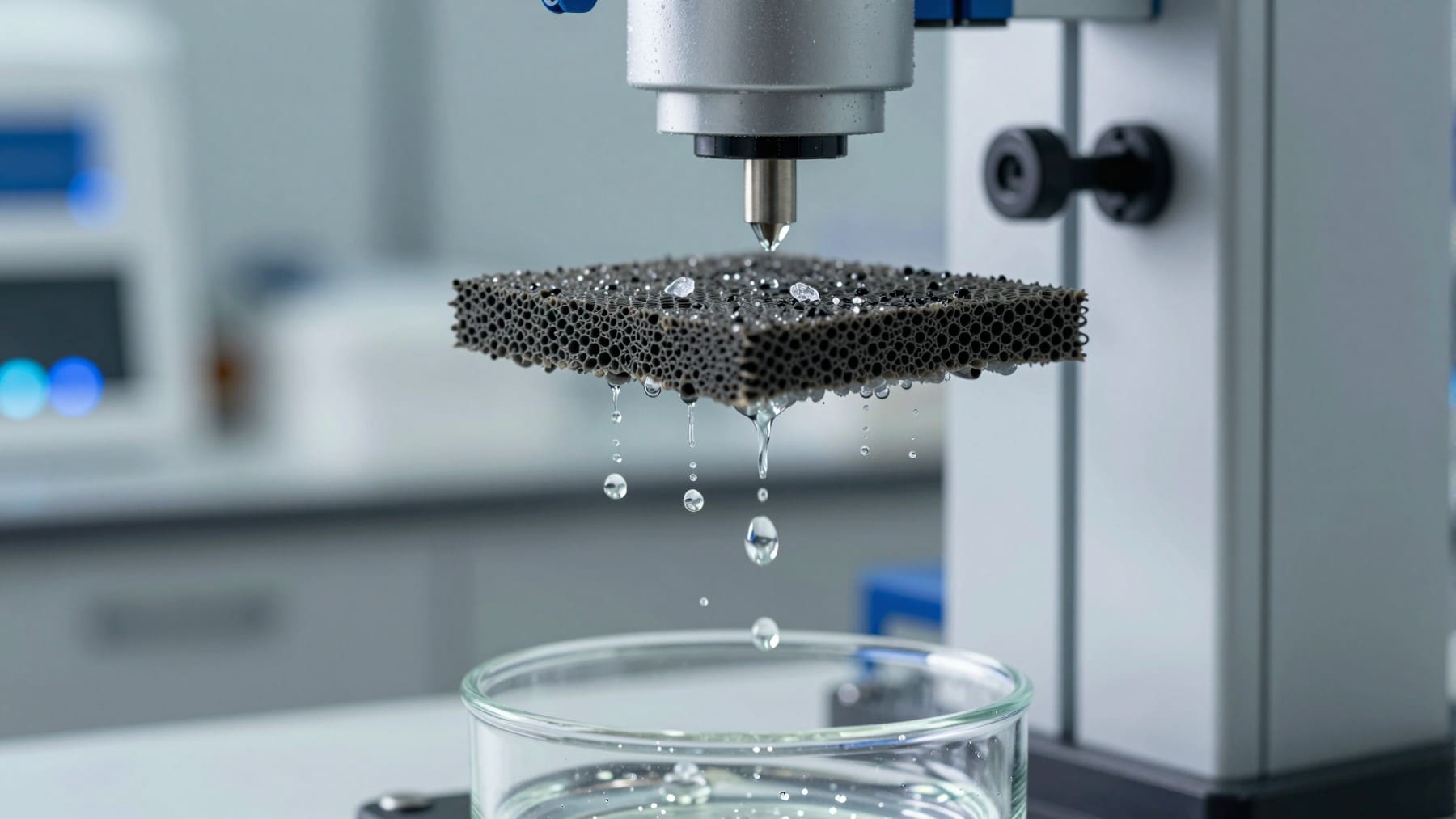
The ultrasonic actuator the team built is straightforward in concept. At its center sits a flat ceramic ring that vibrates when voltage is applied, surrounded by a second ring containing small nozzles. As water molecules shake loose from the sorbent placed on top, droplets fall through those nozzles into collection containers positioned both above and below the vibrating ring.
The team ran tests using quarter-sized samples of previously developed sorbent materials. Each sample was placed in a humidity chamber at varying humidity levels until fully saturated, then set onto the actuator. In every single trial, across all humidity conditions, the device dried the material within minutes. Boriskina highlights a key design advantage: “The beauty of this device is that it’s completely complementary and can be an add-on to almost any sorbent material.”
45 times more efficient than solar heat
The team’s measurements put a concrete number on the improvement. The ultrasonic method is 45 times more energy-efficient than heat-based extraction from the same material — a gap large enough to change what is practically possible in the field.
Because the device runs on electricity rather than heat, a small solar cell can power the actuator. That same cell can double as a saturation sensor, detecting when the sorbent is full and triggering the actuator automatically. The result is a system that cycles continuously throughout the day — absorbing, releasing, and resetting — without human intervention.
The research was published November 18 in Nature Communications, with Shuvo as lead author and principal research scientist Svetlana Boriskina and colleagues Carlos Díaz-Marín, Marvin Christen, Michael Lherbette, and Christopher Liem as co-authors.
A window-sized appliance for water-scarce communities
Boriskina’s vision for where this technology leads is concrete. She imagines a household unit roughly the size of a window: a fast-absorbing sorbent panel on one side, an ultrasonic actuator on the other. When the panel saturates, the actuator activates briefly, shakes the water out, and resets — all powered by a small solar cell.
The intended users are communities in desert regions and other areas lacking access to freshwater sources or coastlines suitable for desalination. Repeated daily cycles could accumulate into a meaningful household water supply. “It’s all about how much water you can extract per day,” Boriskina says. “With ultrasound, we can recover water quickly, and cycle again and again. That can add up to a lot per day.”
Researchers also note the approach could complement atmospheric water harvesting systems already in development worldwide. As sorbent materials improve and the ultrasonic actuator scales up, the combination could move the technology from a promising concept to a practical tool — one cycle at a time.

Carlos is an engineer with strong expertise in technical and industrial topics. He previously worked at international companies such as Siemens and is multilingual.
