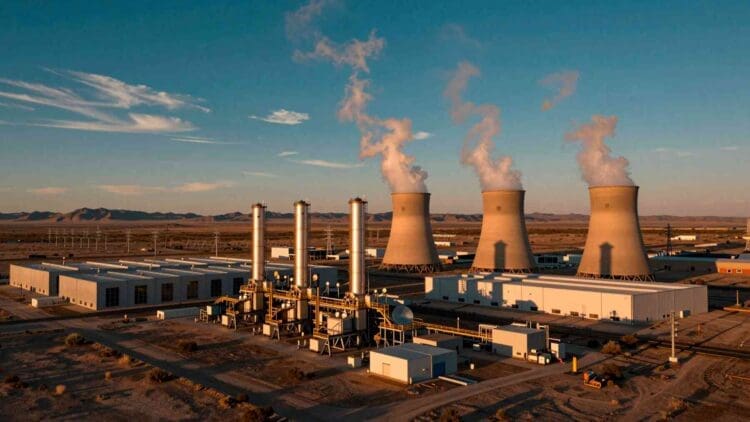

Chevron’s wholly owned subsidiary Energy Forge One LLC has agreed to develop a 2.67-GW natural gas power plant in West Texas dedicated to supplying electricity to a Microsoft data center under a 20-year power purchase agreement. Known as Project Kilby, the development is a collaboration between Chevron and investment firm Engine No. 1, and Chevron describes it as among the largest collocated natural gas power and data-center projects in the United States.
Chevron and Microsoft finalize West Texas power deal
Energy Forge One LLC, the Chevron subsidiary leading the project, will serve as the developer of record for Project Kilby. The plant will sit alongside a Microsoft-operated data center, making it a collocated facility — meaning power generation and consumption occur at the same site, removing the need to move electricity across long distances through the public grid.
The 20-year power purchase agreement establishes a long-term commercial relationship between the two companies. That duration reflects serious commitment on both sides: Microsoft secures a dedicated, large-scale power source for its data center operations, while Chevron gains a predictable revenue stream across two decades.

Engine No. 1, the US-based investment firm, is a collaborating partner in the development. Pairing an oil major with an activist firm known for pushing energy transition strategies is notable in its own right — it illustrates how the economics of data center power demand are drawing together some unlikely partners.
Project design, turbine suppliers, and phased construction approach
Chevron and its partners plan to build Project Kilby through a phased, modular approach. Rather than constructing the full 2.67-GW capacity at once, this method allows the facility to expand incrementally — a practical strategy given the project’s scale and complexity.
Most of the plant’s generation capacity will come from large GE Vernova turbines and associated electrical infrastructure. GE Vernova ranks among the dominant suppliers of large gas turbines globally, and its involvement reflects the industrial scale Chevron is targeting here.
Additional generation capacity will come from Solar Turbines, a wholly owned subsidiary of Caterpillar. Solar Turbines specializes in mid-range industrial gas turbines and has a long track record across energy and oil and gas applications. Chevron has described Project Kilby as among the largest collocated natural gas power and data center developments in the US—a claim that speaks to both the raw generation capacity involved and the integrated, dedicated supply model at its core.
Environmental and operational measures built into plant design
Water use is a significant concern for large power plants, particularly in arid West Texas. Project Kilby plans to address this by using non-potable brackish groundwater for plant operations rather than drawing on freshwater supplies. Brackish water is too saline for drinking or agriculture, so its use for industrial cooling is a less contested choice in a water-stressed region.
Chevron is also working to advance solutions for reusing produced water — the water that surfaces alongside oil and gas during extraction. If viable, that could provide another non-freshwater source for plant operations while reducing disposal demands from Chevron’s existing activities in the area.
On air quality, the plant design will incorporate advanced emissions control technologies, including selective catalytic reduction systems engineered to cut nitrogen oxide emissions—a key pollutant associated with gas combustion. These systems are standard in modern gas plant design, though their inclusion signals Chevron’s intent to meet regulatory requirements. The design also addresses noise and light impacts on surrounding communities, relevant considerations even in sparsely populated West Texas given the facility’s scale.
Timeline, financial outlook, and Chevron’s broader growth ambitions
Chevron expects to reach a final investment decision on Project Kilby by the end of 2026. If that timeline holds, the first power delivery is targeted for 2028—meaning the plant could be generating electricity for Microsoft’s data center within roughly two years of a green light.
The Microsoft project has already been factored into Chevron’s 2026 financial guidance, according to Jeff Gustavson, president of Chevron’s New Energies group. That integration into official guidance suggests the company views Kilby as a near-certain commitment rather than a speculative development.
Gustavson spoke about the project at the JPMorgan Energy, Power & Renewables Conference 2026, framing it as more than a single deal. He described the Kilby model as “a platform for growth” and indicated his team is already exploring additional partnerships—with Microsoft and with other companies. The financial ambitions he outlined were substantial: the business could generate free cash flow in the billions of dollars over time, provided the returns equation works for Chevron and its shareholders.
Final investment decision expected by the end of 2026
Project Kilby is a 2.67-GW natural gas power plant being developed by Chevron’s subsidiary Energy Forge One LLC in West Texas. It will supply dedicated electricity to a Microsoft data center under a 20-year power purchase agreement. Construction will follow a phased, modular approach using GE Vernova and Solar Turbines’ equipment. Environmental measures include the use of brackish groundwater and NOx reduction systems. Chevron expects a final investment decision by end-2026 and first power delivery in 2028, with the project already reflected in the company’s current financial guidance.
Kelly is an experienced writer with 15 years of experience exploring the big stories that shape our world, from tech breakthroughs and space exploration to climate, energy, and the fascinating quirks of science. She has a talent for turning complex ideas into sharp, memorable insights that stay with readers long after they’ve finished reading.