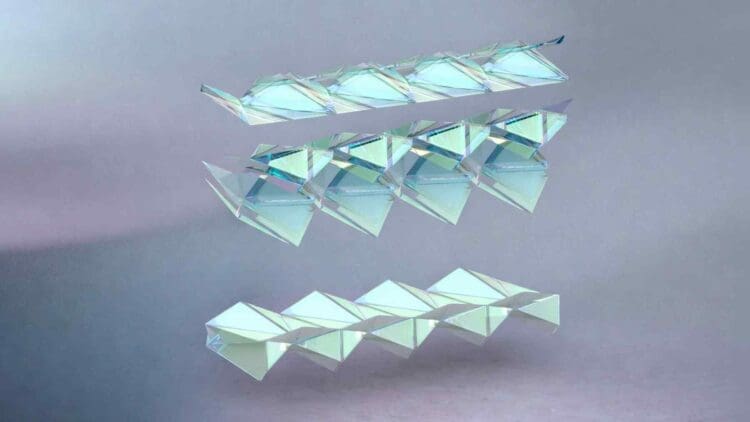

Overshadowing others but catching and bouncing light from various angles.
This is what it takes to stand a chance in an industry that has become highly competitive. That’s right, no more typical, boring designs.
Now, eccentric concepts such as origami-inspired solar designs are becoming more prominent.



It is artistic, sustainable, easily integrated, and beyond what is expected from conventional concepts.
Will this become the new norm in the solar power industry?
What it takes to stand out in the solar power industry
In a world so focused on portraying “the right image,” it is often bad to stand out from the crowd. Fortunately, in the world of solar, the exact opposite is true.
Manufacturers and installers are actively focused on differentiating themselves from the competition.
But what does it take to stand out?
The basis of all exceptional solar panels is high energy efficiency. Most panels have achieved powerful efficiency, which is why this is no longer the only thing consumers desire.
Location now plays a vital role in deciding which design to opt for. For example, urbanites would prefer a small-scale design that is simple to install.
Additionally, urban settings are now calling for more visually pleasing solar panel designs.
Ben Berwick, an Australian architect, may have just the design that ticks all the boxes. It is truly an inspiring concept.
Integrating solar power into cities
As global urbanization increases exponentially, “zero-energy” homes are becoming more than a concept.
Renewable energy solutions in urban regions are becoming more important due to higher power consumption and demand.
These solutions will also help improve health and morale by lowering carbon emissions. This, in turn, boosts air quality, which is a major problem in cities.
Now, some cities have gone as far as to plant “liquid trees” to address pollution.
Berwick’s architecture company, Prevalent, specializes in sustainable solutions. It has used another approach to integrate solar power more easily.
So, what is Prevalent’s unique take on solar energy?
Origami-inspired solar panels, that’s what. This innovative design particularly helps people residing in apartments to access clean, solar power.
Nevertheless, this design is not a solar panel in the literal sense. The design concept was introduced to an everyday household item.
Unfolding origami-inspired solar power
The art of origami is an ancient practice dating back many centuries. However, it is not entirely a new approach in the world of renewable energies.
The folding art form has taken shape in the wind industry, but Berwick has brought it to the solar industry. His design is called Solgami, and it is actually a window blind that produces solar power.
How these origami-style solar blinds operate
Berwick combined thin-film photovoltaics with inks that have reflective properties. These thin films were folded into deep shapes measuring less than four inches, allowing light to bounce off.
Solgami can open, close, and fold back just like normal blinds. The concept also allows more natural light to enter an apartment.
The folded origami shape enables greater light absorption, thus producing greater output and efficiency.
“It’s a bit of a reconnection to the natural setting. It’s making your apartment a better place to be.” – Samuel Berwick, architect and the director of Prevalent
Building-integrated photovoltaic (BIPV) systems have dominated the urban market. Photovoltaics are now even available in nearly all the colors of the rainbow.
Now, it is high time to move over to the next best thing.
Solgami certainly overshadows several other solar power design concepts. It offers urbanites one of the easiest ways to cost-effectively install clean solar power.
No muss, no fuss. Just simple, sustainable designs to make everyday life efficient.