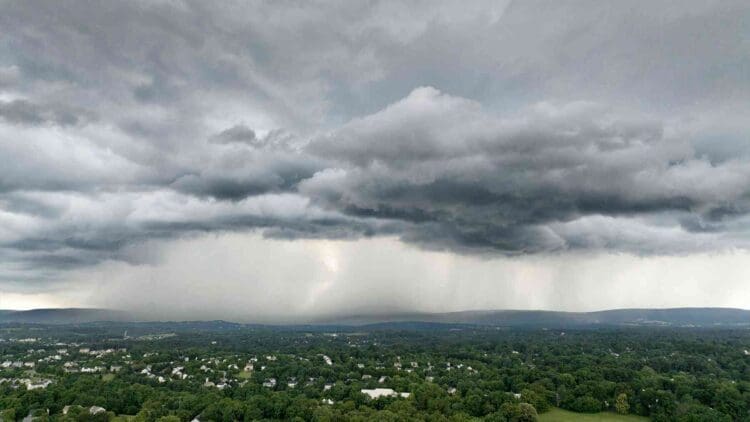

On Colorado’s Eastern Plains, dry summers and shrinking water supplies are facts of life, not abstractions. So the quiet station sitting outside Gill, Colorado, looks almost unremarkable—no aircraft, no chemical flares, no dramatic machinery. Just a solar-powered array that its makers say can pull more rain from clouds already forming overhead.
The question is whether it actually works.
A new kind of cloud seeding
The system behind that quiet station is called WETA—Weather Enhancement Technology Array—developed by a company called Rain Enhancement Technologies. It looks nothing like the cloud-seeding operations most people picture. No aircraft circling overhead, no silver iodide flares, no fuel-burning generators. The entire station runs on solar power and stays fixed to the ground.

The test site sits near Gill, on the Eastern Plains—a region where dry summers are routine and water pressure is a seasonal constant. State approval allows the Weld County operation to keep running through late October, giving researchers a genuine window to collect data under real conditions.
How the technology actually works
The core idea is straightforward, even if the engineering behind it isn’t. The station electrically charges naturally occurring particles near the ground surface, and existing air currents carry those charged particles upward into clouds already forming overhead—no mechanical assist required.
Once inside a cloud, those particles interact with water droplets, helping them grow large enough to fall as rain. Rain Enhancement Technologies is explicit about this: WETA only works when clouds are already present. The claimed benefit is a precipitation increase of roughly 10% to 20% from clouds that would have produced some rain anyway. This isn’t weather creation. It’s weather nudging.
Why warm-season seeding is a different challenge
Traditional cloud seeding is a winter practice. It targets snowpack—seeding clouds during cold months to boost the snowfall that mountain reservoirs and river systems depend on through the following year. Colorado has relied on that approach for decades.
WETA is built for a different problem entirely. It’s designed to operate during warmer months, when water demand peaks and snowmelt is no longer available as a buffer. CEO Randy Seidl described the gap plainly: a poor snow year leaves communities short on water not just in spring, but through summer and fall as well. “That’s where we come in,” he said. This year’s difficult snowpack made that point without any prompting.
What’s at stake for Colorado’s water supply
Water scarcity in Colorado isn’t an abstract policy concern. It shows up in higher food prices, tighter lawn restrictions, and communities managing drought that doesn’t let up between seasons.
Agriculture feels it most directly. Farms depend on reliable moisture through the growing season, and when rainfall falls short, crop stability suffers—pressure that eventually reaches grocery prices and food availability well beyond the state’s borders. Even a modest rainfall increase in the 10% to 20% range the company describes could meaningfully reduce strain on local water systems during the months when demand is highest and natural supply is lowest.
The Eastern Plains location isn’t incidental. This is an agricultural country, where the gap between enough rain and not enough carries direct economic consequences for the farms and communities that depend on summer precipitation. The system won’t solve Colorado’s water challenges on its own, but it could ease pressure at precisely the moment relief is hardest to find.
Early days: What the data does and doesn’t yet show
Here’s the honest part: there isn’t enough Colorado-specific data yet to confirm how much additional precipitation the WETA system has actually produced. The trial is still in its proof-of-concept phase, and what the company claims and what the data will eventually show remain two different things.
State approval runs through late October, extending the evaluation window through the heart of the warm season—the period the technology was built for. That timing matters more than it might seem. The real test isn’t whether the system can operate; it’s whether it can demonstrate measurable results under actual field conditions, not controlled ones.
Researchers and officials will be watching closely as the data accumulates. If the numbers support the company’s claims, the next question becomes scalability — whether a system that works near Gill could be deployed across other water-stressed regions. That’s still a long way off.
For now, the station outside Gill represents a careful, early step: a solar-powered probe into whether ground-based technology can do something new in the long effort to stretch Colorado’s water supply through its hardest months. The warm season ahead will offer the clearest look yet at whether the answer is yes.
Kelly is an experienced writer with 15 years of experience exploring the big stories that shape our world, from tech breakthroughs and space exploration to climate, energy, and the fascinating quirks of science. She has a talent for turning complex ideas into sharp, memorable insights that stay with readers long after they’ve finished reading.