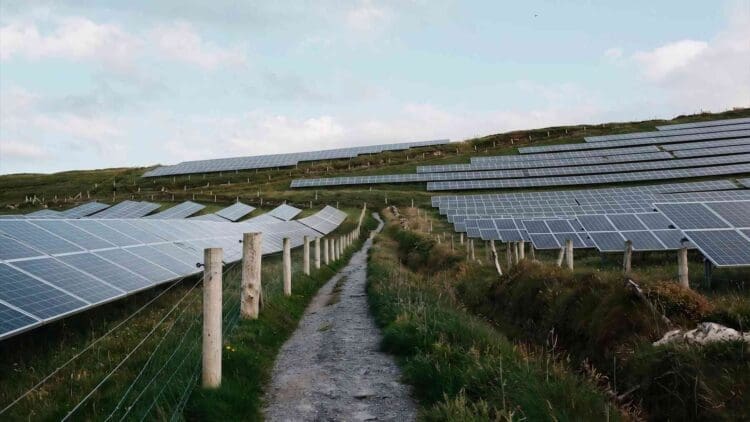

A recent solar farm project in Ireland perfectly captured an intersection of the ancient past and modern present.
Globally, nations are rushing to increase their renewable energy capacity.
Solar power is leading this unprecedented shift, and now millions of acres of land are needed.

This creates significant competition over land, and often, developers collide with human history.
What happened when the Irish solar project discovered that someone else had been there long before them?
How the global and Irish race for clean energy has accelerated
Climate change is affecting nations worldwide.
Now, a major global shift away from fossil fuels has become imperative.
Countries are racing to lower greenhouse gas emissions.
The general goal is to secure independent power supplies while maintaining low carbon footprints.
For many, this means a rapid buildup of wind and solar infrastructure.
Among these nations under immense pressure to meet global targets is Ireland.
The country aims to generate 80% of electricity from renewable sources by 2030.
Additionally, it wants to cut total emissions in half this decade.
Historically, Ireland has heavily relied on onshore wind energy. But this resource is not enough to meet the growing demand.
New data centers, electric vehicles, and residential heating are driving a boom in electricity needs.
Ireland plans on bridging this gap by launching a massive solar revolution.
Utility-scale solar farms are leading this charge. However, they require vast footprints.
The hunt for solar farm land to power the grid
While new onshore wind turbine contracts in Ireland increase, another ambitious goal has been set.
By 2030, the nation aims to install 8 gigawatts of solar capacity.
Recently, utility-scale solar pushed past 1.5 GW nationwide.
This scale requires thousands of new solar arrays.
But this ambition requires major physical space.
Developers need approximately 32,000 acres of land to host massive panel arrays.
Usually, this requirement creates direct competition for prime agricultural land.
However, this does not always have to be the case.
Ireland’s largest solar project to date is Ballymacarney, stretching across 500 acres near the Dublin-Meath border.
Acquired by Statkraft in 2019, the land supports co-location practices.
Sheep graze under the panels, and biodiversity initiatives have been implemented, such as managed wildflower meadows.
Yet, land conflicts were not the only obstacle to overcome.
During pre-construction, IAC Archaeology discovered that the land had been occupied thousands of years ago.
Getting a glimpse into the 4,500-year-old past
Before any project development can commence, archaeologists need to conduct surveys of the site.
The Ballymacarney site underwent extensive geophysical testing.
Deep trenches were dug across the landscape, and beneath the soil, they struck a major historical find.
Ancient structural remains dating back 4,500 years were uncovered.
The traditional Irish cooking place from the Bronze Age
The Bronze Age fulacht fia, or burnt mound, was the standout discovery.
These sites were used to boil water, cook meat, and brew beer.
Stones were heated in large fires and dropped into water-filled troughs to heat quickly.
Ballymacarney contained a rare, intact treasure.
Inside the mound was a preserved, wood-lined trough that survived thousands of years in the damp Irish soil.
Historical pits and postholes were also uncovered in the surrounding area.
A dual mitigation strategy was chosen to preserve the discovery.
Some sections were preserved in-situ by being left undisturbed underground. Others were preserved by record through careful excavation and documentation.
The Ballymacarney project proves that modern progress does not have to compromise the ancient past.
Today, Ireland’s 200 MWp capacity solar farm is fully operational and powers over 40,000 homes.
Green energy and grazing sheep now share the landscape with precisely preserved history.
The success proves that a cleaner energy future can be achieved while honoring the deep roots of human heritage.
Anke Maree is a writer with a clear and engaging editorial style. Her work focuses on making complex topics accessible, informative, and relevant for readers across different areas of interest.