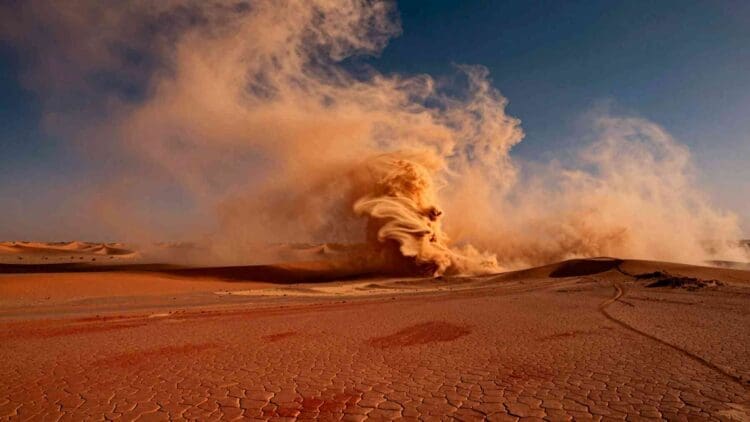

Mineral dust drifting off the Sahara and other arid regions is one of the atmosphere’s most abundant — and least understood — climate forces. Depending on its composition, it can cool or warm the planet, yet scientists have long struggled to model its effects with confidence.
A Cornell-led international team may have changed that. In a study published June 1 in Nature Geoscience, researchers used high-resolution mineral data from NASA’s EMIT instrument, mounted on the International Space Station, to sharply narrow a stubborn gap in how accurately climate models capture dust’s influence on Earth’s energy balance.
Study finds NASA instrument cuts dust-radiation uncertainty sixfold
The research was led by Longlei Li, a research associate at Cornell’s Department of Earth and Atmospheric Sciences. His team integrated global mineral data from NASA’s Earth Surface Mineral Dust Source Investigation — known as EMIT — into four independent Earth system models.




EMIT is an imaging spectrometer aboard the International Space Station that maps the mineral composition of Earth’s dry regions at 60-meter resolution. It produced the first near-global dataset capable of identifying key dust-forming minerals, including hematite and goethite.
The results were striking. EMIT data reduced uncertainty in iron oxide radiative forcing from 0.62 watts per square meter to just 0.1 watts per square meter — a greater than sixfold improvement.
Iron oxides in dust were the largest obstacle to accurate climate modeling
Mineral dust is lifted from arid regions across the Sahara, the Middle East, and East Asia. Once airborne, these particles both scatter and absorb sunlight, meaning dust can either cool or warm the atmosphere depending on its composition.
Iron oxides are particularly influential. Minerals such as hematite and goethite strongly absorb solar radiation, so even small variations in their abundance can shift whether a dust plume warms or cools the surrounding atmosphere.
In a prior study, Li had identified iron oxide abundance as the single largest source of uncertainty in estimating dust’s radiative effects — a finding that directly shaped this research. “A key focus of this study has been the amount of iron-rich minerals in the dust, mainly iron oxides, because these minerals strongly absorb sunlight,” he said.
Improved data reduces modeling errors by up to 80% over the Sahara
The gains are most visible over the Sahara Desert, the world’s largest source of atmospheric dust, where EMIT-enabled models reduced errors in simulated radiative effects by as much as 80% — bringing results into closer alignment with satellite observations.
Across all major global dust source regions, including North Africa and the Middle East, the study cuts uncertainty by more than half. Regional differences also came into sharper focus: dust from parts of North Africa tends to be more iron-rich and thus more warming-prone under certain conditions, while dust from some Asian regions is more reflective and associated with a net cooling effect.
Globally, dust’s overall effect on solar radiation remains within previously estimated ranges. The new results, though, provide considerably greater confidence in those estimates — a meaningful distinction for the climate modeling community.
Research shifts focus to dust transport, particle size, and broader climate impacts
With iron oxides no longer the dominant source of uncertainty, researchers can redirect attention to what remains unresolved. Dust emission, transport, and particle size distribution now represent the next frontier for reducing modeling error.
The study also points toward dust’s broader role in the climate system. Beyond direct effects on radiation, dust influences ocean fertilization, snow darkening, and cloud formation — each carrying its own climate consequences, and each potentially clarified by better mineral data.
The research involved institutions including NASA’s Goddard Institute for Space Studies, the Barcelona Supercomputing Center, NOAA’s Geophysical Fluid Dynamics Laboratory, NASA’s Jet Propulsion Laboratory, and the California Institute of Technology. Running EMIT data through four independent Earth system models strengthens confidence that the improvements are robust rather than artifacts of any single model’s assumptions.
“This makes our understanding more physically grounded, and that’s essential for improving climate projections,” Li said.
Insight into iron-oxide-rich dust
This study delivers a clear, measurable advance: a sixfold reduction in one of climate modeling’s most persistent uncertainties. By drawing on EMIT’s high-resolution mineral maps, the Cornell-led team has given climate scientists a more accurate picture of how iron-oxide-rich dust interacts with solar radiation.
The 80% reduction in modeling error over the Sahara — and the broader gains across major dust regions — represents concrete progress on a problem that resisted resolution for years. Iron oxides are no longer the bottleneck. Future work will focus on how dust moves through the atmosphere, how particle size shapes its effects, and how a warming climate may alter dust sources over time.
Kelly is an experienced writer with 15 years of experience exploring the big stories that shape our world, from tech breakthroughs and space exploration to climate, energy, and the fascinating quirks of science. She has a talent for turning complex ideas into sharp, memorable insights that stay with readers long after they’ve finished reading.