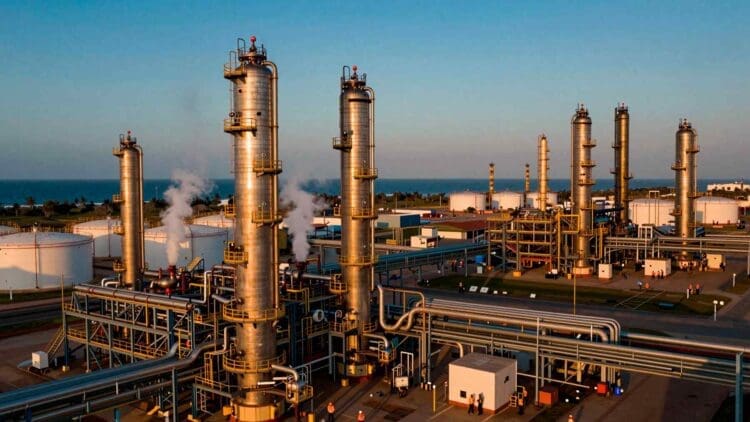

African countries are greatly dependent on the international market, meaning when fuel experiences a shortage or a surge in pricing within developed nations, then it is likely that the same thing will happen in Africa. The Middle East region is recognized as the main supplier of oil in the world market. As such, many countries have to commit a tremendous effort to attaining and transporting oil supplies. On that note, news broke that Nigerian company Dangote Refinery surpassed its nameplate capacity, reaching 700,000 barrels per day after performance testing.
Assessing the ongoing growth of Dangote Refinery in the African landscape
One of Africa’s leading fuel-producing firms, Dangote Petroleum Refinery, reached a significant milestone after it was able to process more than 700,000 barrels of crude oil per day during a recent performance test. The reason why there has been such a tremendous spotlight placed on this news is that the achievement goes way beyond the facility’s official nameplate capacity of 650,000 barrels per day.
Ultimately, the achievement is one that signals the refinery’s growing importance in global energy markets. The record throughput comes at a time when the refinery is actively scaling up operations following its commissioning in 2024. For industry enthusiasts, the development is a massive step toward enhancing Africa’s energy independence while reducing reliance on imported refined petroleum products.



One of the reasons why African refineries fail to grow is that they are unable to refine oil on their own, meaning they have to rely on foreign companies. Dangote Refinery is a groundbreaking $19 billion petroleum and petrochemical complex located in the Lekki Free Zone near Lagos, Nigeria.
It is owned by Africa’s richest man, Aliko Dangote. It is recognized as the world’s largest single-train petroleum refinery after it successfully progressed Nigeria from being a raw crude exporter to a net exporter of refined fuel products.
Assessing how the Dangote Refinery was able to exceed the expected design capacity
The refinery is specifically designed to use the latest technology to comply with strict guidelines and regulations to protect the local environment while simultaneously producing the most recent environmentally friendly petroleum products.
The refinery’s most recent achievement was reached during performance testing which was done by process licensors, reaffirming the refinery’s capability to process crude volumes beyond its original design specifications.
How important is the Dangote Refinery to Nigeria’s overall landscape?
The Lagos-based refinery is viewed as essential to the country, with reports suggesting that it has made steady progress since beginning fuel production in early 2024. The main areas in which this progress has been notable include gasoline, diesel, jet fuel, and other refined products.
So what exactly does the refinery’s surpassing nameplate capacity indicate? This is a question that industry enthusiasts have answered by stating that surpassing nameplate capacity is an important representation of operational maturity.
Refineries typically need extensive optimization after startup before they can start to consistently operate above their designed throughput. Ultimately, the successful test shows that the Dangote facility is entering a new phase of operational stability and efficiency.
Breaking down how the Dangote Refinery might transform fuel trade
The facility is enjoying a great deal of momentum after reports broke that it had reached an earlier achievement of full 650,000-barrel-per-day design capacity after an extensive ramp-up process.
Additionally, Dangote Industries has revealed to the public that it plans to expand processing capacity to 1.4 million barrels per day within the next 30 months. If this materializes, the facility will undoubtedly become one of the largest refining complexes in the world.
As things stand, the Dangote Refinery is already changing fuel trade patterns both within Africa and worldwide. For instance, data from market analysts show that exports of refined products have increased greatly as production volumes continue to rise. Products from the refinery are now reaching destinations across Africa, Europe, the United States, and the Middle East.