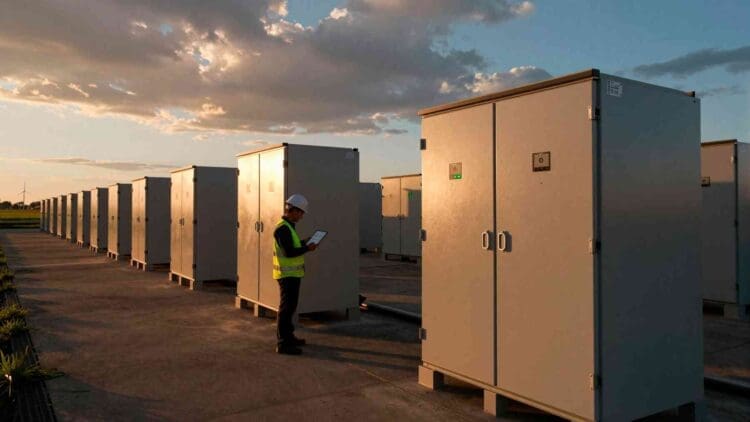

DNV, one of the world’s leading independent assurance providers, has verified that Fluence’s global battery energy storage fleet achieved 98.7% MW-weighted availability — a figure the company says customers and investors can rely on in a market where such claims are common but external checks are rare. The assessment, announced this week, also confirmed a separate 99.3% availability reading for reviewed operating fleets of 50 MW and larger.
DNV confirms Fluence fleet availability at 98.7%
To produce its verified figure, DNV reviewed fleet-level availability data that Fluence provided, examined the calculation methodologies written into the company’s contracts, and checked operational data for a selection of individual projects. The result confirmed Fluence’s own internal finding: 98.7% MW-weighted availability across the reviewed global fleet.
The 99.3% reading applies specifically to reviewed operating fleets of 50 MW and larger — a subset where scale and operational maturity likely contribute to stronger performance.




Fluence chief customer success officer John Zahurancik put it plainly. “Customers invest in energy storage to deliver power exactly when it is needed, and every minute of downtime represents lost revenue and grid vulnerability,” he said, describing the DNV assessment as a validated benchmark that addresses a long-standing transparency gap in the industry.
Why Fluence sought third-party validation
Availability figures between 95% and 98% are routinely promoted across the energy storage sector. The problem is that definitions and measurement approaches vary considerably from one supplier to the next—planned maintenance, derating events, and partial outages may or may not be counted against availability depending on how a contract is written.
That inconsistency makes it genuinely difficult for customers, investors, and asset owners to compare claims across suppliers on a like-for-like basis. A figure of 97% from one vendor and 98% from another may reflect entirely different underlying methodologies rather than any real difference in performance.
Fluence pursued external verification to give buyers a number they can anchor to. The commercial context adds weight to that decision: the company’s order intake for the first half of its financial year reached US$2 billion — twice the prior year’s figure — suggesting that customers are scrutinizing what performance commitments actually mean before committing capital.
What the 98.7% figure means in practice
Availability and uptime are related but distinct metrics. Availability measures the proportion of time a system operates as intended, while uptime more narrowly refers to time online and not in an active outage. The two can diverge depending on how planned maintenance and partial outages are treated in the underlying calculation.
The arithmetic difference between 98.7% and 99.5% availability translates to roughly 70 additional hours of downtime per year. That sounds manageable — until you consider when those hours fall. A system that goes offline during a three-day summer heatwave, when wholesale prices and capacity payments peak, can underperform a system with nominally lower annual availability that stays online during those critical windows. The headline percentage matters less than the timing.
Fluence’s Smart Service Plans offer an Availability Guarantee of up to 99%, alongside what the company describes as the industry’s first Dispatchable Energy Guarantee — designed to enable 24/7 dispatchable energy availability with reduced operational buffers.
Competitive context: unverified claims set a higher bar on paper
Just days before DNV’s verification was announced, Sineng Electric used SNEC 2026 to launch a new liquid-cooled BESS platform. The company stated that the platform “ensures annual availability exceeding 99.5%,” attributing the figure to a modular design that reduces maintenance complexity and liquid-cooling technology that cuts internal temperature rise by 5K.
On a simple percentage basis, Sineng’s claimed figure sits above Fluence’s DNV-verified 98.7%. Sineng’s number, though, carries no independent verification. That asymmetry matters: Fluence’s lower figure currently has third-party validation that competitors’ higher claims do not.
The contrast points to a broader industry problem. As one energy storage engineer noted in published commentary, projects can deliver less than modeled and less than the offtaker expected while remaining technically within the bounds of their contractual availability definition. Verified numbers and contracted numbers are not always the same thing.
For data center customers—two hyperscale operators recently signed master supply agreements with Fluence—the stakes are concrete. Analysts estimate that outages at AI-focused facilities can cost operators up to US$1 million per megawatt per day in lost revenue. At that scale, availability shortfalls are not a rounding error.
Fluence is addressing transparency
DNV’s verification confirms several things worth holding onto. Fluence’s global BESS fleet achieved 98.7% MW-weighted availability, with 99.3% confirmed for larger reviewed operating fleets of 50 MW and above. That figure carries independent validation at a time when most industry availability claims do not. The gap between a verified number and an unverified one is precisely the transparency issue Fluence set out to address—and the one that customers, investors, and data center operators are increasingly unwilling to overlook.
Kelly is an experienced writer with 15 years of experience exploring the big stories that shape our world, from tech breakthroughs and space exploration to climate, energy, and the fascinating quirks of science. She has a talent for turning complex ideas into sharp, memorable insights that stay with readers long after they’ve finished reading.