
DOE announces $100 billion partnership to build AI data center campus and new energy infrastructure at Paducah Site in Kentucky
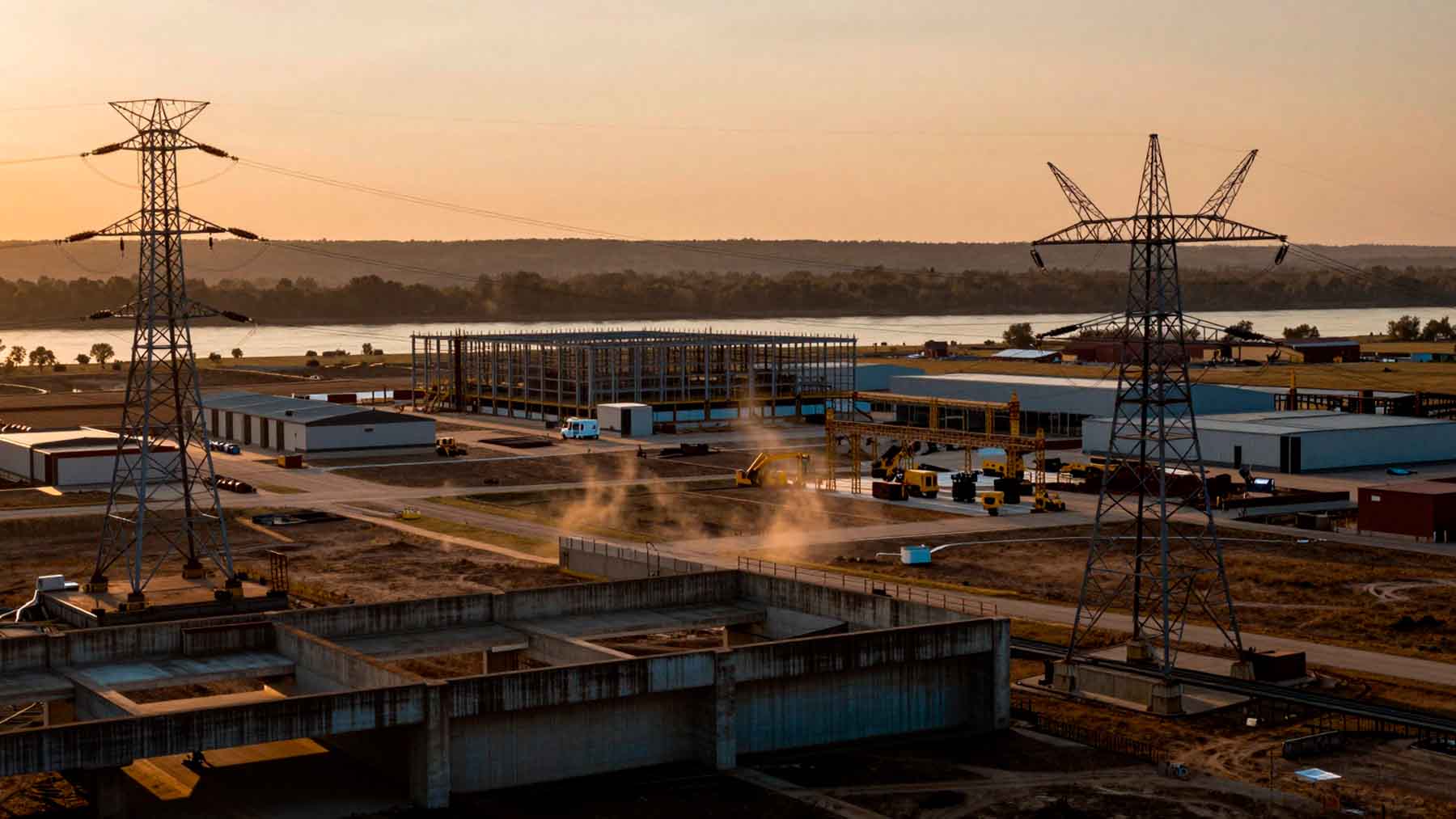 Image generated with artificial intelligence
The U.S. Department of Energy (DOE) announced on July 29, 2026, that it’s partnering with Brookfield, NextEra Energy, Big Rivers Electric Power Corporation, Jackson Purchase Energy Cooperative, and Paducah Power System to redevelop parts of its Paducah Site in Western Kentucky into a major AI data center campus. The project is backed by more than $100 billion in private funding — described as one of the largest investments in Kentucky’s history — and is expected to generate roughly 8,000 construction jobs and 600 permanent positions.
DOE selects Brookfield and NextEra to redevelop the Paducah site
The announcement came out of Washington, D.C. on July 29, 2026. Following a formal Request for Offers issued in November 2025, DOE picked Brookfield to develop and operate the data center campus, while NextEra Energy will build and own the dedicated energy infrastructure behind it.
Three regional utilities round out the partnership: Big Rivers Electric Power Corporation handles wholesale electric service, Jackson Purchase Energy Cooperative covers retail distribution, and Paducah Power System steps in as a community partner. None of that takes effect until the power service agreement clears the Kentucky Public Service Commission — approval that’s still pending.
Both figures exceed what the campus itself will actually consume — the facility is designed to support 1.8 GW of AI and high-performance computing workloads.
The scale of the commitment is hard to ignore. More than $100 billion in private funding will flow into a region long defined by its industrial past rather than any technological future. Officials called it one of the largest investments in Kentucky’s history.
Why the Paducah site was chosen and how the project was structured
The Paducah site didn’t land on this list by accident. DOE pointed to its existing transmission capacity, water infrastructure, fiber connectivity, and available land as factors that make it uniquely suited for large-scale AI infrastructure — a combination few sites can match.
The project follows a model DOE already piloted at its Portsmouth site under the American Energy Hubs initiative. That earlier partnership showed how federal, state, local, and private-sector collaboration could accelerate investment. Paducah is the next application of that same playbook, though the power service agreement still awaits Kentucky Public Service Commission approval, leaving some structural details not fully locked in.
Energy infrastructure: Natural gas, battery storage, and grid capacity
The energy side of this project is ambitious on its own. NextEra Energy plans to develop 2 GW of new grid-connected natural gas-fired generation at or near the Paducah campus, paired with upgrades to existing transmission infrastructure.
Up to 2.6 GW of battery energy storage will also be deployed. Both figures exceed what the campus itself will actually consume — the facility is designed to support 1.8 GW of AI and high-performance computing workloads. That surplus isn’t incidental. Consistent with what DOE called the Ratepayer Protection Pledge, excess electricity will feed the regional grid, with the stated goal of reducing energy costs for consumers and businesses across the area.
Expected jobs, construction timeline, and economic impact
Roughly 8,000 construction jobs are expected during the build-out phase, with around 600 permanent positions once the campus is operational. Construction is currently targeted for completion by 2031.
Local and state officials were quick to voice support. Congressman Andy Barr (R-KY) called the $100 billion private-sector investment “historic” and noted he personally advocated with Secretary Wright to bring the project home after conversations with local and state stakeholders. Beyond the job numbers, the project is expected to boost local tax revenue and deliver lasting economic benefits to Paducah and surrounding communities — a meaningful near-term shift for a region that has watched industrial activity decline over decades.
Context: DOE’s American energy hubs initiative and federal land use
The Paducah deal fits within a larger federal strategy. DOE’s American Energy Hubs initiative is explicitly aimed at repurposing former DOE sites — lands once tied to weapons production or uranium enrichment — into centers of energy production, advanced manufacturing, and tech innovation.
Secretary of Energy Chris Wright framed the initiative in competitive terms, describing it as part of ensuring the U.S. “wins the AI race” by leveraging federal assets like government-owned land to attract private investment and add power generation capacity. DOE Assistant Secretary for Environmental Management Tim Walsh echoed that framing, emphasizing the goal of putting federal land back to productive use. Environmental cleanup at the Paducah Site will continue alongside the redevelopment — the two efforts are designed to run in parallel, not in sequence.
A high-performance computing campus
Here’s what the announcement adds up to. The Department of Energy has selected Brookfield and NextEra Energy, along with three regional utilities, to transform the Paducah Site into a 1.8 GW AI and high-performance computing campus backed by more than $100 billion in private investment.
NextEra will build 2 GW of natural gas generation and up to 2.6 GW of battery storage—capacity that exceeds the campus’s own needs, with surplus electricity flowing to the regional grid. Roughly 8,000 construction jobs and 600 permanent roles are expected, with completion targeted for 2031.
The power service agreement still awaits Kentucky Public Service Commission approval, and environmental cleanup at the site will continue in parallel. This project is part of DOE’s broader American Energy Hubs initiative, applying the same partnership model that’s been tested at other former federal sites across the country.
Kelly is an experienced writer with 15 years of experience exploring the big stories that shape our world, from tech breakthroughs and space exploration to climate, energy, and the fascinating quirks of science. She has a talent for turning complex ideas into sharp, memorable insights that stay with readers long after they’ve finished reading.
