
Drought is quietly draining America’s mightiest dams and reservoirs, and millions of homes that depend on their power may never see the crisis coming until the lights go out
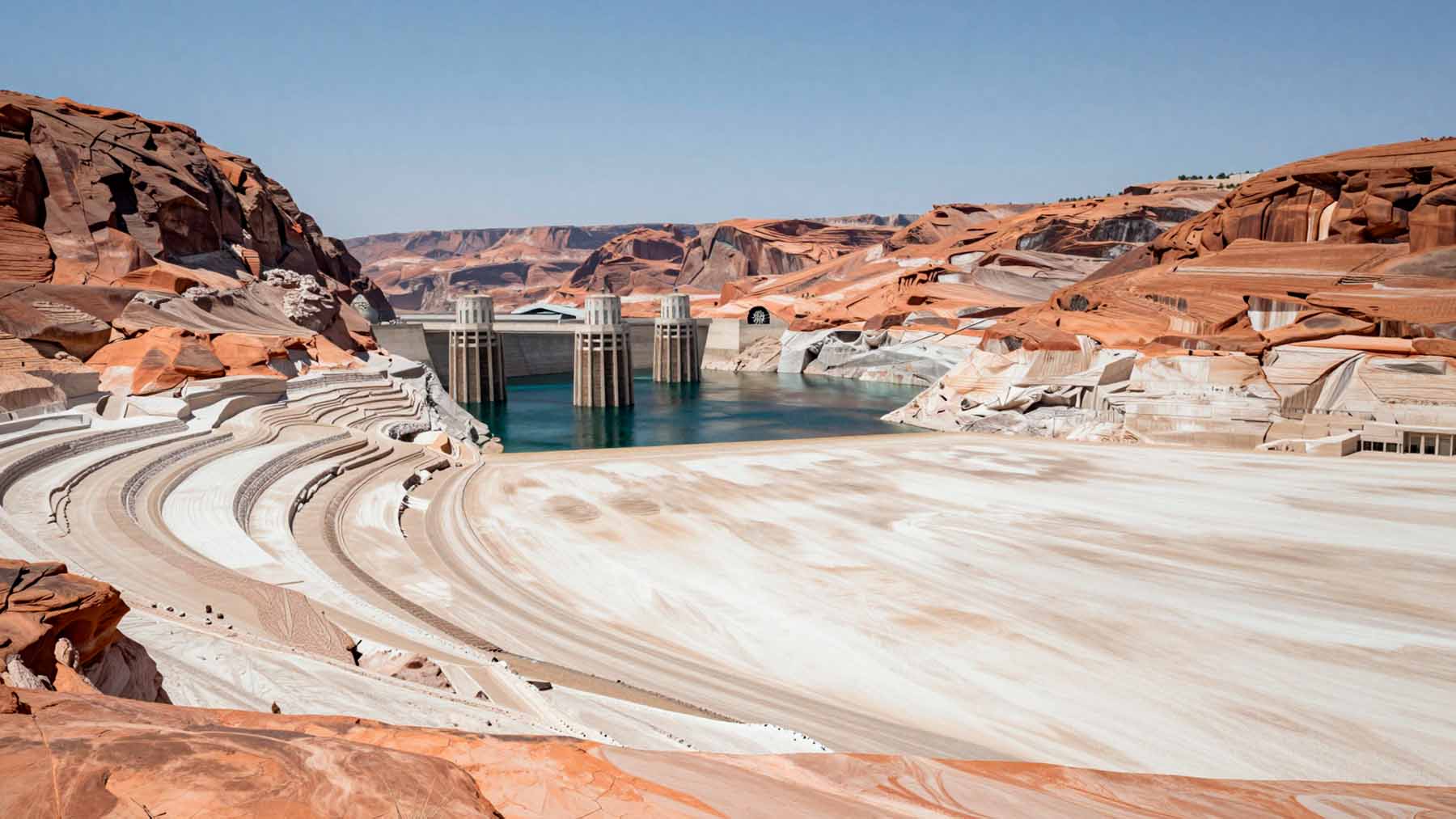 Image generated with artificial intelligence
Drought is quietly draining America’s mightiest dams and reservoirs, and millions of homes that depend on their power may never see the crisis coming until the lights go out.
For most Americans, electricity is simply an invisible constant—flipped on, taken for granted, and assumed to be limitless. Much of that clean energy flows from an equally invisible giant: water rushing through massive turbines buried inside concrete dams across the country.
That baseline assumption is undergoing a severe stress test. Lake Mead and Lake Powell—the nation’s two largest reservoirs—have plunged toward critical historic lows. When full, these two western giants generate over 3 gigawatts of electricity, enough to power two million American homes. Today, they generate a mere fraction of that, with federal water managers warning power generation could halt entirely.
Compounding the emergency, these reservoirs deliver drinking water and irrigation to 40 million Americans across seven Southwestern states.
Record lows at the nation’s biggest reservoirs
Lake Mead and Lake Powell did not reach this tipping point overnight. A disappointing winter across the Rocky Mountains left regional snowpack well below normal. An unseasonably warm spring then melted the remaining snow far faster than the Colorado River basin could absorb. Consequently, both reservoirs, impounded by Hoover Dam and Glen Canyon Dam, hit perilous historic lows.
Generating 3 gigawatts is out of reach under current water elevations. The U.S. Bureau of Reclamation has raised alarm over a genuine probability that water levels could fall below the “minimum power pool”—the physical elevation required to spin the turbines. If water drops below those intakes, generation stops completely. Compounding the emergency, these reservoirs deliver drinking water and irrigation to 40 million Americans across seven Southwestern states.
A western water crisis decades in the making
This isn’t a single bad weather cycle. The American West has endured a structural water deficit for over two decades, where average winters fail to replenish depleted storage. What is unfolding today is the compounding interest of a multi-decade mega-drought.
Climate shifts are accelerating these pressures. Prolonged droughts grow more severe, and river systems feeding hydroelectric dams bear the primary impact. Beyond Hoover and Glen Canyon, dozens of smaller hydropower facilities across Western states operate at severely reduced capacity.
Furthermore, legal allocations governing the Colorado River were written a century ago during an unusually wet era. Modern water rights promise water that simply no longer exists, forcing U.S. states to slash allocations while struggling to keep regional power grids stable.
Canada’s hydropower drought adds a cross-border dimension
The hydro bottleneck extends beyond Western borders. American grid operators in the East have increasingly relied on imported Canadian hydro to power dense population centers. In 2026, major cross-border transmission projects like the 1,250-megawatt Champlain Hudson Power Express came online to deliver hydroelectric power directly into New York City and New England.
However, widespread drought in Quebec has sharply reduced reservoir reserves. Combined with technical line outages during peak summer demand, these imports delivered far less power to American cities than projected. Northeastern states counting on Canadian hydro to anchor clean energy targets face an unexpected supply deficit, proving cross-border green power isn’t immune to weather risks.
What the hydropower squeeze means for the clean energy transition
Hydropower supplies nearly 6% of total U.S. utility-scale electricity and serves as the country’s largest source of renewable, on-demand power. Its decline represents a major setback for national decarbonization goals.
Grid operators treat hydro as a critical zero-carbon backstop. Unlike solar and wind, hydroelectric power is dispatchable—it ramps up instantly when demand surges. Losing that flexible capacity destabilizes grid reliability just as electric vehicles and heat pumps add record demand to the U.S. power grid.
Looking ahead
Monitoring Bureau of Reclamation elevation projections for Lake Mead and Lake Powell over coming months is essential. Falling below power pool thresholds will trigger escalating electricity rates and rolling reliability warnings across Western states.
Yet, the ultimate threat hidden beneath this drying infrastructure isn’t just dimming lights. The true, alarming reveal of America’s hydropower crisis is that to prevent catastrophic grid collapse when the turbines freeze, grid operators are quietly preparing to fire up legacy natural gas and coal plants as emergency backups. The cruel paradox of the hydro drought is that the very climate impact drying up clean water will actively force America to burn millions of tons of fossil fuels—accelerating the exact warming cycle that drained the reservoirs in the first place.

Kelly is an experienced writer with 15 years of experience exploring the big stories that shape our world, from tech breakthroughs and space exploration to climate, energy, and the fascinating quirks of science. She has a talent for turning complex ideas into sharp, memorable insights that stay with readers long after they’ve finished reading.
