
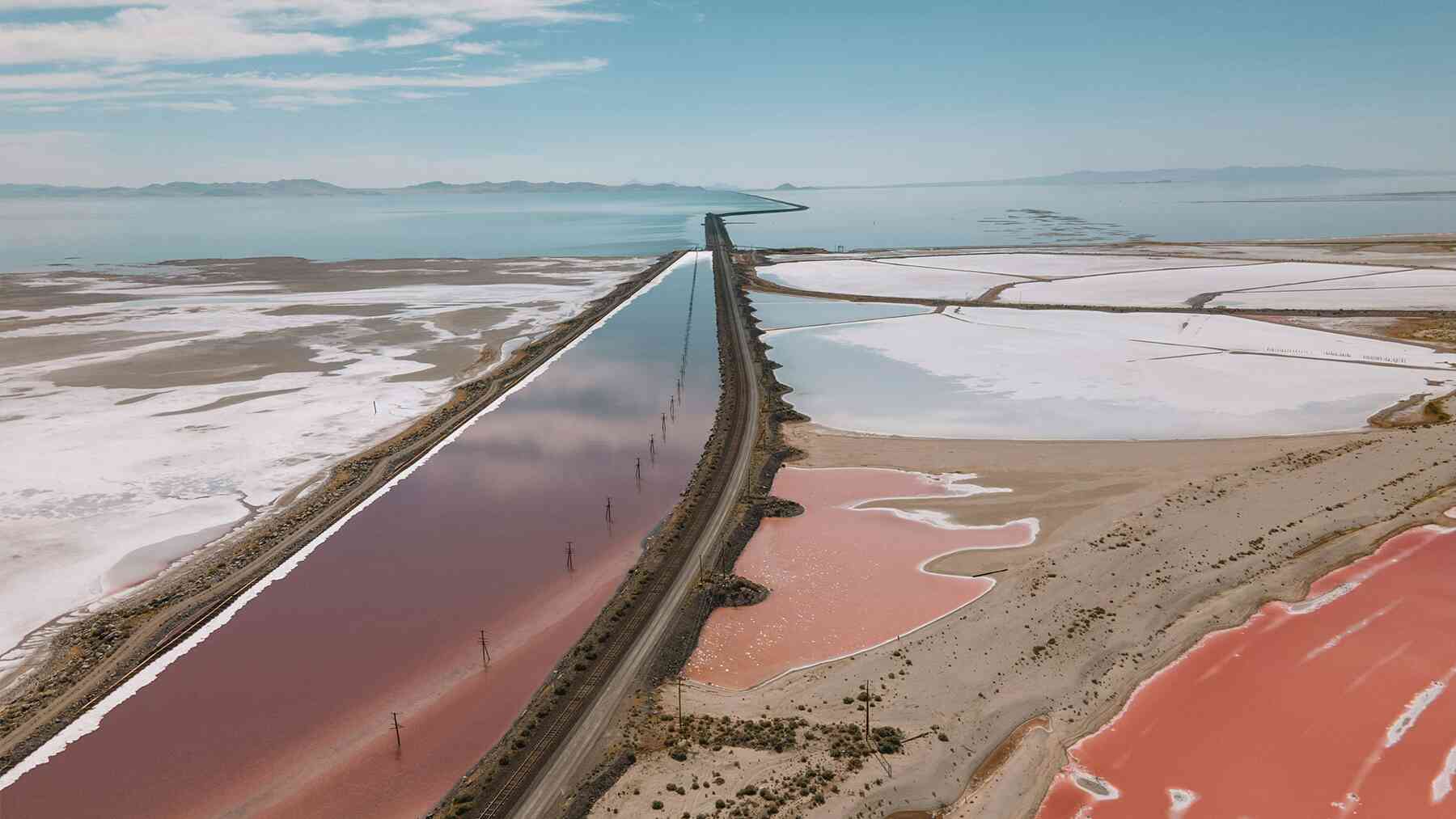
Drained by farms, choked by drought, and now facing its worst snowpack year on record, the Great Salt Lake is running out of time
 Credits: Energies Media Internal edition
Researchers are advocating for immediate action as the Great Salt Lake continues to diminish.
Climate change is traditionally the main culprit when it comes to the decline of ecological systems.
Yet, the rise of irresponsible and negligent human activity also plays a crucial role worldwide.
Long before the words “climate change” ever crossed man’s lips, the planet and society looked slightly different.
Globally, unique saline lakes are gradually but steadily disappearing as a result.
Utah is among those losing its iconic landmark, but what can be done to save it?
How mankind continues to dig a deeper hole in the atmosphere
Long before the words “climate change” ever crossed man’s lips, the planet and society looked slightly different.
Food and water resources were naturally abundant, and volatile weather happened once in a blue moon.
These ideal conditions led to a significant increase in the global population.
Soon, lush greenery and unspoiled landscapes had to make way for growing towns and cities.
Industrialization followed promptly, as mankind planned to streamline operations and manufacturing.
This expansion was heavily reliant on burning fossil fuels for centuries.
Unknowingly, human progress ignited the world’s rise in carbon emissions that shifted the climate.
Knowledge about climate change grew in stages.
It was not until the 1980s that public and political awareness increased.
By then, the damage of the greenhouse effect had already been done.
Today, several sectors remain carbon-heavy.
This, along with intense land development, ensures that the global warming cycle persists.

The planet is taking the brunt of the force
Every year, this hole dug by humanity continues to grow deeper.
For the past 11 years, global warming has led to some of the hottest temperatures recorded since 1850.
This can be attributed to a significant increase in fossil fuel carbon dioxide emissions.
The world’s total is currently at a peak of 38.1 billion tons.
As a result, atmospheric carbon dioxide concentrations increased 52% above pre-industrial levels.
Past choices altered the atmosphere, and current energy-intensive infrastructure prevents this destructive cycle from breaking.
In recent years, changes to the atmosphere have resulted in highly unpredictable, extreme weather events.
Natural ecosystems are affected by excruciating temperature changes, prolonged droughts, and flash floods.
An example includes Utah’s iconic Great Salt Lake.
The Great Salt Lake’s Commissioner’s Office is now actively working on saving this landmark.
This mission is not only to preserve the ecosystem, but also to protect the state’s public health.
The Great Salt Lake’s dual defenses
For years, humans diverted water upstream for agricultural irrigation and municipal expansion.
Consequently, this has depleted the lake’s natural freshwater inflow by up to 45%.
The lake’s south arm dropped to its third-lowest level ever. Extreme regional droughts and record-low winter snowfall drove this.
Sediment has been exposed, and winds are lifting the toxic, arsenic-laced dust.
Cities along the Wasatch Front are directly exposed to this dangerous dust.
Preventing the landmark’s complete collapse
$300 million in state funding enabled the Commissioner’s office to allocate $30 million to permanent water rights purchases.
The rights guarantee an annual bypass of 144,000 acre-feet of water to flow into the drying basin.
Additionally, a Brigham Young University team, led by Dr. Ben Abbott, launched the “Grow the Flow” initiative.
The movement unites scientists, students, and locals into an advocacy network pushing for policy change.
It demands implementing a legally binding mandate that ensures minimum water flow requirements for stream networks.
Together, the two ensure an immediate defense line while fighting for the legal right of the river system’s existence.
The Great Salt Lake represents the dire consequences of mankind’s growing ecological footprint.
This landmark can therefore only be saved by admitting that water mismanagement fuels environmental decline. Utah must react accordingly, or risk losing its iconic landmark while public health collapses.
Anke Maree is a writer with a clear and engaging editorial style. Her work focuses on making complex topics accessible, informative, and relevant for readers across different areas of interest.
