
Finland doesn’t get enough sunlight for solar panels, so one town is heating homes with a giant mountain of hot sand—and Alaska could be next
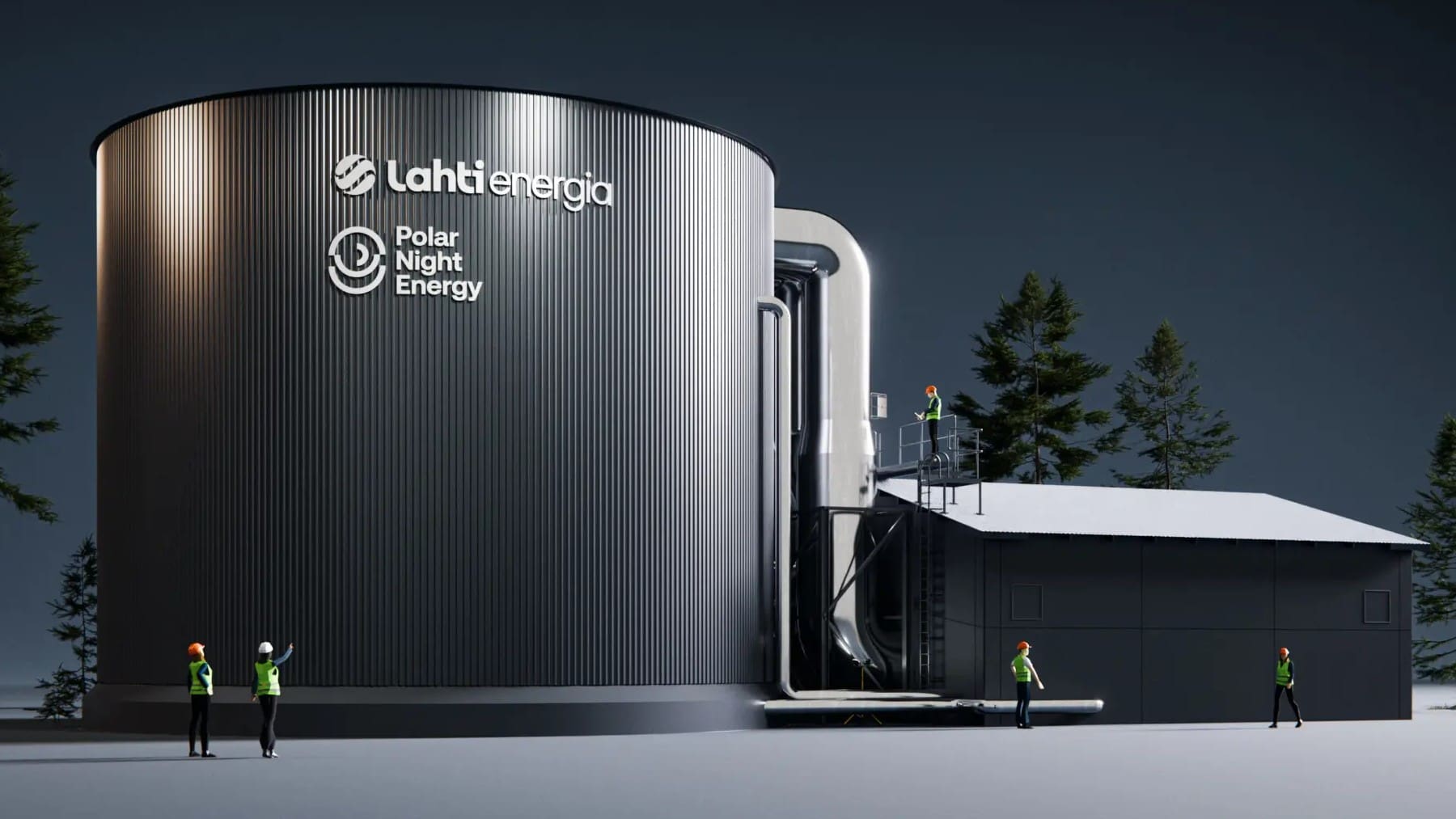 Credits: Polar Night Energy
Energy storage could become more affordable thanks to Finland’s hot sand battery.
Worldwide, nations are racing to meet decarbonization goals, leading to significant green power expansion.
Yet, sub-arctic regions face seasonal hurdles when it comes to the global number one renewable source, solar.
Implementing unique energy storage systems will enable remote Alaskan communities to reach their decarbonization goals while achieving clean energy resilience.
Solar panels often fail in dark, freezing winters, leaving communities reliant on fossil fuel burning for warmth.
Will using hot sand as a cost-effective alternative help these areas to finally achieve resilience?
How carbon-free targets are slowed by heating needs
In recent years, global renewable energy capacity has increased significantly.
This surge has followed stricter international climate mandates that require grids to decarbonize.
These tightened pacts were introduced after experts noted that global warming is accelerating.
To limit Earth’s temperature rise to the set threshold, solar and wind power had to scale up.
Wind energy currently accounts for nearly 1,291 GW worldwide.
Meanwhile, solar energy is leading the green transition and has reached roughly 2,392 GW globally.
Despite these major strides in cleaning up electricity grids, municipal heating remains a significant challenge.
Approximately 15% of all carbon emissions are generated by heating and cooling buildings.
In sub-arctic nations such as Finland, the majority of this footprint is attributed to burning fossil fuels.
During harsh winters, seasonal energy demand becomes highly unbalanced.
The need for heating skyrockets while solar generation falls to zero, and conventional batteries cannot bridge the gap.
Falling short when temperatures hit sub-zero
Lithium-ion batteries have become a standard addition to many large-scale solar plants.
When it comes to storage, these batteries offer excellent short-term grid stability.
Unfortunately, seasonal sub-arctic heating demands remain high over multiple months.
That is why more innovative, sustainable, and cost-effective storage is needed in these regions.
In these regions, conventional storage falls short due to two specific factors.
The cold causes battery capacity to drop by up to 50%.
Lithium ions cannot properly insert into the anode, forming metallic plating and dendrites.
These formations cause permanent damage and increase the risk of severe fires.
To remain operational, they need constant heating, which defeats the purpose.
Furthermore, storing summer solar power for winter needs is uneconomic.
Conventional storage systems will only cycle once per year, significantly driving up the cost per unit of supplied electricity.
Finnish company, Polar Night Energy, has deployed an inventive system to overcome conventional challenges.
A mountain of hot sand to help heat homes
Thermal energy storage systems are actively being explored as feasible alternatives to lithium-ion batteries.
Pornainen, Finland, received an industrial-scale alternative storage method that uses a sustainable by-product.
Instead of using traditional sand, this battery contains 2,000 tons of crushed soapstone, sourced from a local fireplace manufacturer.
Soapstone is exceptional at retaining heat, and forms part of a circular economy.
Heat conversion using a closed-loop air pipe system
The battery charges using affordable, excess solar electricity from the grid during peak generation.
Air is heated using electric resistance heaters. The air then circulates through internal pipes.
The air’s heat is transferred to the crushed soapstone, heating it to over 932°F.
As heating needs rise in winter, the system reverses the air circulation.
The thermal energy is then conveyed to local district heating networks using heat exchangers.
Communities then benefit from the summer’s green power months after generation.
This innovative system has successfully ended municipal oil dependence while lowering local heating emissions by 70%.
It serves as a proof-of-concept, which makes it highly feasible for expansion into Alaska.
The two regions have identical sub-arctic climates. Both experience long, dark winters and major seasonal energy imbalances.
Implementing unique energy storage systems will enable remote Alaskan communities to reach their decarbonization goals while achieving clean energy resilience.
Anke Maree is a writer with a clear and engaging editorial style. Her work focuses on making complex topics accessible, informative, and relevant for readers across different areas of interest.
