
Divers strapped oysters, clams, and mussels onto a floating wind turbine to see whether the submerged tower could double as a marine farm
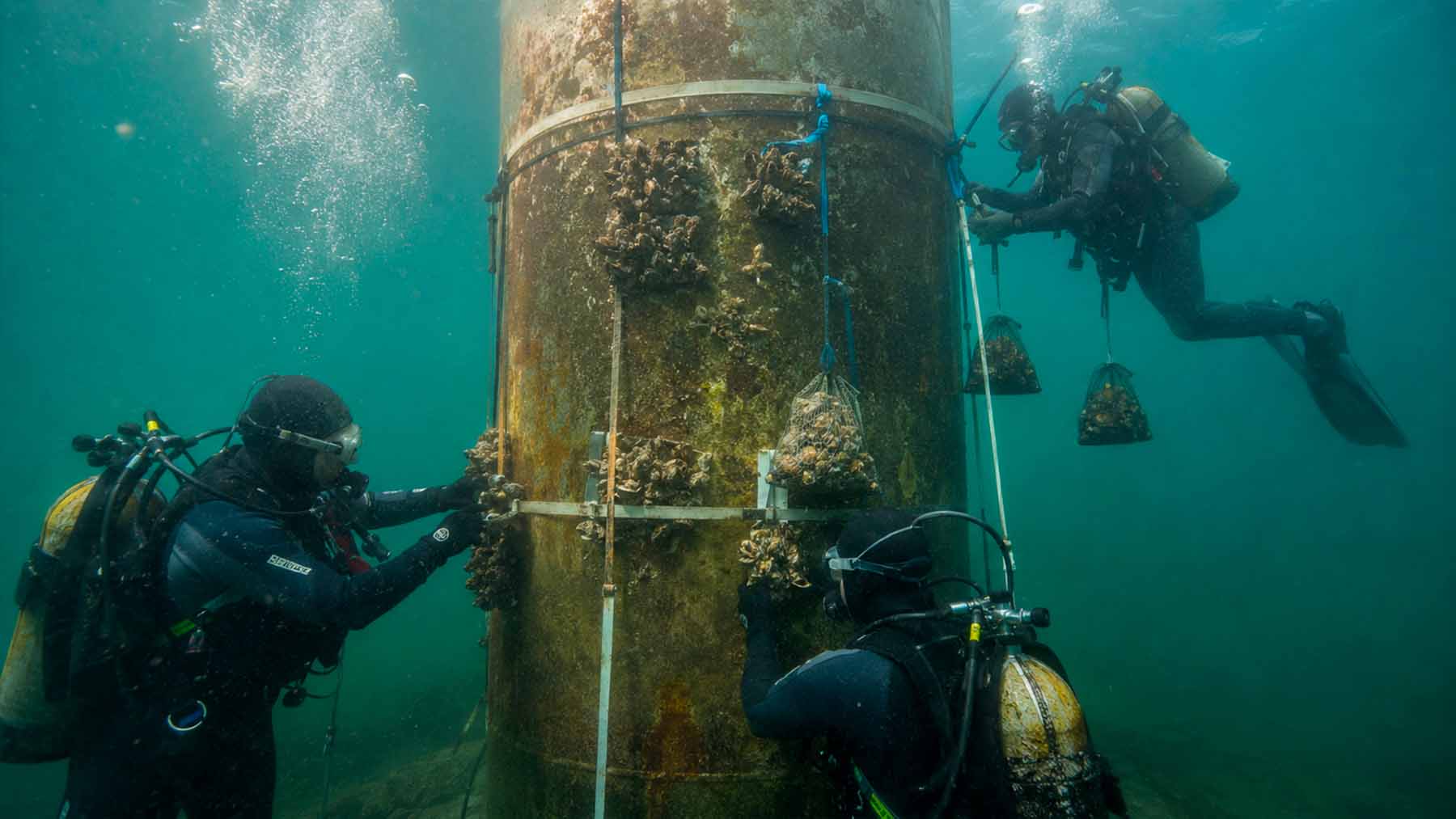 Image generated with artificial intelligence
A study off the coast of Spain explored whether a floating wind turbine could double as a marine farm.
Developers are expanding clean power infrastructure across global waters to meet rapidly rising energy demands.
Floating structures are now moving into the deep ocean, increasing pressure to ensure oceanic ecosystem conservation.
Further expansion becomes limited due to competition with military areas, shipping lanes, coastal conservation zones, and commercial fishing.
Innovators suggest transforming these platforms into marine farms, but tests must be conducted first.
Will using floating foundations as multi-use concepts help restore the sea?
How surging energy consumption has raised dependence on the ocean
Coastal regions across the world have become densely populated.
People have been attracted to the coast for years due to moderate climates, rich economic opportunities, and maritime trade access.
Today, more than 40% of the population lives within 60 miles of a coastline.
More people require more infrastructure to maintain a fairly comfortable life.
Rapid industrialization and urbanization led to a rise in local electricity usage.
As a result, these regions have become hard to decarbonize.
Transport accounts for roughly 20% of global emissions. Meanwhile, conventional power generation contributes billions of tons of carbon dioxide per year.
Since these coastal layouts are dense, viable space for green infrastructure is limited and expensive.
To meet clean energy needs, developers are increasingly relying on the sea.
Deploying offshore turbines in 1% of suitable waters could supply 6,000 terawatt-hours of wind energy annually.
However, as shallow sites fill up quickly, floating wind must rise in the deep ocean.
Tapping the wind potential of deeper waters
Offshore wind projects near coastal regions are rising in popularity.
However, these nearshore zones are filling up quickly.
This is because conventional fixed-bottom turbines need shallow seabeds under 200 feet deep.
Further expansion becomes limited due to competition with military areas, shipping lanes, coastal conservation zones, and commercial fishing.
Some projects experience delays due to community concerns over visual disruption.
Consequently, wind energy is being deployed farther out to sea. This is where over 80% of global offshore potential lies in depths over 200 feet.
In the deep ocean, traditional steel foundations are not practical or cost-effective.
Instead, floating foundations are more advantageous.
They are anchored with flexible mooring lines, unlocking much stronger winds while resolving space conflicts.
However, since the long-term effects of these floating turbines on the marine ecosystem remain limited, impact studies are vital.
Off the coast of Spain, Saitec is exploring whether these platforms can serve a dual purpose.
Transforming floating turbines into multi-purpose concepts
Offshore wind farms in nearshore zones are transforming into artificial reefs for various marine species.
Saitec conducted a trial at the BiMEP open-sea test site off Armintza, Spain. The goal was to see whether floating platforms can do the same while generating clean energy.
Windtech International covered the experiment, which used the 2 MW DemoSATH floating demonstrator platform.
Conducted through the AQUASATH project, professional divers installed Nature-Inclusive Design (NID) components onto the submerged columns.
Introducing native marine species
Suspended lantern nets, collector ropes, and mussel lines were used to add four species:
- Ulva algae
- Pullet carpet shell clams
- Mussels
- European flat oysters
The operation confirmed that the floating foundation served as a stable anchor for underwater habitats.
Additionally, it did not interfere with primary platform systems.
The multi-trophic equipment was safely handled, transported, and secured to the floating turbines in the open-sea environment.
The pilot project is still actively gathering real-world data with the DemoSATH platform.
Suggestions include extending monitoring periods. This will help evaluate long-term biological yields and impacts under seasonal ocean currents.
By integrating sustainable seafood production with deep-sea platforms, marine spatial planning can be optimized.
Furthermore, offshore operational costs become lower.
Ultimately, multi-purpose floating turbines will help developers gain essential public and regulatory support for future wind projects.
Anke Maree is a writer with a clear and engaging editorial style. Her work focuses on making complex topics accessible, informative, and relevant for readers across different areas of interest.
