
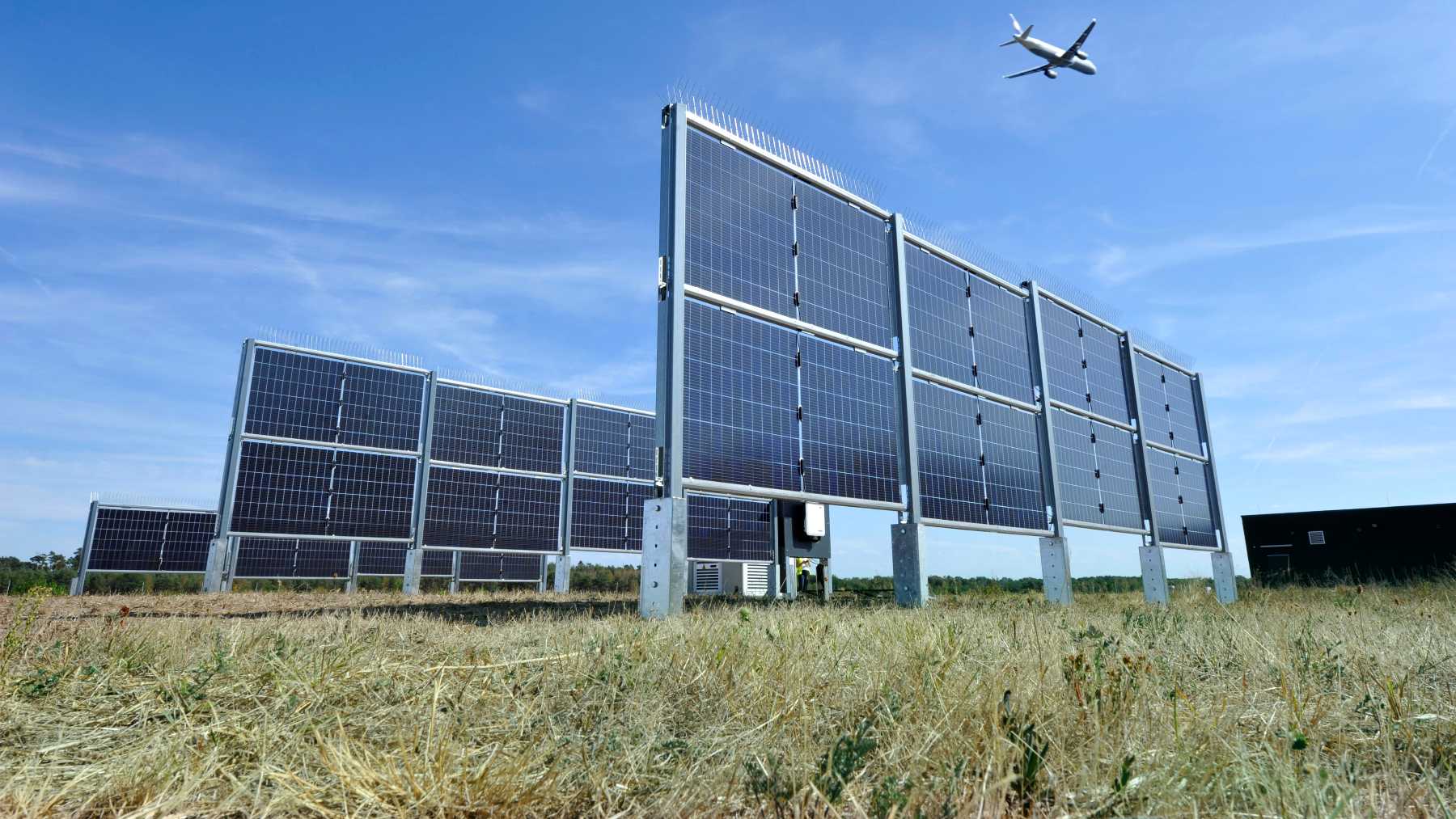
Frankfurt Airport lines its runway with 37,000 upright solar panels stretching 1.7 miles, generating more electricity at dawn and dusk
 Fraport AG
Industrial aviation is infamous for its negative carbon footprint.
However, while we all wait for electric planes, the industry is using existing green sources to eliminate its emissions.
Recently, Frankfurt commissioned a massive photovoltaic installation on one of its runways.
Today’s commissioning is a milestone on our path toward our Net Zero climate goal,
Instead of relying on flat tracts typical of conventional solar farms, Frankfurt’s installation will place its panels vertically along the runway.
So, how can vertical solar panels line an active runway to transform airport energy supply?
Achieving net-zero greenhouse gas emissions by 2045
In the past, Frankfurt Airport has consistently featured in the upper echelon of global aviation polluters.
Being Germany’s largest airport, it has frequently ranked alongside other heavy emitters, such as Dubai.
Despite it being a tall order, the airport committed to achieving net-zero greenhouse gas emissions by 2045.
Given such a commitment, Frankfurt Airport enlisted the services of Next2Sun to assist with the project.
The Next2Sun Group is a pioneer in vertical photovoltaics.
The company not only served as the system supplier but was also responsible for the implementation of the project.
The project location was on the airport’s Runway West, which was still fully operational.
Given the space and the scale, project planners had to coordinate closely with local conservation guidelines during construction.
Ecological and other considerations in the implementation
Before beginning construction, Next2Sun had to ensure that the renewable energy facility would not interfere with the runway activities.
In addition, the company had to ensure that the facility did not damage the green areas of the airport.
Airfields are strictly regulated to maintain safety and operational standards.
For that reason, the surrounding green expanses are managed to discourage wildlife, such as large birds that may risk collisions with aircraft.
Nevertheless, all airfields do have specialized plant and grass mixes used to maintain a controlled ecosystem
Therefore, Next2Sun designed its construction phases to align with the breeding and nesting seasons of the existing wildlife.
The scale of the facility would make it the world’s largest vertical photovoltaic installation.

Frankfurt Airport lines its runway with 37,000 solar panels
Frankfurt Airport commissioned Next2Sun to construct a 2,800-meter-long vertical photovoltaic installation on its runway.
Using its innovative technology, Next2Sun was able to install a total of 37,000 solar modules
The system generates up to 17.4 million kilowatt-hours of green electricity annually.
What sets the installation apart as one of a kind is how it functions.
Traditional solar panels are usually placed facing up toward the sun and capture maximum energy during midday. ,
Frankfurt Airport’s solar modules are designed to stand vertically.
Their vertical placement allows the panels to capture maximum solar energy during the early morning and evening hours.
The new installation was added to complement the conventional midday-peaking rooftop systems the airport already has.
As a result, the airport has created a stable energy supply throughout the entire day.
Upon its commissioning, the construction garnered global attention.
“Today’s commissioning is a milestone on our path toward our Net Zero climate goal,” said Dr. Stefan Schulte, CEO of Fraport AG.
The green electricity generated by the vertical installation is primarily used to power heating and air conditioning across the airports.
In addition, it also generates enough electricity to power the airport’s expanding ground fleet of electric vehicles.
Powering across airport terminals
Commercial airports and airlines may still have a bad name in green circles.
However, some industry players, such as Frankfurt Airport, are slowly turning the narrative around.
The airport did not wait around for a huge plot of land to become available. Instead, it used what it already had: its own runway.
Today, those vertical solar panels are actively powering the heating, air conditioning, and even the electric vehicle fleet of the entire airport.

