
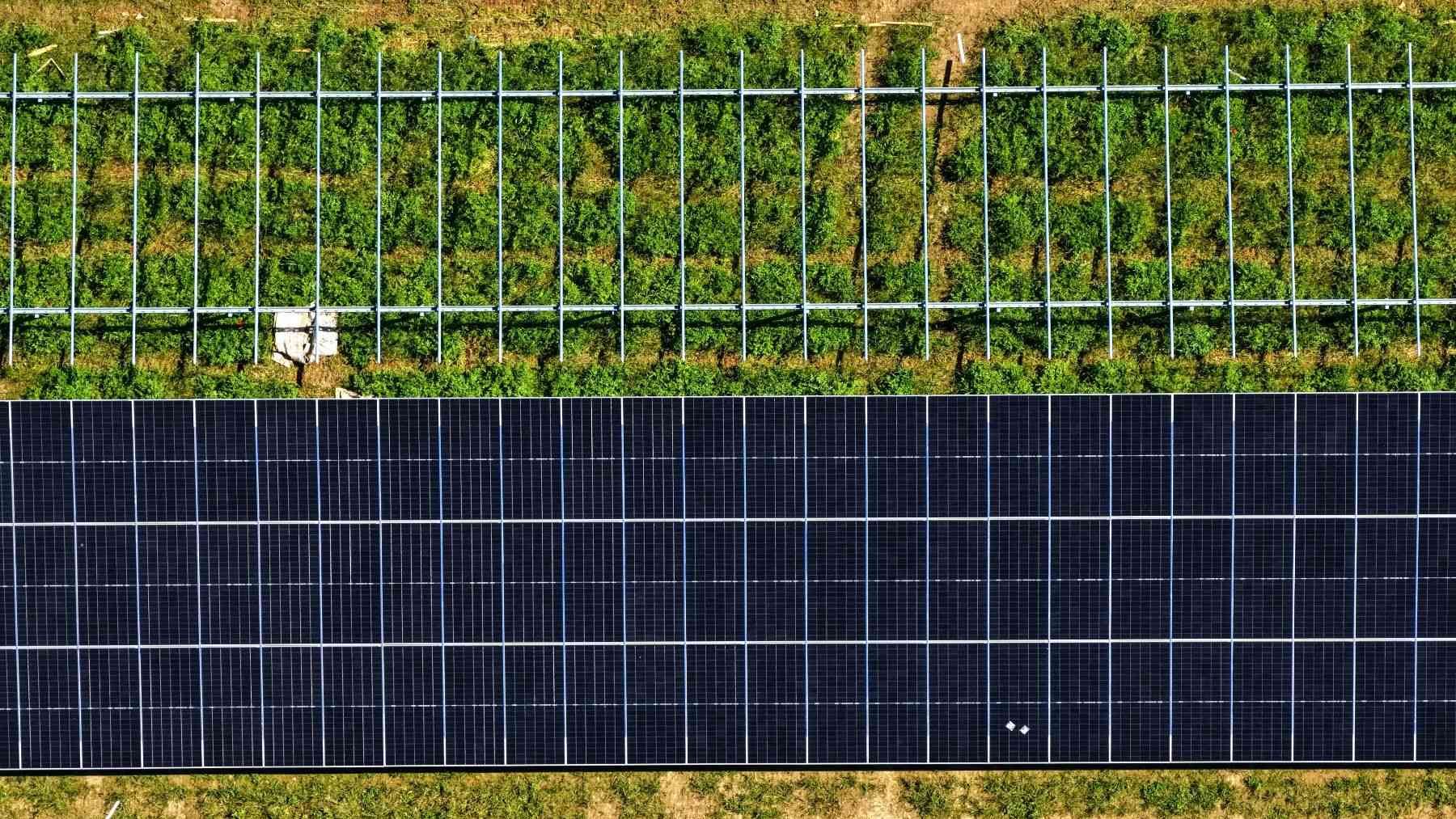
Solar panels stand 10 feet above a Massachusetts cranberry bog, testing three layouts with 30% shade over the vines
Traditional farming and renewable energy generation rarely go together,
Let alone on the same piece of land.
Typically, when renewable energy facilities are created, they are developed on unused plots in the middle of a desert.
With enough scientifically backed evidence, agrivoltaics can be optimized for different crops to yield the best results for dual-use farmlands.
However, researchers at the University of Massachusetts Cranberry Station wanted to test dual land-use efficiency.
So they launched an agrivoltaic initiative on a commercial cranberry bog.
They wanted to measure: How does solar panel shading impact the physical health and quality of the crops?
Agrivoltaics and dual land use efficiency
Agrivoltaics is the practice of using the same piece of land to grow crops and generate solar energy for electricity.
It mainly started out as a theoretical idea.
However, with climate change speeding up, in the last decade, the idea not only crystallised, but it has also become commercialised.
Naturally, UMass Cranberry Station researchers wanted to test how efficient this practice actually was.
Would there be any trade-offs, and how would the quality of the crops be impacted?
So they chose to set up an experiment on a commercial ‘Howes’ cranberry bog in Plymouth, Massachusetts.
They installed fixed-tilt solar panels on steel poles, with the panels standing exactly 3.0 meters above the cranberry vines.
They also divided up the field into three layouts to test different spacing for the panels.
Finally, the researchers placed various sensors throughout the different sections in order to take measurements.
The idea was to track how the cranberries performed across three growth stages: green, blush, and full-red phases.
Solar panels placed over cranberries
The UMass Cranberry Station, founded in 1910, is the only agricultural research group solely dedicated to the study of cranberries.
The institution works with over 400 commercial farmers and harvests thousands of barrels of cranberries annually.
In their natural habitat, cranberry vines usually grow best under the canopy of larger trees.
In other words, they only need to receive partial sunlight to survive and thrive.
In the experiment, the solar panels were placed approximately 3 meters above the ground.
The setup sought to imitate the natural shading provided by large trees.
As experts in the field of cranberry studies, the researchers took specific measures to test the quality produced under the canopy of solar panels.
In the first year, they evaluated how the crops responded, starting immediately after the solar panels were installed.
Although they note that multi-year studies are needed to fully understand the impact, their findings were very interesting.
The resulting benefits and trade-offs
In order to attain truly accurate readings, the experiment had to be set up in a specific way.
The solar panels in the three testing layouts were spaced 9.0 m, 7.0 m, and 5.0 m apart.
That produced 30%, 35%, and 37% shading levels over the cranberry vines.
The finding in the first year was that moderate shading at 30% and 35% reduced environmental stress on the cranberries.
However, they also found that the same shade suppressed important processes like photosynthesis, carbon storage, and antioxidant production.
It is also worth noting that the 37% shading crossed over the negative threshold.
Ultimately, the results of the study were that the row spacing of solar panels mattered just as much as the height.
Multi-year studies needed in cranberry agrivoltaics
In a world where farmers struggle and renewable energy is needed, agrivoltaics is shaping up to be a sustainable alternative.
Dual-use farmlands can help farmers earn a dual income.
They can benefit from selling their crops as well as take advantage of producing renewable electricity.
Although a multi-year study is needed, the UMass Cranberry Station findings are encouraging.
With enough scientifically backed evidence, agrivoltaics can be optimized for different crops to yield the best results for dual-use farmlands.

