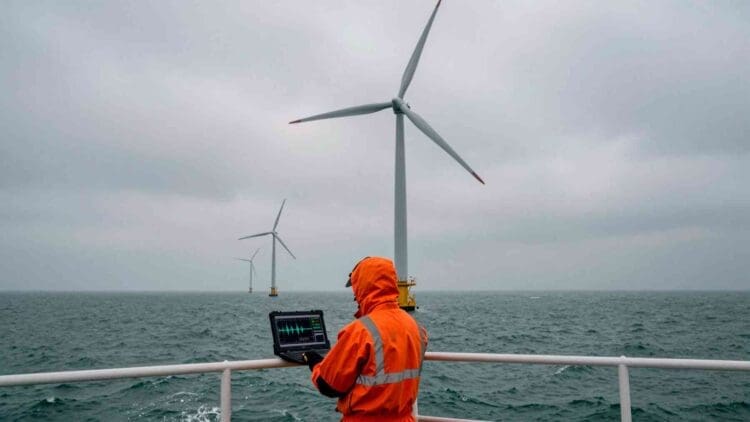

Researchers at Fraunhofer IWES have developed a remote diagnostic workflow that can classify the severity of power converter faults in offshore wind turbines before a technician ever sets foot on site. Published in Wind Energy Science as part of the ReCoWind2 project, the study describes a data-driven method that draws on converter control system data to determine how serious a fault-related shutdown is — and what a repair visit will likely require.
Remote diagnostic workflow classifies converter fault severity before site visits
The study was conducted through the ReCoWind2 project, a collaboration involving three research institutes and six industry partners. Data came from an offshore North Sea wind farm and covered roughly two years of turbine operation.
The team drew on four distinct sources: high-resolution fast logs sampled at 4.5 kHz capturing a window from 350 milliseconds before to 200 milliseconds after a fault trigger, 1-minute operating data, and fault flags extracted from converter event logs. Together, these gave a detailed picture of each turbine’s condition at the exact moment a fault occurred.


The diagnostic target was straightforward. The model classifies post-fault standstill time as either short — under one hour — or long — one hour or more. That distinction signals fault severity and helps operators figure out what a repair visit will actually require before anyone makes the trip.
The best-performing model used just four features, achieving a cross-validated accuracy of 0.89 and an F1 score of 0.86 — a strong result given the dataset size.
Power converter failures are a leading cause of wind turbine downtime
Power converters rank among the most failure-prone subsystems in both onshore and offshore wind turbines. The failure rate stands at 0.21 converter system failures per megawatt of converter capacity per year — a figure that has remained persistently high despite incremental improvements.
Fraunhofer IWES previously analyzed failure data from over 10,000 wind turbines worldwide to identify factors affecting converter reliability, and that work provides important context here.
A core operational problem is that fault mode and required spare parts can often only be confirmed once a technician is physically on site. Multiple visits to a single turbine are common as a result, each one extending downtime and adding cost. The economic stakes grow considerably with turbine size and offshore deployment, where limited site accessibility makes every unnecessary trip especially costly — in travel time, vessel expenses, and lost generation.
High-resolution fast-log data and fault flags drive diagnostic accuracy
The team started with 864 engineered features, most derived from fast-log signals. Variance filtering and correlation filtering brought that number down to 164. A subsampled decision-tree inclusion-rate filter — training 400 models on randomly selected subsets — cut the set further to 34 features.
To work with three-phase fast-log signals effectively, the researchers applied the Clarke transformation, converting those signals into a two-axis stationary reference frame. That step enabled more effective feature extraction from the high-resolution waveform data.
Logistic regression on the 34 remaining features revealed a clear pattern: fast-log signals and converter fault flags carried the most predictive information, while low-resolution 1-minute operating data contributed very little to classifying fault severity.
Counterintuitively, the final four-feature model outperformed versions built on all 34 features. With roughly 100 fault events in the dataset, larger feature sets led to overfitting — F1 scores around 0.6 for both logistic regression and decision tree models using the full 34 features.
Tool could raise first-time fix rates and cut offshore maintenance costs
The first-time fix rate — the share of maintenance visits that resolve a fault in a single trip — is a key performance metric for wind farm operators, and this diagnostic tool is explicitly designed to move that number upward.
By delivering remote, explainable decision support before a technician departs, the system could allow operators to dispatch the right parts and personnel on the first attempt. Decision nodes and regression coefficients remain transparent to users, which the authors describe as essential for practical industry adoption.
The study is framed as an initial step toward a full decision support tool. No market-ready condition monitoring system for power converters currently exists, and prototypes published in recent years have not reached commercial deployment.
The dataset of approximately 100 fault events is a recognized limitation. Conclusions about generalizability are constrained by that size, and validation on larger datasets is needed before the method can be applied across different turbine types or wind farms.
Faults classified before a technician attends
The Fraunhofer IWES study demonstrates that converter control system data — particularly high-resolution fast logs and fault flags — can classify the severity of wind turbine power converter faults with 89% accuracy before a technician visits the site. The workflow, developed under the ReCoWind2 project and published in Wind Energy Science, reduces a starting set of 864 features to just four while maintaining strong predictive performance on a small dataset. Power converters fail at a rate of 0.21 failures per MW per year, and multiple repair visits per fault event are common — the problem this tool directly targets. The authors stress that larger dataset validation remains necessary before broader deployment.