
For years America built solar farms with foreign parts, but a giant Georgia megafactory just changed that calculation
 AI-made
For five years running, the U.S. has installed more solar capacity than any other type of power generation. Yet for most of that boom, the cell — the component that actually converts sunlight into electricity — has been manufactured almost entirely overseas. American factories could assemble finished panels, but the critical piece at the heart of each one came from somewhere else.
Now, inside a sprawling, L-shaped factory in Cartersville, Georgia, that long-standing gap is beginning to close.
A manufacturing gap years in the making
The U.S. solar boom has been real and sustained. But American factories were handling the easier part of the job. Panel assembly scaled up quickly, and by the time the Cartersville factory came online, the U.S. had enough assembly capacity to produce nearly 70 gigawatts of finished panels annually, according to the Solar Energy Industries Association — far exceeding what the country installs in a single year.
ES Foundry is working to expand its South Carolina factory to 3 gigawatts by year’s end, and T1 Energy is building a cell fabrication plant outside Austin.
Solar cells were a different story. Before QCells began production, only three U.S. companies made them: Suniva in Georgia, and ES Foundry and Silfab in South Carolina. Their combined operational capacity sat at roughly 3 gigawatts. The cell remained the weak link in an otherwise expanding domestic supply chain.
The Biden administration recognized this gap. The Inflation Reduction Act introduced manufacturing tax credits for domestic cell producers and domestic-content bonuses for developers who buy American-made components — explicitly designed to pull cell production back to the U.S. after years of ceding that ground to overseas competitors, particularly China.
What QCells built in Cartersville
QCells, a subsidiary of South Korean industrial giant Hanwha Group, first announced the Cartersville project in early 2023. Rather than building a single-stage factory, the company pledged to colocate all four major steps of the solar supply chain under one roof: silicon ingots, wafers, cells, and finished modules.
The facility’s module lines went live in 2024. Cell production lines took longer to calibrate and have only recently begun commercial output. Full 3.3-gigawatt production is expected by the third quarter of this year — and when that happens, QCells alone will more than double current U.S. operational solar cell capacity.
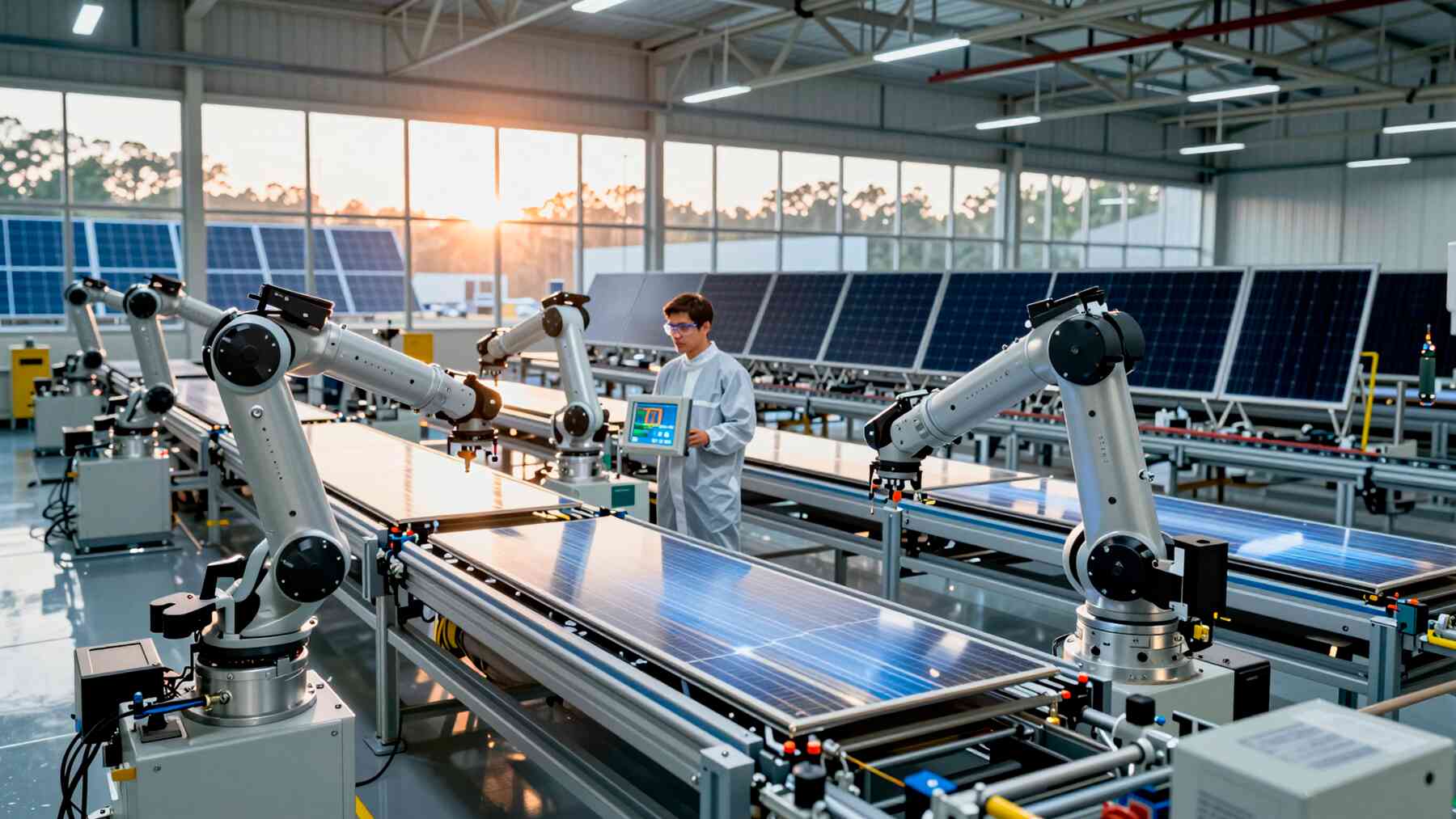
Polysilicon enters at one end, moves sequentially through each production stage, and finished panels roll off the line at the other. Combined with a module assembly plant roughly 30 miles north in Dalton, Georgia, the broader operation is expected to employ 3,800 people in high-tech, robot-assisted manufacturing roles.
Why making cells is harder than assembling panels
Cell manufacturing is more complex than panel assembly, which helps explain why domestic capacity has been slow to develop. Etching silicon wafers into functional solar cells involves potent chemicals — including hydrofluoric acid and potassium hydroxide — and requires precise, multi-step industrial processes. As one industry figure put it: “You’re leveraging complicated science to create a solar cell that generates electricity. There are more steps to the process, and the steps are more intensive.”
The risks are not abstract. In March, Silfab temporarily shut down its South Carolina cell factory after accidentally releasing both potassium hydroxide and hydrofluoric acid in rapid succession. State authorities found no impact to the surrounding community, but the incident illustrated what is at stake when chemical processes go wrong.
A wave of new capacity — but with an uncertain future
QCells is not alone. Another 22 gigawatts of cell capacity is currently under construction nationally, according to the Solar Energy Industries Association. Toyo recently announced a $357 million investment to add 1.5 gigawatts of cell production at its Houston facility. ES Foundry is working to expand its South Carolina factory to 3 gigawatts by year’s end, and T1 Energy is building a cell fabrication plant outside Austin.
The policy environment, however, has shifted. The Trump administration phased out the installation tax credit for solar projects completed after July 4, 2025, though a four-year safe harbor provision still applies to projects already in the pipeline. Once those projects are built or lapse, developers may lose their primary financial incentive to choose domestically produced cells over cheaper imports.
Domestic production still offers something imports cannot: resilience. Covid-era supply chain disruptions and rising shipping costs reminded developers that foreign supply chains carry real schedule risk. American-made components, delivered by truck from a nearby factory, sidestep that uncertainty entirely.
Electricity demand and the AI factor
Electricity consumption in the U.S. is at its highest level in a generation, driven significantly by the rapid buildout of AI data centers. Those companies have become focused on what the industry calls “speed to power” — the ability to bring new generation online quickly. Solar, with its relatively short installation timelines, is well positioned to meet that need.
Whether U.S. solar cell manufacturing can sustain momentum beyond the safe harbor window remains an open question. The convergence of industrial policy, AI-driven electricity demand, and supply-chain localization does create conditions that could support domestic production even as some incentives fade. The Cartersville factory is the most visible sign yet that the U.S. is serious about owning more of this supply chain.
Kelly is an experienced writer with 15 years of experience exploring the big stories that shape our world, from tech breakthroughs and space exploration to climate, energy, and the fascinating quirks of science. She has a talent for turning complex ideas into sharp, memorable insights that stay with readers long after they’ve finished reading.
