
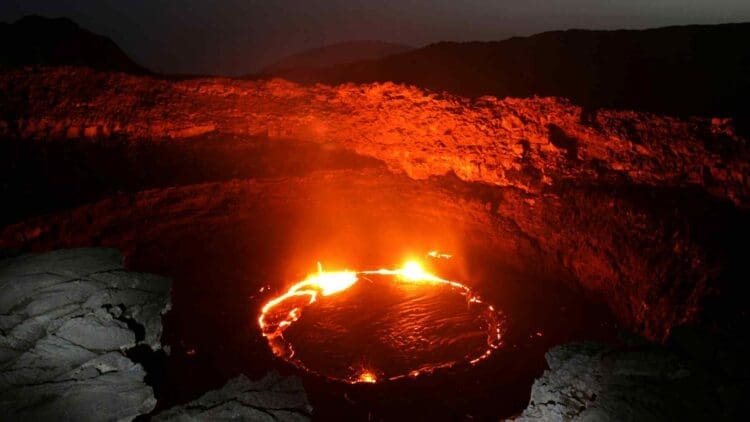

Researchers decided to dig a little deeper to uncover extremely hot, clean energy, but then they found something else.
For some, the thrill lies in the known, but for others, it is getting to uncover more about the unknown.
Then there are exploration and drilling sites that accidentally result in a double-discovery and double the exhilaration.



But will the excitement over the next-generation geothermal energy potential and its magma well last, or eventually fizzle out?
How traditional geothermal energy is merely a drop in the bucket
There are vast amounts of untapped clean power boiling beneath our feet, as 99% of Earth’s bulk mass, or mantle, is hotter than 1,832ºF.
You see, the planet is essentially one big bucket of thermal power.
Humans have been using merely a drop or two for millennia. From the Romans and their heated bathhouses, to the first-ever geothermal power plant in Italy in the 20th century.
Today, experts have realized that geothermal energy could play a major role in the global energy transition. However, despite the obvious amount of heat waiting to be exploited, this source remains untapped.
Conventional geothermal has been facing what engineers refer to as the “Goldilocks” problem.
This source has three requirements that must align, or the global transition will remain stuck in a rut.
Digging extra deep for “just the right” conditions
With the right conditions to exploit Earth’s natural heat systems, the world can be powered by clean energy 24/7.
Traditionally, researchers merely tapped the planet near the surface to gain access.
But the amount of power generated was not nearly enough for the end goal. This is because near-surface, the three requirements do not align.
Extreme heat is needed to convert water into steam. A fluid, such as natural or injected water, is required to carry heat to the surface.
There must also be pathways in the rock to allow free movement of the fluid. These rare conditions have limited geothermal energy to certain volcanic “hotspots.”
So, to overcome the “Goldilocks” problem, researchers realized they had to dig exceptionally deep to tap concentrated heat.
This led to the Iceland Deep Drilling Project (IDDP), but this project accidentally discovered something in addition to superhot sites.
An accidental and superhot “eureka” moment
Interest in investing in enhanced geothermal energy has been growing, but achieving it takes some time.
In 2009, the IDDP-1 drill drilled approximately 1.3 miles deep for superheated water. Instead, the researchers found extremely high temperatures escaping from a rhyolitic magma chamber.
Nearly 1,800°F of molten rock pushed upwards, creating the world’s first ever “magma well.”
This did not stop the purpose of the IDDP. Water was piped down, which created steam at 842°F, which means the well could potentially generate 36 MW.
But that was not the only point of interest from this drill site.
Looking at lithium through the obsidian “looking glass”
The magma cooled nearly instantly as it reached drilling fluids, causing dark, razor-sharp obsidian glass to erupt to the surface.
It may have signaled the end of the drill bit, but it was the beginning of something else. Inside the obsidian were microscopic crystals, and inside them were lithium isotopes.
Additional information is in the study “Lithium systematics in the Krafla volcanic system: comparison between surface rhyolites and felsic cuttings from the Iceland deep drilling project -1 (IDDP-1)” published in Springer Nature Link.
The IDDP went from a mishap to a dual victory for sustainability and science.
Not only is “Superhot Rock” geothermal power a reality, but the lithium isotopes are also used to analyze volcanic behavior.
These discoveries are vital, especially as interest continues to grow.
Bill Gates and the U.S. have realized geothermal’s potential. They even added a pinch of innovation to make geothermal energy greener, but will it gain traction?



