
Researchers connected two lemons with a cable as a simple test until they realized they could store energy like tiny batteries
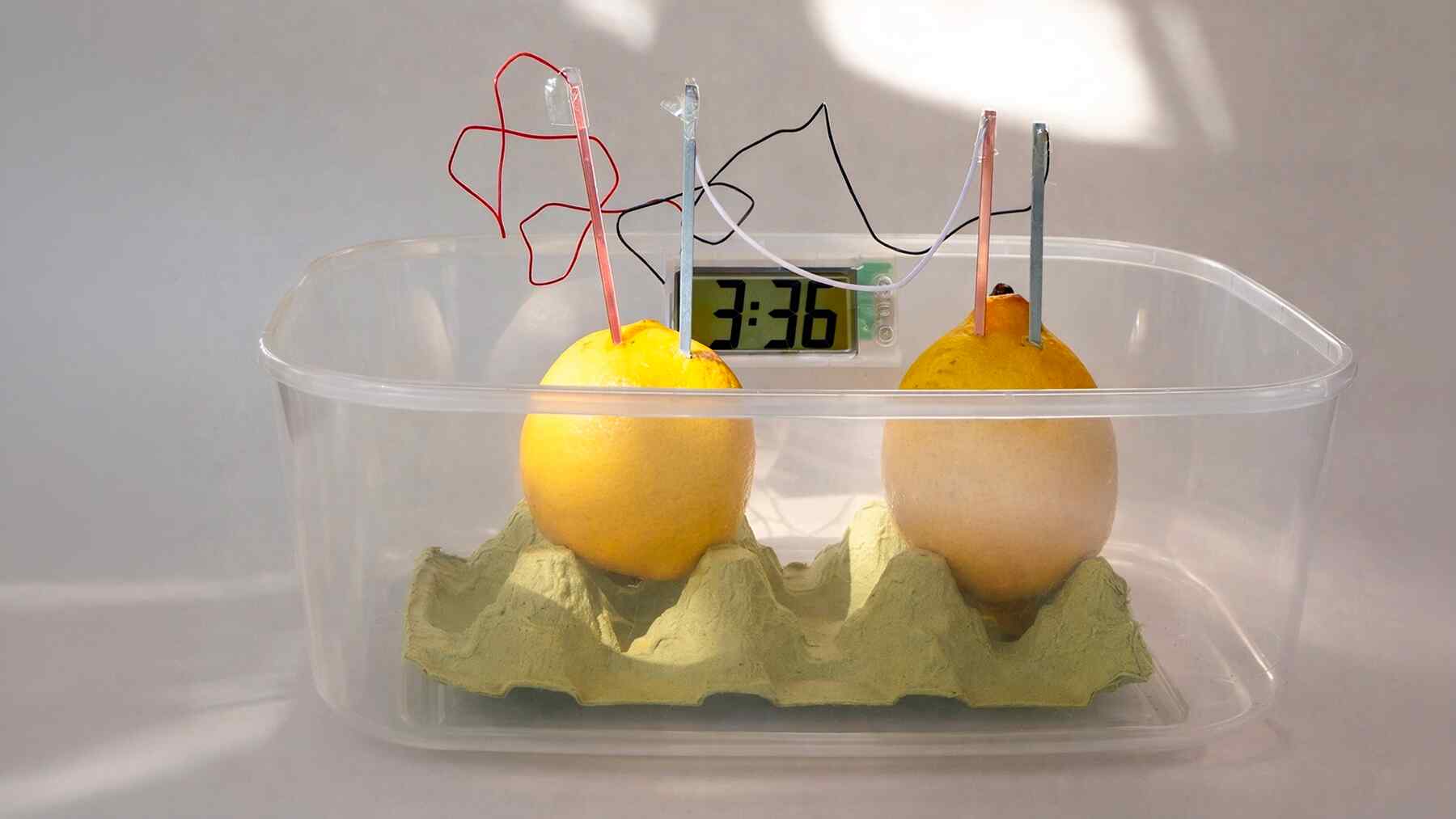 Credits: Nevit Dilmen / Wikimedia Commons / CC Share Alike 3.0
When life gives you lemons, connect them to create the ultimate eco-battery.
Global sustainability is in a complex stage, as excess green energy storage is not entirely eco-friendly.
While some experts have been turning to complex solutions, McGill University researchers turned to the kitchen for an old-school bio-solution.
Perhaps these “citrus-powered” storage systems could soon be integrated with Pennsylvania and Michigan Universities’ solar-powered nanobot.
Could the answer to managing waste and powering the future have been in your fruit bowl all along?
How conventional batteries are becoming part of the problem
On paper, the answer to mitigating the effects of climate change seems straightforward.
Unfortunately, the transition away from fossil fuels to renewable energy hasn’t gone smoothly.
The intermittency of sources such as solar and wind energy necessitates battery storage systems to prevent unnecessary power losses.
Beyond these large-scale solutions, traditional small-scale batteries have also become central to everyday life. Without AA cells in remotes and flashlights, and the lithium-ion ones in smartphones, most people will feel lost.
However, these integral cells that have become a given in society come with a great cost, literally and figuratively.
Their production relies on heavy metals and toxic chemicals like lead, cadmium, and lithium. Used batteries more often than not end up in landfills.
As they begin to degrade, the hazardous materials leak into the soil and groundwater.
To prevent the dangers of e-waste, researchers are exploring more sustainable alternatives.
Seeking greener alternatives to storing energy
Most people may not realize that traditional batteries have a hidden footprint before they reach the end of their lifecycles.
The metals needed for their production are obtained through highly invasive and carbon-heavy mining and processing methods.
They are also referred to as critical minerals, as they are becoming very rare. The U.S. already ranked second-to-last in critical mineral mining development.
So, besides being bad for the environment, traditional batteries thus also contribute to global supply chain tensions.
That is why alternative storage solutions are essential. Ironically, a mine is showing great potential in being repurposed as a “gravity battery.”
However, that source is just too big for devices such as monitors and smartphones that require a small power solution.
Nothing seemed to fit these applications just right. That is, until the McGill University research team decided to regroup in the kitchen.
Two wrongs never make a right, but two lemons make a battery
Advanced electronics are key to scaling future green technologies for the energy transition.
But sometimes the most high-tech solutions are based on classic inventions of the past.
Such is the case with McGill University’s biodegradable battery that uses a gelatin-based electrolyte. The team was led by Associate Professor Sharmishta Bhadra and PhD candidate Junzhi Liu.
The team’s inspiration? The childhood classic two-lemon battery, of course.
Artistically folding in a touch of citrus to create a powerful bio-solution
Typical biodegradable batteries create a “passivation layer” that lowers performance.
By adding citric and lactic acids to the gelatin-based electrolyte, the team’s battery produced 1.3V. This mimics the power of a standard AA battery minus the toxicity.
To enhance the design flexibility, they used the traditional Japanese paper-folding and cutting art called “Kirigami.”
Precise, 3D-inspired cuts to the gelatin structure enable the battery to stretch 80% of its initial length.
So, this energy storage solution can be twisted, pulled, or bent in monitors or medical implants that flex with humans.
Additionally, once it reaches its end of life, it simply disappears in nearly two months. It is made from wood pulp, natural fibers, and benign metals that degrade when placed in saline solutions.
It seems the future is micro. Perhaps these “citrus-powered” storage systems could soon be integrated with Pennsylvania and Michigan Universities’ solar-powered nanobot.
Anke Maree is a writer with a clear and engaging editorial style. Her work focuses on making complex topics accessible, informative, and relevant for readers across different areas of interest.
