
Japan unveils magnetic levitation — Could mark the end of batteries as we know them
 Credits: oist.jp
Nowadays, we use batteries to store energy, however, this way is very inefficient because overcoming friction and gravity takes most of the energy. But Japan presents a very innovative solution which is magnetic levitation and will be the (supposed) end of hydrogen engines.
Will the use of magnetic levitation do away with the need for batteries?
A group of Japanese researchers attached to the Quantum Machine Unit of the Okinawa Institute of Science and Technology (OIST) report having created a track that provides magnetic levitation, which does not need external maintenance power.
By the latter, we mean that it does need power, but only at start-up for the generation of the magnetic field it initially requires. After that, objects, will operate by moving on it without using any other type of thrust energy such as batteries.
Now, OIST scientists have improved this method, making it so that only electricity is needed at the moment of starting the system to create the magnetic field.
What does this revolutionary invention consist of?
On a surface, magnetic levitation causes objects to rise a few centimeters above this track. This eliminates friction, so the energy is able to move without the need for batteries, motors or any form of mechanical or electrical thrust.
To achieve this effect, the battery is required to be made of diamagnetic materials, then magnets along the tracks provide an intense magnetic field that causes the object to “float” on the surface. And it is to generate this magnetic field that the initial energy is needed.
One example where magnetic levitation is applied is the Maglev train, where powerful superconducting electromagnets drive trains that move without motors or batteries. However, this train requires continuous electrical power to keep it elevated.
This is because if the electricity is switched off, the magnetic field over which the train floats is switched off. Now, OIST scientists have improved this method, making it so that only electricity is needed at the moment of starting the system to create the magnetic field.
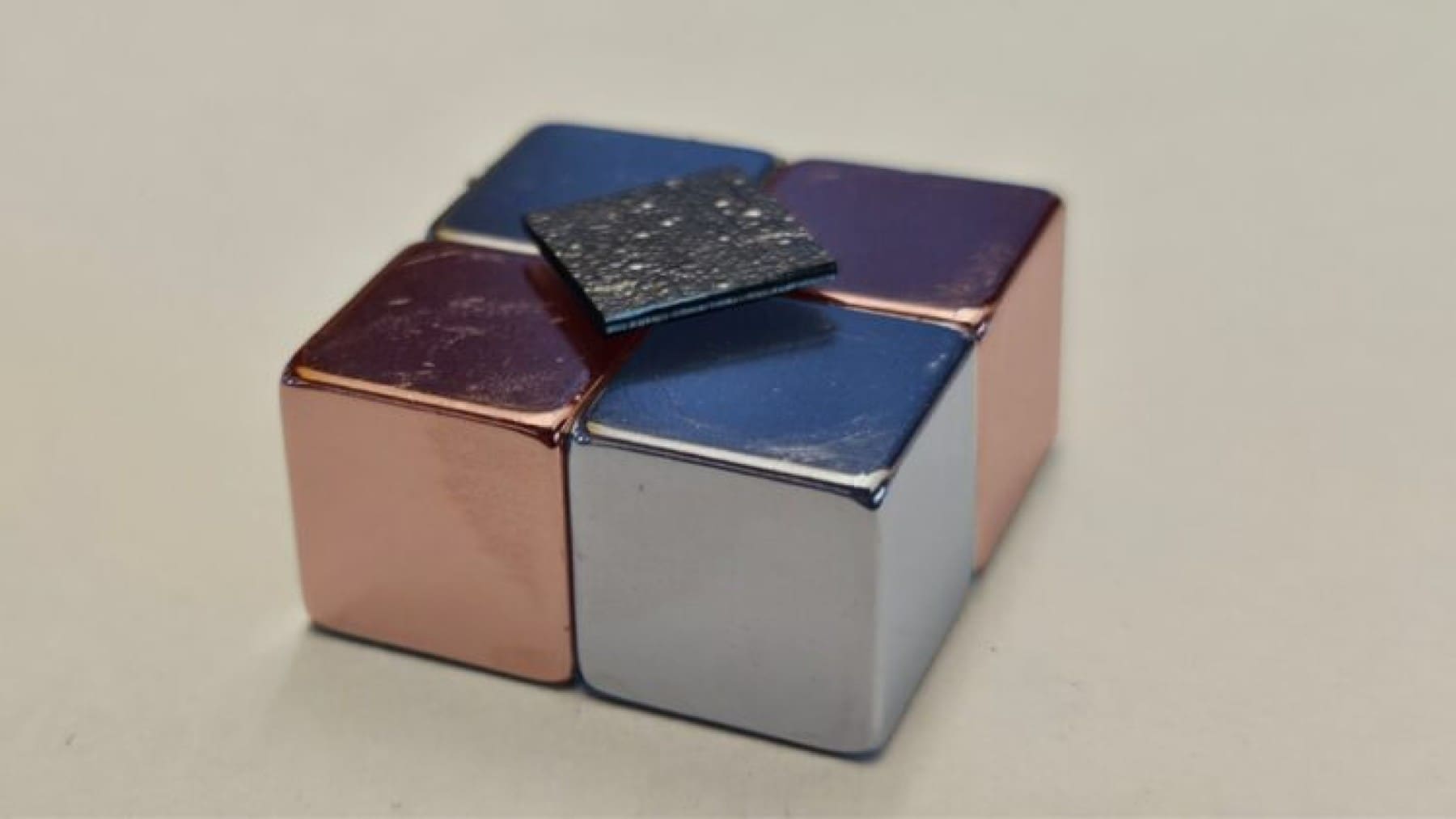
To do this, they used pulverized graphite, which is a crystallized carbon material. Through a chemical process, they created a paste by mixing it with wax and thus, the researchers made a plate under which there are several magnets arranged in a continuous grid.
These are powerful enough to cause the effect of magnetic levitation. In this way, the table is set for the movement of objects by eliminating friction, making the movement more efficient for many applications.
The challenges that magnetic levitation must overcome before it can become widespread
The experimental prototype has small dimensions. But to bring it to a real scale, where it can have practical applications, a couple of problems need to be solved. The first is that it is necessary to reduce the kinetic energy at the surface level.
This is because the motion into the quantum domain is required to be cooled. In addition, this reduction is necessary to increase self-sufficiency and sensitivity at macro sizes. The other problem brought by the real size is the so-called vortex damping.
Which is explained as follows: a system that is oscillating tends to lose this condition by external forces and with time. It is applicable in our case, in the sense that a way must be found to prevent graphite immersed in a magnetic field from losing energy.
In conclusion, with magnetic levitation, the use of motors and batteries will be a thing of the past. That is, once the limitations it brings are overcome. Since it will eliminate the obstacles that reduce the efficiency, such as friction and gravity.

Carlos is an engineer with strong expertise in technical and industrial topics. He previously worked at international companies such as Siemens and is multilingual.
