
The Engineer Who Starts Where the Answers Run Out
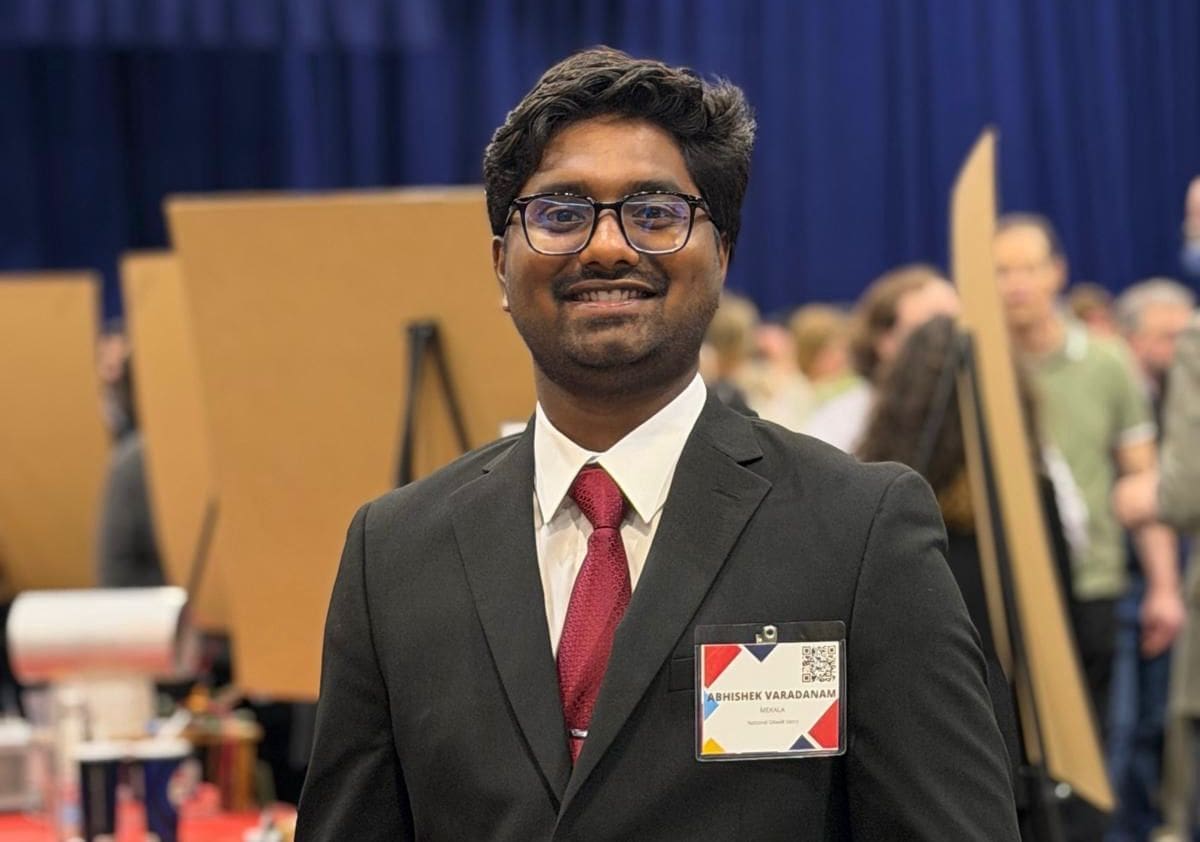 Abhishek Varadanam Mekala
 Abhishek Varadanam Mekala has spent his career solving problems that didn’t have good solutions. In April 2026, the Cases and Faces Award for Product Innovation confirmed what his years of engineering work had already shown.
Aviation accounts for approximately 2 to 3 percent of global CO2 emissions, and with passenger demand projected to double by 2050, the pressure on aerospace engineers to build more efficient, quieter, and more reliable aircraft has never been greater. According to the Air Transport Action Group, the civil aerospace sector already spends $15 billion per year on efficiency-related research and development, and the gap between what existing wing designs can deliver and what next-generation flight demands require remains one of the field’s defining unsolved problems. It is precisely that kind of gap that has defined Abhishek Varadanam Mekala’s engineering career from its very beginning.
Some engineers wait to be handed a problem. Abhishek Varadanam Mekala has always gone looking for one. Growing up in India and studying aeronautical engineering at MLR Institute of Technology in Hyderabad, affiliated with Jawaharlal Nehru Technological University, one of India’s premier public technical universities and a nationally recognized institution for engineering education, he developed an early habit of reading prior art not to learn what had already been done, but to find where the existing answers ran out. That habit produced four patent applications before he graduated. It carried him through an internship at one of India’s most respected aerospace manufacturers. And it is the same habit he brings to work every day at National Oilwell Varco’s Chemineer unit in Dayton, Ohio.
In April 2026, Abhishek Mekala received the Cases and Faces Award for Product Innovation for his redesign of an industrial mixing gearbox.
“The questions that stuck with me were always the ones nobody had a clean answer to yet. I was always more interested in why something didn’t work than in what already did.”
Four Patents Before Graduation
During his undergraduate years, Mekala identified four distinct engineering problems in aerospace and propulsion technology where he felt the available solutions were either overcomplicated, inefficient, or simply incomplete. Each one became a patent application filed under India’s Patents Act of 1970. What is striking about the four inventions is not just their technical ambition but the discipline of thinking behind them. Every solution he developed was constrained by a simple rule: it had to be practical. It had to work in the real world, without adding complexity, cost, or operational burden that would prevent it from ever being adopted.
His corrugated nozzle for ramjet-powered helicopters reduced the exhaust jet core length by approximately 80 percent through fixed corrugated plates at the nozzle exit, significantly increasing the mixing rate with atmospheric air and producing a measurable reduction in jet noise, with negligible thrust loss, no moving parts, no extra fuel, just a geometry change that accelerated exhaust mixing with the atmosphere. His gear-rod morphing wing mechanism achieved something no prior design had managed: simultaneously deflecting both the leading and trailing edges of a wing through a single motor-driven gear, continuously reshaping the wing’s camber without separate control surfaces. His redesigned rocket payload fairing solved the binary failure problem that had destroyed missions on the Atlas SLV-3, PSLV-C39, and Long March 2E by dividing the conventional two-piece clamshell into three independently separated sections, giving the system more ways to succeed when a single joint comes under stress. And his fourth invention addressed a limitation that conventional aircraft control surfaces have never solved: while flaps and slats can alter a wing’s camber during flight, no standard mechanical system changes the wing’s thickness-to-chord ratio, the parameter that governs drag, lift coefficient, and aerodynamic efficiency across different flight phases. By integrating a rack-and-pinion system directly into the wing structure, driven by a single motor that simultaneously reshapes the wing’s thickness, leading edge, and trailing edge, he developed a mechanism that allows continuous aerodynamic adaptation without smart materials or pneumatic actuators. The design was validated through physical wind tunnel testing on a scaled prototype. NASA and Boeing have since pursued adaptive wing geometry programs for the same underlying reason because a wing that optimizes its profile for each phase of flight flies more efficiently, consumes less fuel, and extends the aircraft’s performance envelope.
Learning the Cost of Getting It Wrong
After completing his degree, Mekala joined one of India’s most respected aerospace manufacturers, working in the design and quality divisions on the AH-64 Apache helicopter program, one of the world’s most advanced military helicopters, built to Boeing and AS9100 quality standards. During a design review for assembly tooling he had helped model, he identified a positional interference between a fixture locating feature and a structural frame in the forward fuselage assembly area, catching it before the tooling was released to manufacturing. That identification prevented a production disruption on one of the world’s most advanced military helicopter programs and demonstrated the kind of precise, anticipatory engineering judgment that experienced professionals at Boeing-standard facilities rely on to keep a live defense production program running on schedule.
From Aerospace to the Oilfield
Today, Mekala works as a Design Engineer at National Oilwell Varco, which is сonsistently ranked among the top 10 global oilfield equipment companies by market share and revenue. National Oilwell Varco is one of the world’s leading providers of equipment and technology for oil and gas drilling and production operations, with revenues of $8.74 billion and a presence across more than 500 locations in over 60 countries. The company’s mixing technology division is one of the most established names in industrial agitation, with decades of experience supplying mixing systems to the chemical, oil and gas, pharmaceutical, and water treatment industries worldwide. The shift from aerospace to industrial mixing might seem like a change of scenery, but Mekala describes it differently. The physics are the same. What changes is the environment and the consequence of failure. A shaft that fails in an agitator does not crash an aircraft, but it shuts down a customer’s production process and in the industries the company serves, that carries its own serious weight.
He brings to every design at the company the same approach he applied to his patent work and internship. He starts with a full stress and load analysis, identifies where the critical failure points are, and builds to the exact material specification required to meet the safety margins, not more, because unnecessary material is waste, and not less, because the product carries warranty obligations and people depend on it working. The result is equipment that consistently meets its performance requirements with optimized material use, fewer failure points, and longer service intervals, outcomes that have directly improved the company’s product reliability and reduced its customers’ operational costs. By applying finite element analysis and CFD simulation tools to mixing equipment design, a level of computational rigor more common in aerospace than in industrial mixing, he has delivered designs that outperform standard specifications while reducing material waste and warranty exposure across the company’s product lines. And in every design review, he asks the questions about edge cases and failure scenarios that others may not have considered yet. That habit of finding the gap before it becomes a failure is the same thinking that produced four patents as an undergraduate, shaped his work on the Apache program, and now defines the engineering standard he applies at NOV every day.
“The physics don’t care what industry you’re in. Stress is stress. What changes is the consequence of getting it wrong. That’s what keeps you focused on doing the work properly.”
In April 2026, Abhishek Mekala received the Cases and Faces Award for Product Innovation for his redesign of an industrial mixing gearbox. The award is a direct validation of his core methodology: identifying an industry-standard limitation in this case, moisture-related failure and engineering a way around it. By integrating desiccant breathers directly into the housing architecture, Mekala didn’t just fix a part; he proved that “unavoidable” reliability issues are simply design challenges waiting for a workaround. From a classroom in Hyderabad to a production-grade engineering role in Ohio, what has remained constant throughout is a refusal to accept a poor answer when a better one is possible. That is not a career strategy. It is simply how he thinks.
“There are still problems in aerospace and energy engineering that don’t have good solutions. That’s not discouraging. That’s the whole point.”

Carlos is an engineer with strong expertise in technical and industrial topics. He previously worked at international companies such as Siemens and is multilingual.
