
Jellyfish shut down a French nuclear reactor twice in a row, but they are far from the only animals targeting our infrastructure
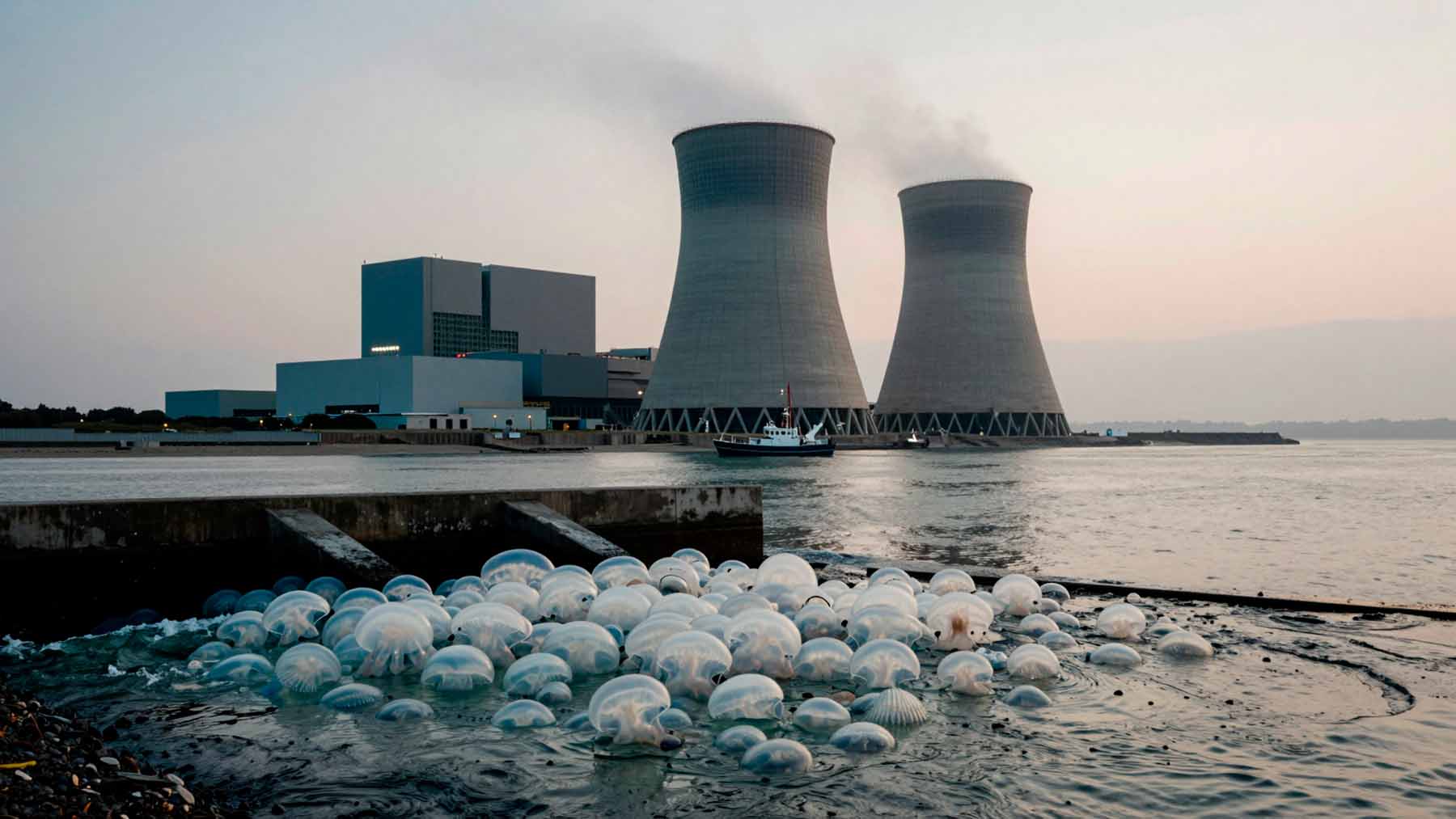 Image generated with artificial intelligence
For the second consecutive year, on the exact same summer date, a massive bloom of translucent jellyfish clogged the cooling water intake systems at the Gravelines nuclear power plant along the English Channel. Despite spending hundreds of thousands of dollars on preventive measures following an initial disruption, operators were forced to shut down the reactor as a precaution. Watching history repeat itself proved financially jarring and ecologically alarming.
While it is easy to write off this coastal incident as an isolated stroke of bad luck, environmental data suggests otherwise. Gravelines is merely the most visible example of a broader, accelerating trend: wild animals routinely colliding with, infiltrating, and disrupting the critical energy and scientific infrastructure that modern society depends on most.
A repeat shutdown nobody wanted
Located on the coast of northern France, the Gravelines nuclear facility draws seawater daily to cool its reactors—a design that functions smoothly until marine life pushes back. Following an initial jellyfish surge that overwhelmed the facility’s filtration systems, French utility operator EDF deployed round-the-clock maritime patrol vessels equipped with netting to keep incoming swarms away from intake valves.
For coastal power plants and industrial facilities that rely on seawater cooling, expanding jellyfish populations represent an escalating operational hazard.
The expensive countermeasures proved insufficient. Exactly one year later, another vast jellyfish bloom invaded the intake channels, forcing technicians to execute an emergency reactor shutdown. While EDF confirmed that full operations resumed within days without triggering safety breaches, the incident delivered a stark warning: one of Europe’s most carefully managed energy facilities had been paralyzed twice in a row by a brainless invertebrate.
Why jellyfish blooms are getting worse
This biological interference is far from random. Marine scientists link the rising frequency and density of jellyfish blooms directly to ocean warming driven by climate change. Warmer waters boost plankton while accelerating jellyfish reproductive cycles and extending breeding seasons.
For coastal power plants and industrial facilities that rely on seawater cooling, expanding jellyfish populations represent an escalating operational hazard. Gravelines is not an isolated anomaly, but an early example of how changing climate patterns alter operational risks for critical infrastructure. Without advanced marine filtration technology, these animal-driven shutdowns will inevitably multiply.
Animals vs. infrastructure: A surprisingly long track record
Jellyfish are hardly the only creatures breaching defenses; the track record of animal-induced infrastructure failures across the United States is surprisingly extensive.
In Connecticut, a single trespassing raccoon infiltrated an electrical substation, short-circuiting equipment and triggering widespread power outages for over 2,500 utility customers.
At the LIGO gravitational-wave observatory in Washington State, researchers spent weeks baffled by data anomalies caused by ravens pecking at ice on outdoor cooling pipes to drink water; the micro-vibrations from their beaks disrupted sensitive space-time measurements.
Similarly, a major power outage at Europe’s Large Hadron Collider was linked to a bird dropping a piece of baguette onto an outdoor high-voltage line. From mammals to birds, wildlife interactions pose a persistent systemic hazard.
Human expansion into nature—and nature’s response
Ecologists emphasize that these collisions are the predictable outcome of aggressive human expansion into wild habitats. We build massive cooling intakes in coastal waters, erect substations across suburban landscapes, and place high-tech observatories in pristine wilderness where animals already live.
Furthermore, human activity alters animal behavior in documented ways. A 2022 Scientific Reports study showed Bali macaques stealing tourist items to barter for food—demonstrating rapid behavioral adaptation driven by humans.
As industrial infrastructure expands, animals adapt to and navigate around human structures, making high-impact collisions far more frequent.
What engineers and operators are doing about it
To date, most engineering responses have remained reactive rather than proactive. EDF deployed patrol boats only after jellyfish shut down Gravelines the first time, just as LIGO modified its pipe insulation after ravens corrupted scientific datasets.
This reactive posture exposes a major flaw in traditional risk modeling. While operators prepare for cyberattacks, equipment failure, and weather, wildlife interactions are rarely integrated into risk models. As climate change alters species ranges and animal behavior, experts warn that proactive biological risk assessments must become standard practice for critical facilities. Ultimately, these recurring disruptions deliver a clear lesson: jellyfish shut down a French nuclear reactor twice in a row, but they are far from the only animals targeting our infrastructure.

Kelly is an experienced writer with 15 years of experience exploring the big stories that shape our world, from tech breakthroughs and space exploration to climate, energy, and the fascinating quirks of science. She has a talent for turning complex ideas into sharp, memorable insights that stay with readers long after they’ve finished reading.
