
New study finds mesoscale wind models underestimate internal turbine wake losses at US East Coast offshore wind farms by more than half
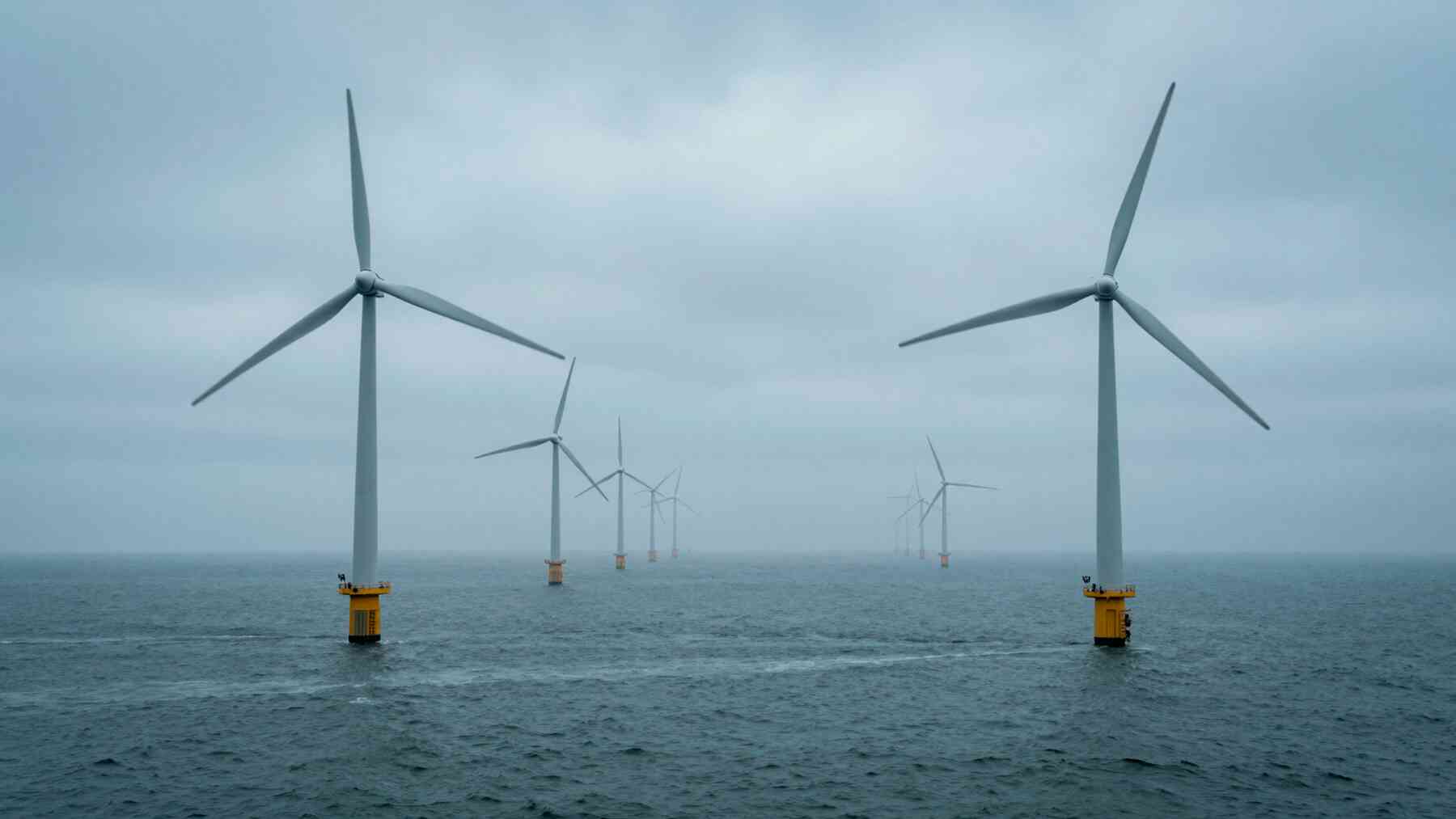 AI-made
A peer-reviewed study published in Wind Energy Science finds that mesoscale weather models – the standard tool for estimating offshore wind energy losses – may significantly undercount how much power turbines lose to the wakes of their immediate neighbors. Researchers at the National Renewable Energy Laboratory and collaborating institutions examined three planned US East Coast wind farms: South Fork, Sunrise Wind, and Revolution Wind, off Rhode Island and Massachusetts.
Where large-eddy simulations found that internally waked turbines produced 37 per cent less power than front-row turbines, mesoscale models estimated only a 16 per cent reduction — less than half the loss.
Study Compares Mesoscale and Large-Eddy Simulations at Three Planned Offshore Wind Farms
The research team ran two distinct simulation types side by side. The first used mesoscale Weather Research and Forecasting (WRF) runs with the Fitch wind farm parameterization — the approach most commonly used in industry and federal planning. The second used large-domain large-eddy simulations, which can resolve individual turbine wakes. South Fork, Sunrise Wind, and Revolution Wind together carry a combined nameplate capacity of 1.76 GW.
At that resolution, the model simply can’t resolve the narrow velocity deficit a single turbine leaves behind — the feature driving within-farm power losses.
The geographic layout made these three farms well suited for the comparison. South Fork and Revolution Wind are roughly 10 km downwind of Sunrise Wind under prevailing southwesterly winds, letting researchers study both cluster wakes — one farm’s wake reaching a neighbor — and internal wakes, where one turbine’s wake reaches the next turbine within the same farm.
Five representative days were simulated, covering a range of atmospheric stability conditions. Seventy-five percent of cases showed stable stratification across the turbine rotor layer, consistent with the long-term climatology of the US East Coast — which makes the results broadly representative of typical operating conditions in the region.
Grid Resolution Limits Prevent Mesoscale Models From Resolving Individual Turbine Wakes
The structural reason for the discrepancy is straightforward. The mesoscale WRF domain uses a grid spacing of approximately 1 km, while the turbine rotor diameter is about 206 m. At that resolution, the model simply can’t resolve the narrow velocity deficit a single turbine leaves behind — the feature driving within-farm power losses.
A second source of error compounds the problem. Numerical discretization of turbine positions can displace them by up to 700 m from their actual locations, altering effective alignment directions between turbines and introducing additional uncertainty into internal wake estimates.
Under stable atmospheric conditions, individual turbine wakes persist over long distances and reach downstream turbines within the same farm. The mesoscale model, unable to resolve those localized velocity deficits, fails to capture this behavior entirely. The authors also note that these resolution limitations aren’t unique to offshore settings — they apply just as much to onshore mesoscale wind modeling.
Internal Wake Losses Underestimated by More Than Half; Broad Velocity Deficits Tracked Accurately
The gap in internal wake performance was substantial. LES found that internally waked turbines generated, on average, 37 per cent less power than front-row turbines. Mesoscale simulations put that figure at just 16 per cent.
Broader wind speed deficits told a different story. Mean root-mean-square errors between WRF and LES results were near 5 per cent downstream of both single and multiple wind farm clusters — a level of agreement consistent with earlier validation studies using aircraft measurements and lidar data in the North Sea. WRF also correctly captured how atmospheric stability shapes wake behavior: unstable conditions produced narrower wakes that recovered more quickly, while stable conditions produced broader, longer-persisting ones. Agreement between the two approaches was strongest for long-range cluster wakes, where individual turbine wakes had already merged into a farm-level signal.
Findings Carry Direct Implications for US Offshore Wind Energy Planning and Federal Assessments
Mesoscale simulations are the standard tool in both industry practice and federal assessments across the US East Coast, where more than 40 GW of offshore wind capacity is planned or under development. Prior mesoscale studies of that region estimated combined internal and cluster wake losses ranging from 11 to 38 per cent. The new findings suggest those figures may carry significant uncertainty, particularly for internally waked turbines.
One complicating factor is partial error cancellation. For certain wind direction sectors — roughly 215 to 230 degrees — combined wake loss estimates from WRF and LES stayed within 2 percentage points of each other. The authors caution, however, that this agreement is specific to the layout and wind rose of the farms studied and can’t be assumed to hold for different turbine arrangements or grid spacings.
What this means for planners and developers is fairly direct: mesoscale models can reliably capture broad wake patterns across a wind farm cluster, but they’re likely to underestimate the power losses that closely spaced turbines impose on each other. Hybrid approaches — pairing mesoscale long-range propagation strengths with the turbine-level resolution of LES — are what the authors recommend. The study’s data and code are publicly available via Zenodo for researchers and practitioners who want to examine the results directly.
Kelly is an experienced writer with 15 years of experience exploring the big stories that shape our world, from tech breakthroughs and space exploration to climate, energy, and the fascinating quirks of science. She has a talent for turning complex ideas into sharp, memorable insights that stay with readers long after they’ve finished reading.
