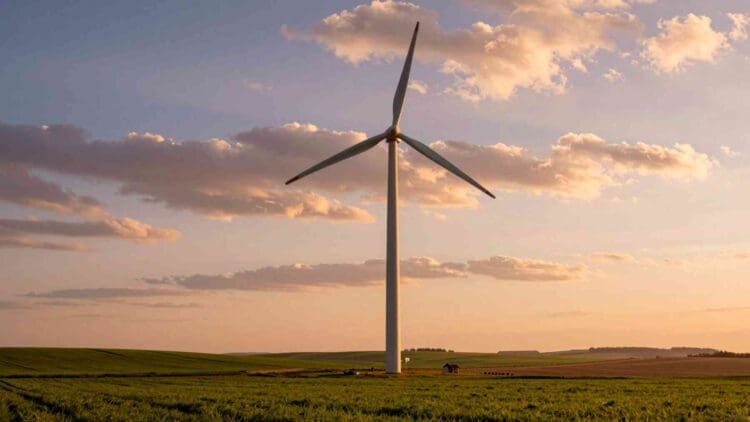

A wind turbine can shift the U.S. agricultural sector’s reliance on fossil fuel-based fertilizers.
Globally, climate change has had a profound impact on food security.
Food production has also faced significant international supply chain issues due to geopolitical tensions.

This has led to energy market shocks that further threaten the world’s food resources.
Will breaking the long-standing dependence on imported fossil fuels through localized production help the sector build resilience?
How the world’s hunger became industrialized
Earth’s natural abundance has been the primary food source for humans for thousands of years.
Soil nutrients were naturally replenished with organic wastes, animal manure, and crop rotation.
The human population grew slowly until 1800, when it reached 1 billion people for the first time.
This demographic trajectory was fundamentally shifted by the Industrial Revolution.
Rapid urbanization and industrialization throughout the 19th and 20th centuries abruptly raised the demand for food.
Soon, traditional farming approaches became unfeasible due to declining soil fertility.
1913 presented a major turning point. The Haber-Bosch process underwent commercialization.
Factories could fix atmospheric nitrogen into ammonia using natural gas under extreme pressure and heat.
These cheap, mass-produced fertilizers triggered the mid-century “Green” Revolution, boosting land productivity.
Today, nearly half of the world’s 8.2 billion people rely on food grown using synthetic nitrogen fertilizers.
However, this massive, fossil-fuel-dependent global infrastructure is now facing major obstacles.
Climate volatility and energy chokepoints
Climate change is escalating due to a continued reliance on fossil fuels that increase global temperatures.
For agriculture, this means vital, predictable weather patterns have become destabilized.
Extreme weather conditions directly degrade soil health, slash active crop yields, and decrease arable land.
Consequently, the planet’s food security has become significantly vulnerable. Volatile fossil fuel supply chains and geopolitical tensions have worsened this strain.
Synthetic fertilizer production has been affected by international energy markets.
Natural gas accounts for nearly 80% of the fertilizer’s manufacturing costs.
The spike in energy prices immediately drove up food production expenses.
The closure of the Strait of Hormuz is an example. Nearly 30% of globally traded fertilizers and 25% of liquefied natural gas shipments were halted.
This ongoing blockade forced farmers into a severe cost shock during crucial planting seasons.
Fortunately, a wind turbine in Minnesota could change it all.
The localized wind turbine solution
A research facility in Morris, Minnesota, is showing that green ammonia is the future.
The plant is operated by the University of Minnesota’s West Central Research and Outreach Center.
Its primary leverage is a local wind turbine that creates carbon-free nutrients. The Morris pilot plant serves as proof of concept that regional agriculture can gain independence.
Currently, the facility yields nearly one metric ton of green ammonia daily.
Using wind power to create clean ammonia for fertilizer
Wind energy powers electrolyzers that split water into hydrogen and oxygen.
Simultaneously, nitrogen is extracted directly from the air.
The onsite synthesis loop combines the elements to create green anhydrous ammonia.
The university has already begun installing a third electrolyzer to scale up to 400 tons annually.
This localized approach safeguards the agricultural sector from volatile global supply chains and erratic international energy pricing.
The reliance on international imports of essential nutrients can finally be broken.
Farmers could soon source these nutrients directly from local wind resources.
Commercial implementation is already emerging as cooperatives seek to secure long-term price stability.
Minnesota’s Central Farm Service has signed a ten-year deal to purchase local green ammonia. In nearby Iowa, modular startups are also deploying similar systems.
Nonetheless, high manufacturing costs remain an ultimate obstacle.
Regional green ammonia production must scale to 50,000 tons annually to achieve cost parity with gas-based fertilizers. If not, dependency on government subsidies could become another hurdle.
Anke Maree is a writer with a clear and engaging editorial style. Her work focuses on making complex topics accessible, informative, and relevant for readers across different areas of interest.