
A powerful alternative battery has the potential to change the future of transportation.
The world is becoming more electric with hopes of making fossil fuels a thing of the past for good.
But this shift has been costing the environment more than it intended, prompting innovative solutions to complete the transition.



Could changing how the electrical future is powered lead to a new era for the global green energy initiative?
How going electric paves the way to sustainability
Fossil fuels became the catalyst behind the explosion of industrial growth.
This growth fueled the rapid growth of cities worldwide, shifting humanity into the modern age.
These concrete jungles soon became synonymous with dense populations, high electricity consumption, and significant emissions.
As technologies became more advanced and cars were introduced to the world, things escalated.
Tailpipe emissions from internal combustion engines skyrocketed, especially impacting the air quality in major cities.
Adding the unchecked burning of other carbon-heavy resources for over a century has left the climate highly fragile.
To prevent further environmental degradation, the global energy sector is embracing a fundamental shift toward electrification.
Transportation is key to this transition, as it will alleviate the chokehold of the past’s smog and pollution.
But there are still a few obstacles to overcome before the world will be ready to be fully electrical.
Conventional batteries won’t help the hidden toll of the urban commute
Today, major urban regions are notorious for their extreme traffic congestion.
Beyond the impact of added stress and frustration on well-being, physical health is also at risk. The highly concentrated pollution levels create a dense cloud of smog, compromising air quality.
Now, while several innovative solutions address urban air pollution, they only treat the symptoms and not the underlying cause.
Electric cars (EVs) are the clear solution to this immediate crisis, as they have no emissions. However, electrifying the commute presents a hidden footprint.
The production of traditional lithium-ion batteries is energy-intensive and highly environmentally invasive.
The extraction of rare-earth minerals destroys habitats and contaminates already very scarce freshwater sources.
Researchers are now seeking alternative ways to power the global electrification shift to overcome this hidden footprint.
A team from MIT found a unique solution by turning toward the most abundant material in cities: concrete.
The concrete battery that could transform the world’s highways
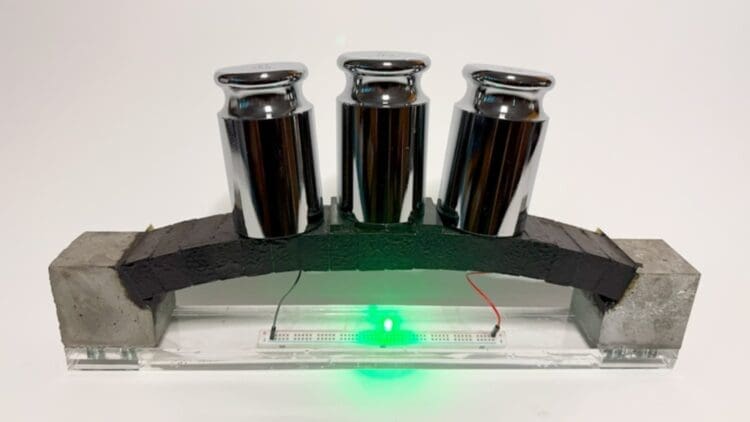
Instead of relying on invasive mining methods, MIT researchers opted for a mixture of cement, water, and carbon black.
The last ingredient is a soot-like substance that has been used since before the Middle Ages.
With this concrete recipe, water and cement react and form complex, branching microscopic tunnels. Carbon black partially fills the gaps, creating interconnected “wires” throughout the concrete.
The result is a supercapacitor that can store and release high amounts of energy.
Structural power with a tenfold leap
The MIT team has recently improved the concrete battery by increasing its energy density tenfold.
This was achieved by optimizing “tortuosity,” or the pathway the carbon uses in the cement.
Now, this battery is powerful enough to support real-world infrastructure.
The most ambitious application is electrifying the actual highways.
Embedding these supercapacitors into the road surface will enable wireless charging of EVs as they drive.
The electric revolution can finally be decoupled from the environmental toll of rare-earth mining by turning roadways into energy reservoirs.
Carbon-heavy regions could thus become part of the solution by being transformed into “active participants.”
The next step is guaranteeing that these concrete batteries are as durable as they are powerful. Once the researchers have confirmed its long lifecycle, electrification could finally pave the way toward a sustainable, wireless future.