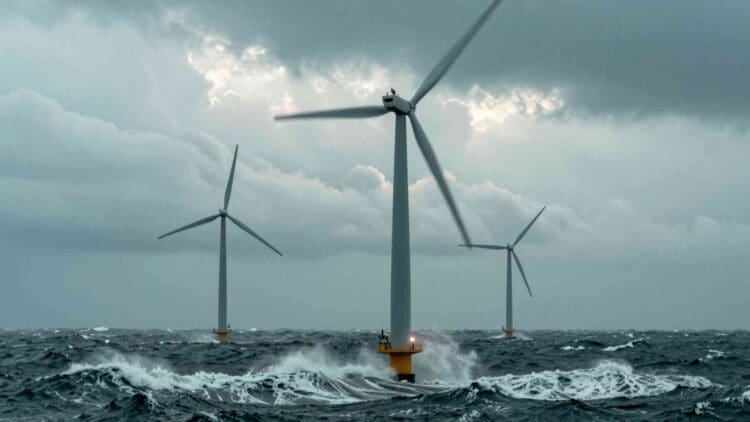

Offshore wind turbines endure brutal conditions.
Salt air corrodes metal fast. Waves shake heavy structures relentlessly. Storms can strand repair crews for weeks.
Deep inside each turbine sits high-voltage switchgear. This gear must open and close with split-second precision, regardless of what the ocean throws its way. A single failure can shut down an entire turbine for months.

As offshore wind capacity expands globally, this pressure point sharpens.
Grids demand absolute reliability.
A new study proposes a one-coil permanent magnet actuator design. This hardware shift could make critical switching equipment vastly more reliable. However, getting there requires demanding engineering tradeoffs.
A subtle mechanical adjustment might hold the key to the industry’s future.
The switching problem at the heart of offshore wind
Offshore wind farms do more than generate power. They manage it through a complex high-voltage network.
Switchgear sits at the center of this web, routing electricity safely. When it fails, consequences ripple outward fast.
Marine environments are incredibly hostile. Salt air accelerates corrosion, humidity degrades insulation, and waves strain every component.
Traditional gas-insulated switchgear raises major environmental concerns. Therefore, engineers are turning to sustainable dry air insulation technology.
This shift introduces new challenges.
Dry air systems depend heavily on ultra-reliable mechanical actuators. They must open circuits at the exact right microsecond.
A hesitating actuator can cause a massive cascading blackout. Repairs at sea take days, costing millions.
The industry desperately needs a smarter mechanical solution.
What is a permanent magnet actuator — and why does it matter?
A permanent magnet actuator (PMA) is a clever device.
It combines two distinct forces. It pairs the fixed magnetic field of permanent magnets with the controllable field of an electromagnet.
Their interaction drives a moving component called the mover. This mover travels through its switching stroke with incredible speed and force.
The advantage over conventional spring-loaded mechanisms is clear.
Springs wear out and snap under stress. PMAs have far fewer moving parts. Fewer parts mean fewer failure points, longer service life, and lower maintenance needs.
In remote marine installations, routine access is dangerous and expensive. A small boost in hardware reliability changes everything.
Researchers have studied PMAs since the late 1990s. However, optimizing them for harsh offshore wind applications is a fresh challenge.
A one-coil design strategy backed by math and simulation
The research team proposed a simplified architecture. They designed a one-coil PMA, cutting the traditional two-coil layout in half.
Reducing the coil count lowers complexity. It eliminates failure points and slashes manufacturing costs.
To make this work without losing performance, the team used advanced numerical and analytical methods.
Finite element analysis allowed detailed modeling of magnetic fields.
Analytical approaches helped derive clean design guidelines. Engineers can apply these formulas without running full computer simulations every time.
The performance targets were incredibly strict.
The mover required precise speeds during opening and closing strokes. It also needed strong holding force at both stable positions.
This mathematical framework creates a highly adaptable design guideline for various voltage classes.
From simulation to prototype: Testing the concept in the real world
Computer models can only go so far. Real hardware must meet real physics.
The team built a physical prototype based on their framework. They subjected it to rigorous driving and speed tests to verify their math.
The results were a total success.
The physical prototype met all required switching speed and holding force benchmarks. This closed the gap between a promising theory and a manufacturable product.
The project succeeded due to a methodical team effort.
Hyoung-Kyu Yang conducted the speed tests. Jin-Seok Kim led data collection and analysis. Jin-Hong Kim developed the conceptual framework.
Their collaboration proved that a simple component upgrade can solve a massive engineering headache.
What this means for the future of offshore wind infrastructure
Scaling clean energy requires more than just building bigger turbines. Hidden components must evolve too. Switchgear actuators rarely make headlines, but they must be reliable and easy to mass-produce.
The one-coil PMA strategy delivers on all counts.
A simpler design is easier to build consistently. Fewer components mean less maintenance in hazardous marine environments.
This matters as wind farms push further into deeper waters.
South Korea’s Korea Institute of Energy Technology Evaluation and Planning (KETEP) funded this research under the Ministry of Trade, Industry and Energy.
This signals national-level recognition. Governments know that green infrastructure depends on solving component-level problems.
Future work will explore smart grid integration and higher voltage classes.
This framework could become the gold standard for durable ocean switchgear. It will keep the power flowing long after storms roll in.
Success hinges on our ability to fortify these systems. What innovations are next on the horizon?
If you want to learn more about these findings, you can check the full study: Kim, JS., Yang, HK. & Kim, JH. Novel Design Strategies of One Coil Type Permanent Magnet Actuator for Offshore Wind Power System. J. Electr. Eng. Technol. (2026). https://doi.org/10.1007/s42835-026-02827-4
Kelly is an experienced writer with 15 years of experience exploring the big stories that shape our world, from tech breakthroughs and space exploration to climate, energy, and the fascinating quirks of science. She has a talent for turning complex ideas into sharp, memorable insights that stay with readers long after they’ve finished reading.