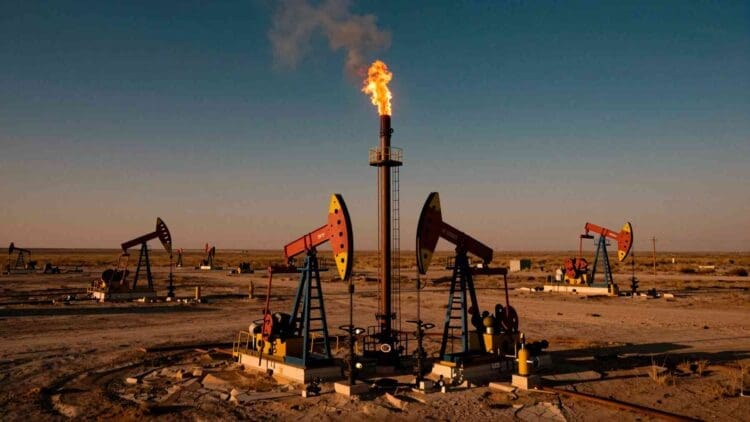

Natural gas output from the Permian region jumped 60% between 2021 and 2025, rising from 17.2 billion cubic feet per day to 27.6 Bcf/d, according to the U.S. Energy Information Administration. That growth rate far outpaced the region’s crude oil production, which expanded 39% over the same period — from 4.7 million barrels per day to 6.6 million b/d. The divergence points to a shift unfolding beneath the surface of America’s most productive oil basin.
Permian natural gas output surges to 27.6 Bcf/d by 2025
The figures come directly from the EIA’s latest Short-Term Energy Outlook. Marketed natural gas production in the Permian climbed from 17.2 Bcf/d in 2021 to 27.6 Bcf/d in 2025 — a 60% increase over four years. Crude oil production also grew, but at a slower pace, rising 39% from 4.7 million b/d to 6.6 million b/d.
That gap between the two growth rates is the real story. Both commodities come from the same wells, drilled by the same operators, in the same basin—yet natural gas is pulling ahead. Understanding why means looking at what happens underground as a reservoir ages.


Rising gas-oil ratios drive the faster growth in natural gas
The key variable is the gas-oil ratio, or GOR—the volume of natural gas produced alongside each barrel of oil. In 2025, the Permian’s GOR averaged nearly 4,200 cubic feet of gas per barrel of oil, a 16% increase from the 2021 average of 3,628 cf/b.
The physics are straightforward. As operators extract more hydrocarbons from a reservoir, pressure inside that reservoir falls. At lower pressures, natural gas flows more freely than oil, so each barrel brought to the surface carries more gas with it as the Permian matures.
This is not a sudden development. The EIA notes that the Permian’s GOR has risen steadily over the past five years—that consistent upward trend, not any single event or policy change, is the primary reason natural gas production has outpaced crude oil growth across the basin.
Higher GOR added an extra 3.8 Bcf/d of gas in 2025
The EIA offers a useful way to quantify the GOR’s impact. Had the ratio held flat at its 2021 level of 3,628 cf/b, Permian natural gas production in 2025 would have reached only 23.8 Bcf/d. Actual output was 27.6 Bcf/d.
That 3.8 Bcf/d difference is directly attributable to the higher GOR—gas that simply would not have been produced had reservoir conditions remained as they were four years ago. Put another way, it accounts for 14% of the Permian’s actual 2025 gas output, illustrating how reservoir maturation, an often-overlooked geological process, can produce measurable and material effects on regional energy supply.
EIA expects natural gas growth rate to continue exceeding oil as basin matures
The Permian is not done maturing. Reservoir pressure will keep declining as operators continue extracting hydrocarbons, and the EIA expects the GOR to keep rising as a result. The gap between natural gas growth and crude oil growth is likely to widen, not close.
For producers, midstream companies, and grid operators, that trajectory carries real consequences. Rising gas output puts pressure on pipeline takeaway capacity out of the basin and increases demand for gas processing infrastructure, since associated gas must be separated and treated before it enters the market. Because the Permian is a major source of U.S. natural gas supply, sustained growth there shapes pricing and availability in markets well beyond West Texas.
A rising gas-oil ratio
The core finding is clear: Permian natural gas production grew 60% between 2021 and 2025, outpacing crude oil growth of 39% over the same period. The driver is a rising gas-oil ratio, up 16% from 2021 to 2025 as reservoir pressure declined with continued production.
The EIA estimates that the higher GOR alone added 3.8 Bcf/d of gas output in 2025—a volume that would not have existed had the ratio held steady. Both the GOR and the natural gas production growth rate are expected to keep climbing as the basin continues to mature.
Kelly is an experienced writer with 15 years of experience exploring the big stories that shape our world, from tech breakthroughs and space exploration to climate, energy, and the fascinating quirks of science. She has a talent for turning complex ideas into sharp, memorable insights that stay with readers long after they’ve finished reading.