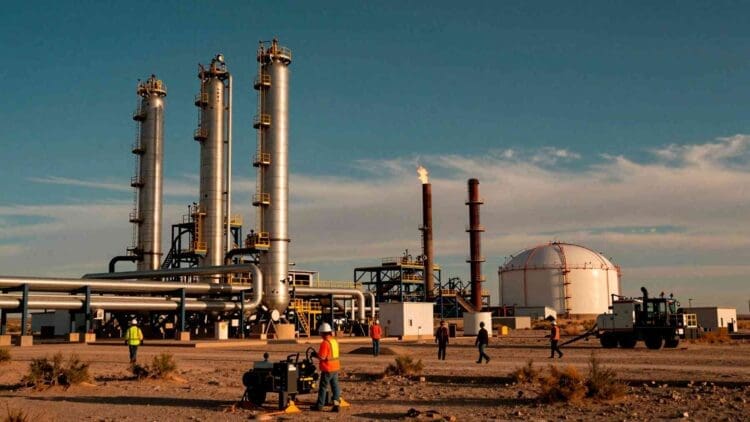

Phillips 66 is adding significant capacity to its Permian Basin midstream footprint with the Iron Mesa cryogenic gas processing plant, now under construction in Ector County, Texas. Designed to handle 300 MMcfd, the new facility is being built directly adjacent to the company’s existing 160-MMcfd plant in the same county.
Phillips 66 breaks ground on Iron Mesa gas plant in Ector County
Iron Mesa ranks among the more consequential capacity additions in the Permian Basin’s midstream sector in recent years. Phillips 66 is building the new cryogenic facility directly next to its existing 160-MMcfd gas processing plant in Ector County—a deliberate siting decision that lets the company draw on shared infrastructure and operational resources already established there.
At 300 MMcfd of nameplate capacity, Iron Mesa is nearly double the size of its neighbor. That scale signals a bet on sustained, long-term demand for processing services in the region—not a reaction to current production levels alone. The project extends Phillips 66’s physical presence in the Permian at a moment when midstream operators across the basin are under real pressure to keep pace with upstream output.


Why Phillips 66 is expanding Permian gas processing capacity
Natural gas production in the Permian Basin has climbed steadily alongside oil output, pushing demand for midstream infrastructure capable of handling large, rich gas volumes. Cryogenic processing technology fits this environment well. Gas streams common in the Permian tend to carry high concentrations of natural gas liquids alongside methane, and cryogenic systems handle that composition efficiently.
Phillips 66’s existing 160-MMcfd plant in Ector County was itself an expression of earlier confidence in the region. Iron Mesa is the next step—a scaling-up of that original commitment.
Upstream drilling activity has consistently outpaced the infrastructure needed to handle associated gas production across the Permian. For companies like Phillips 66, that gap is both a commercial opportunity and an operational responsibility to producers who depend on reliable takeaway. Midstream operators have been moving quickly to close it.
What the Iron Mesa plant means for Permian midstream operations
Once Iron Mesa comes online, combined processing capacity at the Ector County site will reach approximately 460 MMcfd—a substantial concentration of infrastructure in a single location that positions Phillips 66 as a significant processing hub in this part of the basin.
More available processing capacity directly reduces the risk of gas flaring. When producers cannot move associated gas to a processing facility, flaring may be the only option—costly and environmentally problematic. Additional takeaway capacity helps upstream operators avoid that outcome and maintain uninterrupted production.
Cryogenic plants like Iron Mesa are also central to NGL extraction. Liquid recovery is often a primary revenue driver in gas processing, and cryogenic technology is among the most effective methods for capturing those components before residue gas moves on to pipeline delivery. For Phillips 66, the plant strengthens its competitive standing among Permian midstream providers competing to secure producer commitments in one of the most active drilling regions in the country.
Phillips 66’s midstream strategy and Permian Basin context
The Permian Basin, spanning West Texas and southeastern New Mexico, is the most prolific oil- and gas-producing region in the United States. Its output has reshaped domestic energy supply over the past decade, and the infrastructure supporting that production has had to expand rapidly—often struggling to keep pace.
Midstream processing capacity has historically lagged behind upstream growth in the Permian, producing recurring bottlenecks where producers periodically cannot move all of their associated gas to market. New plants like Iron Mesa are part of the ongoing effort to close that gap.
Phillips 66 operates a broad midstream network across the US, including pipelines, fractionation facilities, and processing plants. Iron Mesa fits within that larger strategy of maintaining integrated infrastructure connecting production to downstream markets. It is not a standalone bet—it is an extension of an already established position in the basin.
Cryogenic gas processing works by cooling the gas stream to very low temperatures, causing heavier hydrocarbons—ethane, propane, butane, and others—to condense out and separate from the methane. Those NGLs then move to fractionation facilities, while the processed gas continues into pipeline systems for delivery. At 300 MMcfd, Iron Mesa will handle a substantial share of that work for Permian producers operating in and around Ector County.
Kelly is an experienced writer with 15 years of experience exploring the big stories that shape our world, from tech breakthroughs and space exploration to climate, energy, and the fascinating quirks of science. She has a talent for turning complex ideas into sharp, memorable insights that stay with readers long after they’ve finished reading.