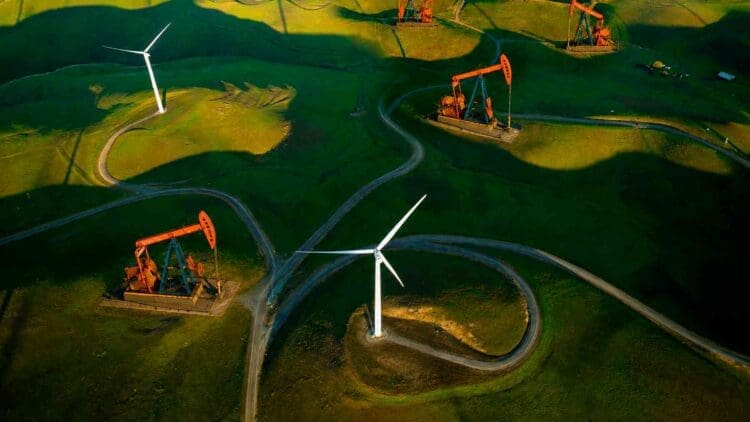

Fossil fuel infrastructure projects are taking over wind leases in the United States.
Global energy consumption is rising rapidly, leaving several power grids under immense pressure.
In Europe and Asia, major coastal grids are supported by the expanding offshore wind capacity.




America, however, is taking a drastically less green path to secure its grids.
Why is the federal government actively dismantling U.S. renewable energy projects, and who is fighting back?
How global energy consumption is surging
Modern economies are continuously evolving smart technologies to streamline operations.
Additionally, complete electrification is being pushed worldwide to lower carbon footprints.
These all form part of the Age of Electricity.
In this era, the world’s power demand is surging rapidly.
In 2025, consumption increased by 3%.
The International Energy Agency projects that the annual growth rate will be 3.6% through 2030.
Consequently, clean energy additions are struggling to keep pace with electricity demand.
Industrial electrification and electric vehicles require massive new power loads.
However, generative AI and data centers are the primary contributors to the energy demand spike.
In the U.S., data centers accounted for 50% of all electricity demand growth in 2025.
The current grid infrastructure was not originally designed to handle this rising pressure.
To close this energy gap and maintain a low carbon footprint, nations are turning to the ocean.
All except for the U.S.
The great American wind reversal
Offshore wind is viewed as a critical solution worldwide.
For many nations, massive turbines are ideal to provide secure, domestic power.
Local economies are protected from volatile international fossil fuel markets.
Its high scalability ensures that substantial amounts of clean electricity can be supplied to major coastal centers.
In 2025, developers added more than 9 GW of new offshore capacity globally.
Annual installations are projected to double in 2026, especially as Europe and Asia expand coastal grids.
For these nations, massive offshore wind farms are critical national security infrastructure.
This is why the world is building coastal wind faster than ever to meet modern energy demands.
However, the opposite is true in the United States.
A statement from the U.S. Department of the Interior confirms that the nation’s offshore wind industry is being dismantled.
It further adds that the U.S. has decided to invest in more “dependable, secure energy infrastructure.”
America has embraced a billion-dollar pivot
The U.S. has a new policy that comes with a massive price tag.
The Department of the Interior is paying Invenergy $765 million to cancel four active offshore leases.
The canceled projects spanned the coasts of California, Maine, and New York.
They represented a combined 4.8 GW of potential clean power.
Federal funds must now be redirected to natural gas plants across five Midwestern states. It will also support geothermal energy projects in the West.
So far, the administration has bought out eight offshore wind leases.
Total payouts have surpassed $2.5 billion.
However, not everyone is supportive of public money funding inland fossil fuels.
Seven states are fighting back
Natural gas plants in the Midwest will not solve coastal energy shortages.
Many coastal states depended on offshore wind farms to power future grids.
Now, seven states are suing the administration over the buyouts:
- New York
- New Jersey
- Massachusetts
- Connecticut
- Maine
- Rhode Island
- Vermont
They argue that the government is illegally misusing public funds reserved for legitimate legal disputes.
Federal courts have been asked to step in.
The dismantling of offshore wind projects in favor of fossil fuels is unsupportive of global green energy trends.
The U.S. power grid’s future now hangs in a precarious legal balance.
Data centers and AI will continue to evolve and drive up electricity demand.
The move to block offshore wind capacity is therefore highly controversial. The fate of American energy security now lies in the hands of the federal court.
Anke Maree is a writer with a clear and engaging editorial style. Her work focuses on making complex topics accessible, informative, and relevant for readers across different areas of interest.