
Texas A&M researchers found a way to predict submarine landslides that have long threatened billions of dollars in offshore energy infrastructure
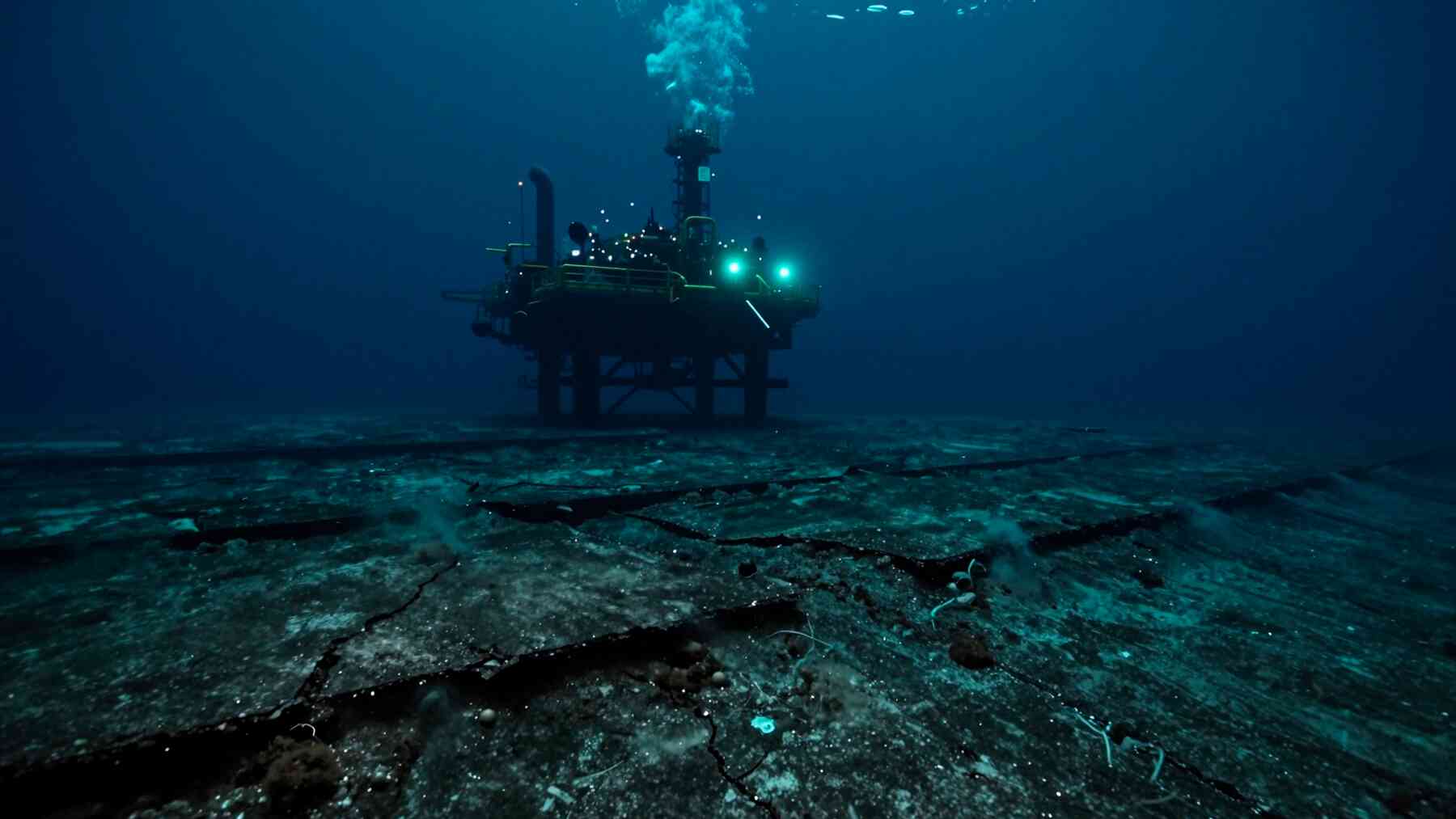 AI-made
Beneath every offshore oil rig and wind farm lies a sprawling network of pipelines, anchors, cables, and risers — infrastructure worth billions, built on seabeds that are extraordinarily difficult to study. For decades, one threat has shadowed all of it: submarine landslides capable of wiping out entire subsea systems in minutes.
Yet the industry has long lacked a reliable way to see them coming. Now, researchers at Texas A&M may have found one.
The invisible danger beneath offshore energy projects
Offshore energy installations rest on some of the least stable ground on Earth. Subsea pipelines, anchors, cables, and risers stretch across seabeds that shift, compress, and occasionally give way without warning. When a submarine landslide occurs, it can sever pipelines, snap cables, and destroy anchoring systems across wide areas in minutes.
That combination of invisibility and destructive potential makes submarine landslides one of the most financially consequential geohazards the industry faces.
Unlike terrestrial landslides, underwater slides are nearly impossible to observe directly. They occur in deep, high-pressure environments where sensors are sparse, and access is expensive. Warning signs tend to be subtle, buried in layers of seafloor data that require multiple disciplines to interpret. That combination of invisibility and destructive potential makes submarine landslides one of the most financially consequential geohazards the industry faces.
A single geohazard event can halt production, trigger costly emergency repairs, and generate liability exposure that ripples through entire supply chains.
What site characterization actually involves
Before any offshore project breaks seabed, a dedicated team spends considerable time mapping what lies beneath the water. This process, called site characterization, covers the seabed surface, the sub-seabed layers beneath it, and the broader environmental conditions that influence how those layers behave over time.
The work draws on a range of specialists: geophysicists scanning the seafloor with acoustic and seismic tools, geologists interpreting the sediment record, geomatic technologists handling spatial data, and geotechnical engineers assessing how the ground will respond to load and stress. Together, their findings form the foundation for any hazard risk model.
This is standard practice across the industry. But as Texas A&M researchers have found, doing the work is not the same as doing it correctly — and that distinction carries more weight than most professionals have recognized.
Why sequence matters more than most people realize
The central finding from the Texas A&M research is not that site characterization matters. That much is already understood. The finding is that the order in which specialists collect and hand off data is critical to the accuracy of any resulting landslide model.
Associate professor Zenon Medina-Cetina frames the principle with a direct analogy: teaching a baby to walk while simultaneously teaching it to run makes the whole process harder and less effective. “A systematic sequence on the use of evidence ensures that the landslide models are better calibrated by learning from the data as they are being produced,” he said.
The correct sequence begins with the geophysicist, moves to the geologist, then brings in the geomatic group working alongside geotechnical engineers. When budget pressures or tight timelines lead companies to compress or reorder those steps, the result is greater uncertainty in the final predictions — and a measurable financial cost.
How Bayesian statistics sharpens the prediction
The methodological core of the research is a probabilistic framework called Bayesian model calibration. It allows a model to update its predictions as new data arrive, combining prior knowledge with incoming evidence to produce increasingly refined probability estimates.
Applied to submarine landslides, this approach maximizes the information extracted from site investigation data collected in the proper sequence. The result is a model that can predict the likelihood of a landslide at a specific location and time with greater accuracy than previous methods allowed. For companies funding offshore projects, that improved confidence supports better design decisions, stronger safety cases, and infrastructure more likely to stay in place over the long term.
What this means for the future of offshore energy
The implications extend well beyond any single project. Offshore wind energy is expanding rapidly, and its long-term viability depends on subsea infrastructure that can survive the environments it operates in. Oil and gas operations face the same geohazard risks. Both sectors stand to benefit from a more rigorous, standardized approach to landslide prediction.
The foundational research was conducted by Medina-Cetina alongside Patricia Varela (now with Geosyntec Consultants) and Billy Hernawan, a civil and environmental engineering student at Texas A&M. Funding came from the Research Partnership to Secure Energy for America and PLENUM Soft. The findings were published in the journal Landslides.
Whether the methodology moves from academic publication into standard industry practice remains to be seen. If it does, the Bayesian sequencing framework developed at Texas A&M could become a routine part of how the offshore energy sector evaluates risk — before the first cable is laid and long before the seafloor has any chance to move.
Kelly is an experienced writer with 15 years of experience exploring the big stories that shape our world, from tech breakthroughs and space exploration to climate, energy, and the fascinating quirks of science. She has a talent for turning complex ideas into sharp, memorable insights that stay with readers long after they’ve finished reading.
