
Solar panels are now buried beneath live Swiss train tracks, and every passing train is either proving the idea works or slowly destroying it
 Representative image
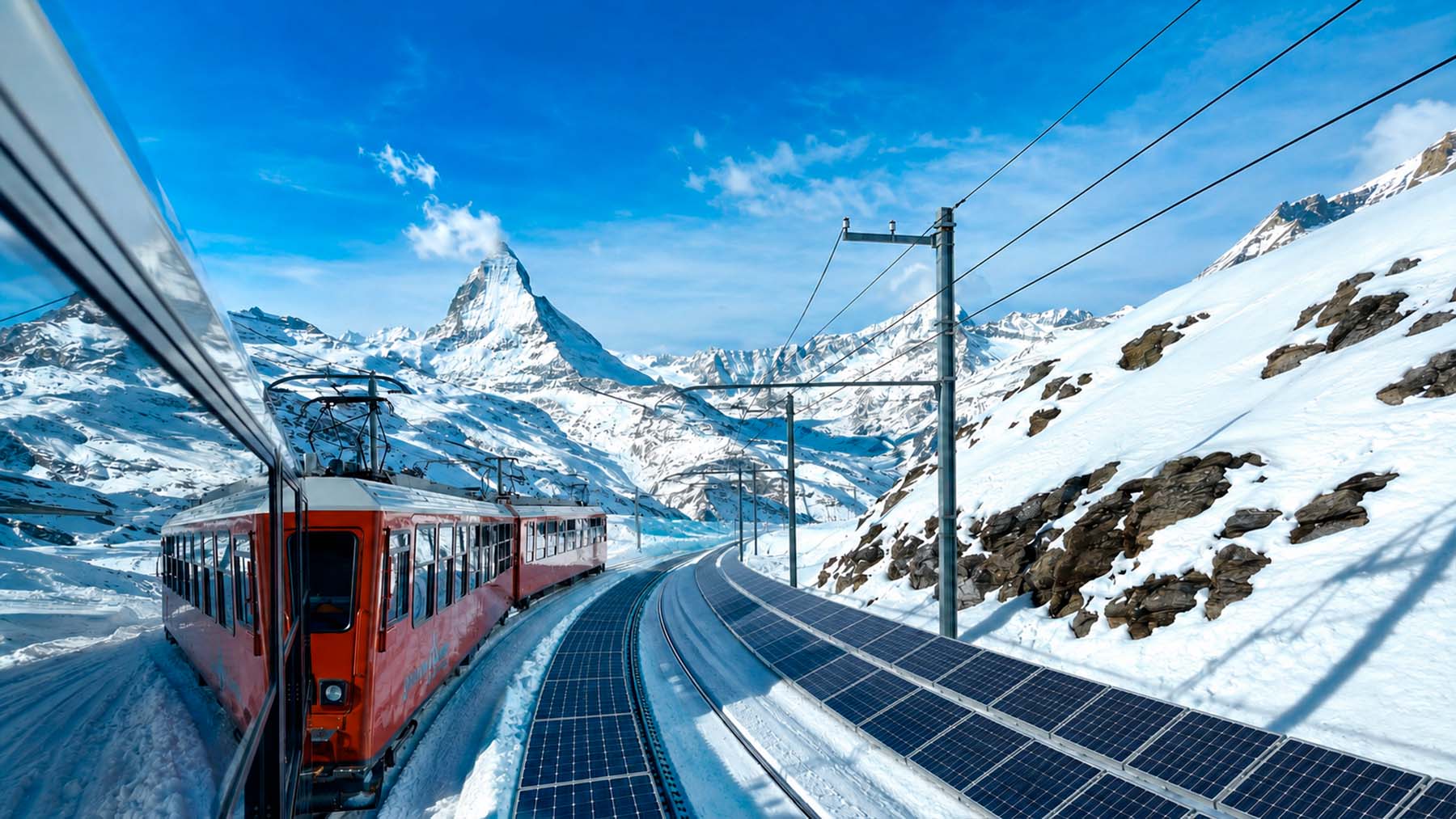
In the quiet Swiss village of Buttes, 48 solar panels now sit between the rails of an active train line, low enough for rolling stock to pass directly over them. The 328-foot stretch, which became operational in late April 2025, marks the first time such a system has been tested on a working railway—not a closed track, not a simulation, but a live line with trains running overhead every day.
The installation is small. But the question it’s designed to answer is not, “Can one of the world’s most overlooked surfaces become a meaningful source of clean power?”
A solar farm hidden beneath the rails
Sun-Ways, a Swiss start-up, developed a system of 2.2-foot-wide photovoltaic panels designed to sit flat in the space between railway tracks—low enough for trains to pass directly overhead. A specialized installation machine, built in partnership with Swiss track maintenance firm Scheuchzer, lays the panels using a piston system. Scheuchzer says the machine could eventually cover up to 3,280 square feet per day.
One proposed cleaning solution is unconventional—brushes attached to passing trains that sweep dust and metal debris from the panels as rolling stock moves overhead.
The pilot on Line 221, operated by regional rail company TransN near Buttes in the canton of Neuchâtel, was initially scheduled to become operational on April 24, 2025, before facing subsequent regulatory and technical delays that pushed its live launch to later in the year. It features 48 panels producing 18 kW of capacity—enough to generate roughly 16,000 kilowatt-hours per year, or about what a few European households consume annually.
Removability is central to the design. Railway infrastructure requires regular inspection and repair, so any fixed installation between the tracks would be a non-starter. Sun-Ways engineered the panels to be detached for maintenance and reinstalled afterward—a practical necessity that also shaped the regulatory conversation.
Why regulators initially said no and what changed
Switzerland’s Federal Office of Transport rejected the project in 2023, citing concerns about railway safety and maintenance. Sun-Ways responded by building prototypes, commissioning an independent scientific study, and working with Geste Engineering on a dedicated safety analysis. The path from rejection to approval was not quick.
The International Union of Railways had raised specific concerns: micro-cracks from vibration, increased fire risk, and glare that could distract train drivers. Sun-Ways addressed each with tougher panel materials, anti-glare coatings, and built-in sensors to monitor panel conditions in real time.
One proposed cleaning solution is unconventional—brushes attached to passing trains that sweep dust and metal debris from the panels as rolling stock moves overhead. Whether that concept works as intended is one of the things the pilot will determine.
What the three-year test is actually measuring
The pilot runs through April 2028. During that period, Sun-Ways will study vibration tolerance, dust and metal particle accumulation, glare effects, compatibility with signaling systems, and overall energy output. The railway environment—repeated pressure waves, ballast movement, and flat panel orientation—makes real-world data essential before any scale-up is considered.
International attention is already formalized. SNCF’s innovation department and SNCF Réseau, France’s railway infrastructure manager, have signed a collaboration agreement with Sun-Ways and will monitor results, including how the panels affect maintenance schedules and infrastructure availability. If the Swiss pilot succeeds, France may move toward adoption, and the data collected in Buttes will directly inform that decision.
Where the electricity could go—and how far the ambition reaches
For now, the pilot’s electricity feeds the local grid. Sun-Ways has outlined longer-term pathways: powering railway switches, signals, and stations through the rail operator’s low-voltage network; feeding electricity into the nearest distribution network; or reinjecting current directly into the traction energy system that powers trains.
CEO Joseph Scuderi has named that last option as the ultimate goal. “Our ambition is to produce energy between the rails and re-inject it into the traction current of the trains so that it is practically 100% self-propelled,” he said. That remains a distant target given how much power trains consume, but the scale of rail networks makes the math worth running.
Sun-Ways estimates that equipping Switzerland’s roughly 3,100 miles of railway could yield approximately one terawatt-hour per year—about 2% of national electricity consumption. Co-founder Baptiste Danichert has suggested that 50% of the world’s 620,000 miles of railways could eventually be equipped—a figure best understood as an expression of ambition rather than a near-term projection.
Solar’s land problem—and why railways offer a different answer
Switzerland’s 2023 referendum rejecting Alpine mountainside solar installations illustrated a tension that extends well beyond its borders. As solar expands, competition for suitable land intensifies—pitting panels against farmland, wildlife habitat, and landscapes communities want to protect.
Railway solar fits into a growing category of dual-use installations that sidestep this conflict. Developers have experimented with solar over canals, reservoirs, parking lots, and agricultural fields. As analyst Lubomila Jordanova noted on LinkedIn, the approach “capitalizes on existing infrastructure, eliminating the need for acquiring additional land for solar farms.” Fewer land conflicts means fewer political obstacles and faster potential deployment.
What to watch for next
The Buttes installation will spend the next three years answering a deceptively simple question: can solar panels survive the railway environment? Vibration, grime, pressure, and weather will test every design choice Sun-Ways has made.
If the panels hold up, the implications extend well beyond Switzerland. Rail corridors run through cities, farmland, and forests across every inhabited continent—infrastructure already built, already maintained, and largely ignored as an energy surface. A positive result in Neuchâtel could accelerate adoption discussions in France and prompt other national rail operators to examine their own networks.
The Buttes pilot is small enough to fail quietly. But if it succeeds, the strip of gravel between two rails may turn out to be one of the more consequential pieces of clean energy infrastructure initiated in 2025.
Kelly is an experienced writer with 15 years of experience exploring the big stories that shape our world, from tech breakthroughs and space exploration to climate, energy, and the fascinating quirks of science. She has a talent for turning complex ideas into sharp, memorable insights that stay with readers long after they’ve finished reading.
