
Singapore scientists found a way to turn raw sewage into clean fuel and food using nothing but sunlight
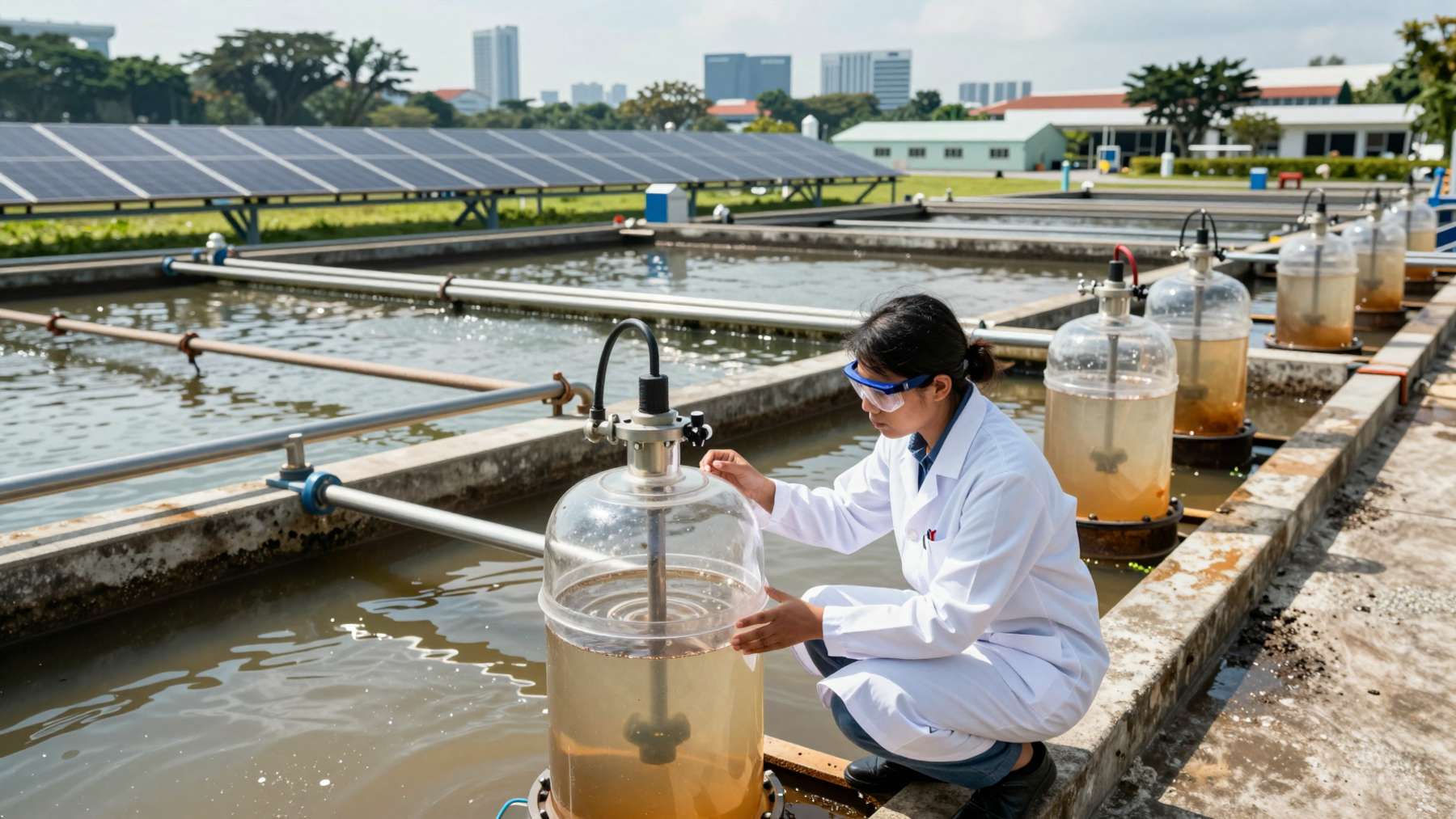 AI-made
Every day, cities around the world flush away a problem they can barely manage: sewage sludge. More than 100 million tonnes of it accumulate globally each year, a figure that grows as urbanization accelerates. Burning it pollutes the air; burying it contaminates the ground.
Now, researchers at Nanyang Technological University in Singapore say they have found a way to feed that waste directly into a sunlight-driven process — and the outputs are worth paying attention to.
A waste problem cities can no longer ignore
Sewage sludge is not a niche environmental concern. According to UN-Habitat, more than 100 million tonnes are generated globally every year — and that number keeps climbing. The United Nations projects that roughly 2.5 billion more people will live in cities by 2050, meaning sludge volumes will grow in lockstep with urban populations.
A chemical treatment step then separates heavy metal contaminants from the organic materials — primarily proteins and carbohydrates — that remain in the mixture.
The disposal options cities rely on today are far from ideal. Incineration is energy-intensive and releases pollutants into the atmosphere, while landfill consumes land and risks contaminating soil and groundwater. Neither approach recovers anything useful from the waste.
What makes sludge especially difficult to handle is its composition — a complex mix of organic materials, pathogens, and heavy metals that resists simple treatment and limits what can safely be done with it downstream.
Three steps from sewage to clean energy and food
The NTU process works in three sequential stages, each addressing a different layer of the problem.
First, the sludge is mechanically broken down to disrupt its structure. A chemical treatment step then separates heavy metal contaminants from the organic materials — primarily proteins and carbohydrates — that remain in the mixture. These two steps set up everything that follows.
That is where sunlight enters the picture. A solar-powered electrochemical process, using specialized electrodes, converts those organic materials into acetic acid and hydrogen gas. Acetic acid has applications in food and pharmaceutical manufacturing; hydrogen is a clean-burning fuel. After this stage, light-activated bacteria are introduced to the processed liquid — they consume the available nutrients and convert them into single-cell protein suitable for animal feed.
Numbers that set it apart from conventional methods
The performance figures the NTU team reported are what distinguish this approach from existing methods. Lab tests showed the process recovers 91.4% of the organic carbon present in sewage sludge. Traditional anaerobic digestion — the most widely used biological treatment method — typically recovers around 50%.
Of that recovered carbon, 63% is converted into single-cell protein, with no harmful by-products reported. The solar-powered electrochemical stage generates up to 13 litres of hydrogen per hour using sunlight, at roughly 10% energy efficiency — approximately 10% more efficient than conventional hydrogen generation methods.
The environmental footprint reduction is substantial: compared to traditional treatment approaches, the NTU process reduces carbon emissions by 99.5% and cuts energy use by 99.3%. Those are not marginal improvements.
Eliminating the toxic legacy of heavy metals
Heavy metals represent one of the most persistent barriers to doing anything useful with sewage sludge. Without proper removal, they contaminate whatever comes out of the treatment process — making outputs unsafe for land application, animal feed, or any other productive use.
In the NTU process, the chemical treatment phase completely removes heavy metal contaminants before the organic materials move on to the electrochemical stage. This is not a partial reduction. According to the researchers, full removal is achieved.
That matters considerably. Without it, the hydrogen and protein outputs could not be considered genuinely clean or safe — the heavy metal removal step is what makes the downstream products viable, not just as laboratory outputs, but as potential real-world resources.
Promising results — but scaling up is the real test
The NTU researchers are careful not to overstate where things stand. The process has demonstrated strong results at the proof-of-concept stage, but the team acknowledges that more studies are needed before industrial-scale deployment becomes realistic.
Two challenges stand out. The electrochemical processing required to fully break down organic materials and extract all heavy metals carries significant costs — costs that may look very different at scale than they do in a lab. On top of that, designing an integrated system that fits within an existing wastewater treatment facility adds another layer of engineering complexity entirely.
The study was published in Nature Water, and the researchers frame the method explicitly as a circular-economy model — one that repositions sewage sludge from a disposal problem into a source of usable resources. Whether that framing translates into deployed infrastructure will depend on what the next round of studies reveals about feasibility at scale. That is the work still ahead.

Carlos is an engineer with strong expertise in technical and industrial topics. He previously worked at international companies such as Siemens and is multilingual.
