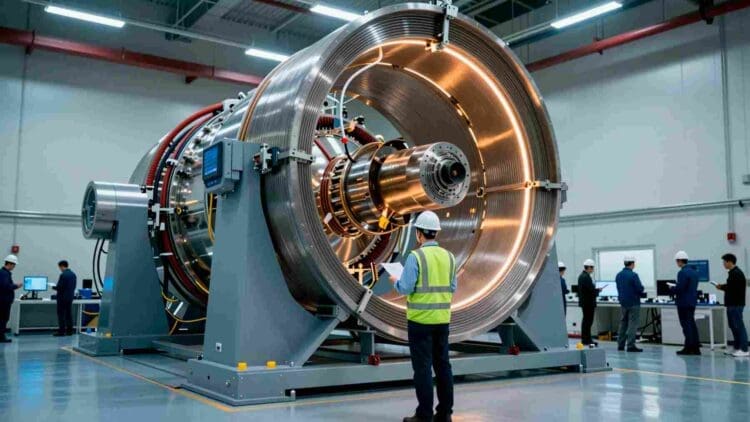

On June 9, 2026, Tennessee became the first U.S. state to put its own regulatory framework for nuclear fusion machines into effect. The rules — an 11-page amendment to state regulations filed in March — are administered by the Tennessee Department of Environment & Conservation and cover licensing, personnel requirements, and safety provisions for fusion facilities.
The timing is no coincidence. Type One Energy has proposed building its Infinity Two fusion plant near Oak Ridge, and Tennessee needed a framework in place before that project could move forward.
Tennessee’s fusion rules take effect
June 9 marked a quiet but significant date in U.S. energy regulation. Tennessee’s new rules for nuclear fusion machines became effective, making the state the first in the country to operate its own dedicated regulatory framework for this technology. Oversight now falls to the Tennessee Department of Environment & Conservation.



The framework is compact but substantive—an 11-page amendment to Tennessee’s Effective Rules and Regulations, filed in March 2026. It covers the registration and licensing of fusion machines, processes, and related activities, establishing the baseline conditions under which fusion facilities can legally operate in the state.
Why Tennessee had to act: the NRC’s 2023 decision
The origin of Tennessee’s rulemaking traces back to a federal decision. In 2023, the Nuclear Regulatory Commission chose to regulate fusion machines under its existing byproduct materials program, meaning fusion machines would not be classified alongside commercial fission reactors as utilization facilities.
That classification had a direct practical consequence. Regulatory responsibility shifted to NRC Agreement States, each of which would need to determine independently how to regulate fusion machines within its borders. Tennessee’s new rules fill the gap that federal decision created.
What the new rules require
The rules set clear expectations for anyone seeking to operate a fusion machine in Tennessee. Applicants must demonstrate that qualified personnel are on staff, along with a method to retrain and test those personnel at least once per year. Facilities, equipment, and operating procedures must also meet standards designed to protect public safety, health, and property.
Two structural requirements stand out. Applicants must appoint a radiological safety officer and establish a radiation safety committee to advise on safety concerns — embedding oversight into the organization’s structure rather than treating it as an afterthought. The rules further specify general safety provisions for facility design, addressing both the physical plant and the people running it.
Impact on Type One Energy’s Infinity Two plant near Oak Ridge
The practical stakes of this regulatory development center on one specific project. Type One Energy is developing Project Infinity at the former Bull Run site near Oak Ridge. This includes the Infinity One prototype and Infinity Two, a 400-MWe fusion pilot power plant proposed in partnership with the Tennessee Valley Authority, Oak Ridge National Laboratory, and the University of Tennessee.
According to a press release from the Tennessee Department of Environment & Conservation, Type One Energy’s commercial site is anticipated to be among the first licensees under the new framework. The site is also expected to serve as a fusion development campus through collaborative projects with those institutional partners. Under the new rules, construction could begin as early as 2028.
Industry reaction and the debate over standardization
At the 2026 Annual Conference of the American Nuclear Society, fusion regulation came up repeatedly. Alexander Valys, cofounder and president of fusion startup Xcimer Energy, described the NRC’s decision to delegate fusion licensing to Agreement States as a win for the industry—companies now have the freedom to weigh different states’ regulatory environments when deciding where to locate their pilot plants.
Valys also looked further ahead. As the industry scales toward deploying dozens of plants per year across the country, navigating up to 40 different state licensing regimes could become a meaningful burden. He described the eventual need for a more standardized national framework as a “champagne problem,” an optimistic framing that reflects confidence in where the industry is headed.
Looking forward to the start of construction in 2028
Tennessee’s fusion regulatory framework, effective June 9, 2026, is the first of its kind in the United States. It was prompted by the NRC’s 2023 decision to leave fusion machine regulation to Agreement States. The rules require qualified personnel, annual retraining, a radiological safety officer, a radiation safety committee, and compliance with facility safety standards. Type One Energy’s Infinity Two plant near Oak Ridge is expected to be among the first licensees, with construction potentially starting in 2028. The broader industry views state-level regulation as workable for now, though a national framework may eventually be needed.
Kelly is an experienced writer with 15 years of experience exploring the big stories that shape our world, from tech breakthroughs and space exploration to climate, energy, and the fascinating quirks of science. She has a talent for turning complex ideas into sharp, memorable insights that stay with readers long after they’ve finished reading.