
Thea Energy partners with Nvidia and Synopsys to build digital twin of Helios stellarator fusion plant
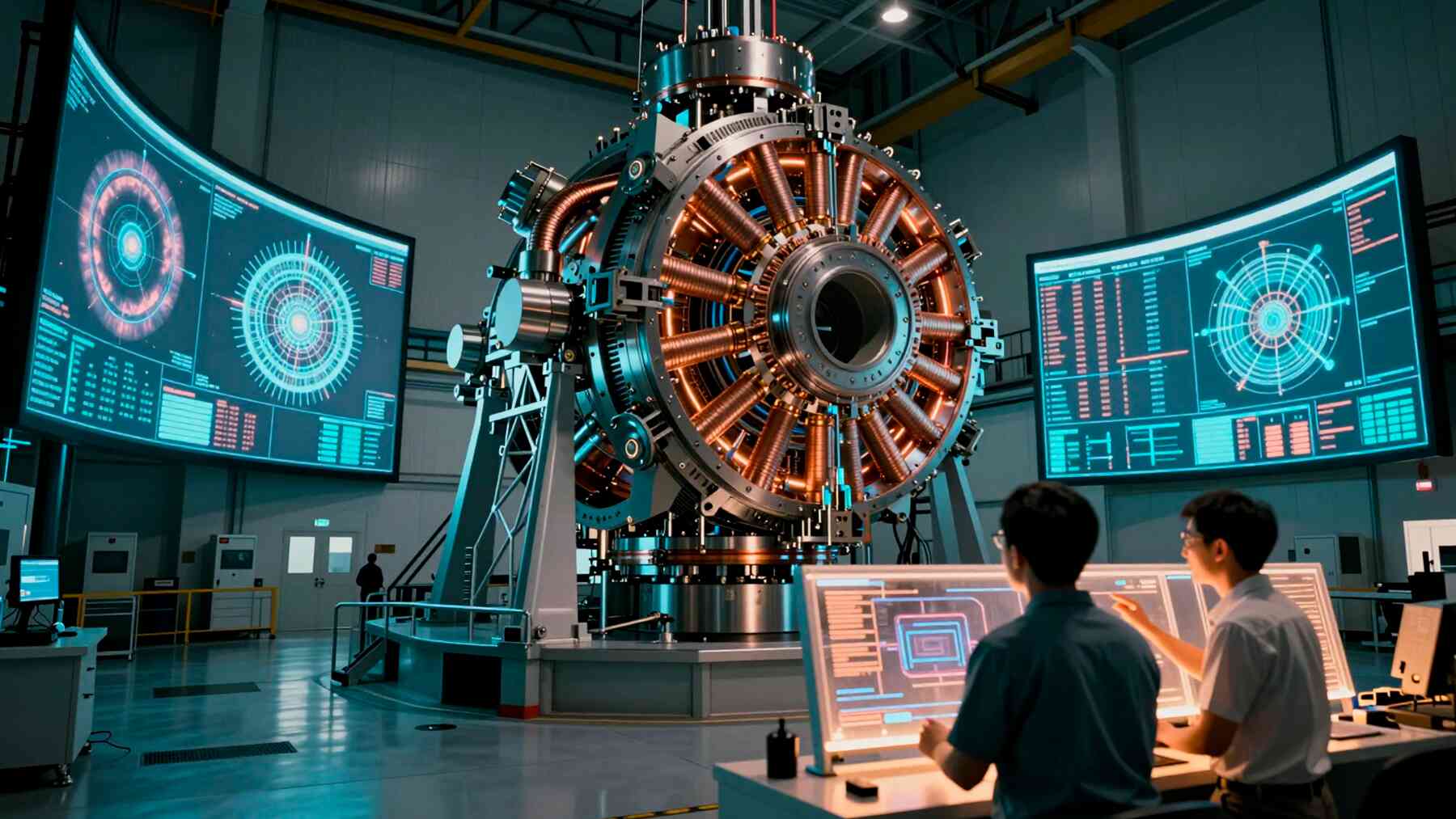 AI-made
Thea Energy has announced a collaboration with Nvidia, Synopsys, Argonne National Laboratory, and Princeton Plasma Physics Laboratory to build a digital twin of Helios, its stellarator fusion power plant concept.
Thea Energy announces multi-partner digital twin collaboration
The announcement came on June 17, 2026, when Thea Energy made the collaboration public. The partnership brings together two major technology companies—Nvidia and Synopsys—alongside two of the United States’ most prominent research institutions: Argonne National Laboratory and Princeton Plasma Physics Laboratory.
At the center of the project is Helios, Thea Energy’s stellarator fusion power plant concept. The goal: construct a detailed virtual replica that can be simulated, tested, and refined without ever building physical hardware.
The trade-off is engineering complexity: the external coil geometry required to produce the correct magnetic field is significantly harder to design and build.
Why a digital twin is needed for stellarator design
Stellarator fusion plants rank among the most geometrically complex machines ever conceived. Unlike simpler reactor designs, they rely on intricate three-dimensional magnetic field geometries to confine plasma — and traditional modeling tools frequently struggle to capture that complexity at the scale and speed required for meaningful design progress.
A digital twin changes that equation. Rather than depending on physical prototypes, which are expensive, slow to produce, and difficult to modify, engineers can run continuous simulations in a virtual environment. Every component, every field configuration, every stress scenario becomes testable computationally. That shift is less about convenience than about what becomes possible at all.
The collaboration is specifically aimed at analyzing and scaling the vast datasets those simulations generate. That data-handling capacity is where Nvidia and Synopsys become essential — their tools and hardware are built for exactly this kind of high-throughput computational work.
Expected outcomes of the Helios digital twin project
According to Thea Energy, the workflow the partners are building is intended to outpace traditional design and simulation tools. That is a direct claim about speed. This collaboration is not simply about doing the same work more conveniently—it is about doing it faster and at a scale that was not previously practical.
One key outcome is AI-assisted design iteration. Rather than manually evaluating each design change, the team plans to use artificial intelligence to rapidly evolve plant designs, compressing development timelines that might otherwise stretch across years.
The other major outcome is pre-implementation stress testing. Before any physical system is constructed, the digital twin will allow the team to simulate how the plant performs across a range of conditions. Identifying failure points or inefficiencies in a virtual environment costs far less than discovering them in a real reactor. Taken together, both outcomes point toward the same goal: accelerating the path from concept to viable design by extending engineering judgment with computational scale.
Background: Thea Energy and the stellarator approach to fusion
Thea Energy is a private fusion company focused on stellarator-based power plant concepts. Stellarators represent one of the two main approaches to magnetic confinement fusion, the other being the more widely known tokamak.
The central difference lies in how each device maintains the magnetic field that confines plasma. Tokamaks rely partly on a current driven through the plasma itself. Stellarators, by contrast, use only external coils to generate the required field geometry—eliminating the plasma current entirely. No current means no dependency on it, which changes how the device behaves over time.
Because stellarators do not depend on plasma current, they can operate in a steady state rather than in pulses — a quality that is potentially valuable for a power plant running continuously. The trade-off is engineering complexity: the external coil geometry required to produce the correct magnetic field is significantly harder to design and build. That is precisely the challenge both national laboratories are equipped to address. Princeton Plasma Physics Laboratory brings decades of plasma physics and fusion research experience, including contributions to stellarator science alongside its tokamak programs, while Argonne adds broad capabilities in computational science and energy research.
What this collaboration means in practice
The Helios digital twin project is, at its core, a bet that computational tools have advanced far enough to meaningfully accelerate stellarator development. Thea Energy is combining AI hardware and software from Nvidia and Synopsys with plasma physics expertise from two leading national laboratories.
The stated aim is a workflow that outpaces traditional design tools—one capable of analyzing large datasets, iterating on plant designs rapidly, and stress-testing operations before any physical construction begins. Whether the collaboration delivers on those goals remains to be seen. What it does reflect clearly is a broader trend: fusion developers increasingly turning to AI and simulation to close the gap between concept and reality.
Kelly is an experienced writer with 15 years of experience exploring the big stories that shape our world, from tech breakthroughs and space exploration to climate, energy, and the fascinating quirks of science. She has a talent for turning complex ideas into sharp, memorable insights that stay with readers long after they’ve finished reading.
