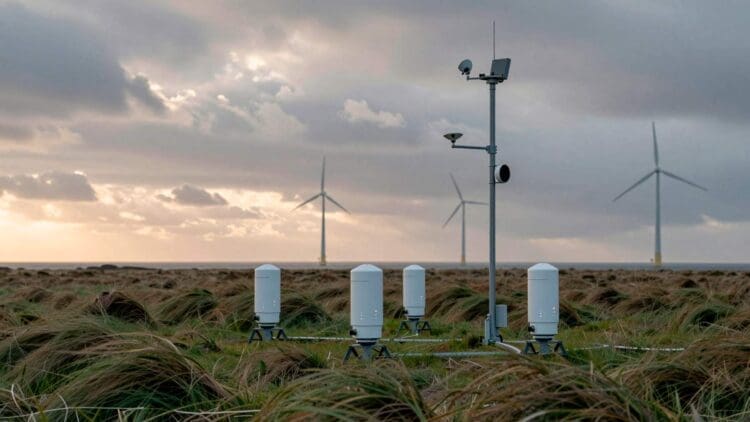

Researchers in northern Germany have deployed three synchronized short-range scanning lidars alongside conventional mast anemometers to measure wind turbulence at a near-coastal site—and the results, published in Wind Energy Science, suggest the triple-lidar configuration performs well across a wide range of atmospheric conditions. The study analyzed single- and two-point turbulence spectra to assess how accurately the lidar system captures wind behavior compared to established sonic and cup anemometer measurements.
Study validates triple lidar system for near-coastal wind measurements
Three synchronized short-range scanning lidars were deployed at a near-coastal site in northern Germany, operating in parallel with instruments mounted on a meteorological mast. The mast carried both sonic and cup anemometers, giving researchers two well-established reference systems. Findings appear in Wind Energy Science.
The central question was whether a synchronized lidar array could reliably characterize wind turbulence across the full range of atmospheric stability conditions typical of near-coastal locations. That range is notably wide—spanning convective, neutral, and stable stratification—and each regime presents different challenges for any measurement system trying to keep pace.




Why the study was conducted: Limitations of existing turbulence measurement methods
Mast-mounted anemometers have long been the standard for wind turbulence measurements. Reliable as they are, they provide point measurements at fixed locations. Adding measurement heights or relocating instruments requires physical infrastructure—costly and not always feasible.
Single lidar systems offer more flexibility, but they carry real constraints. Spatial coherence analysis requires simultaneous measurements at two or more separated points, and a single lidar has limited options for separation direction, distance, and height. That limitation matters most at near-coastal sites, where complex atmospheric dynamics demand robust multi-point characterization. The researchers framed their objective plainly: can a synchronized array of three lidars replicate the spectral and coherence estimates that sonic and cup anemometers produce?
Key findings: Agreement at low frequencies, discrepancies at high frequencies
Across all three measurement systems, agreement at low and intermediate frequencies was strong—every system captured the same key spectral features. Under convective conditions, all three detected the characteristic plateau in turbulence spectra. Under stable stratification, all three identified the spectral gap, a reduction in energy at intermediate frequencies that separates turbulent from mesoscale motions.
At higher frequencies, the picture shifted. Lidar and cup anemometer measurements diverged from sonic anemometer data, a divergence the researchers attribute to spatial and temporal averaging effects. Sonic anemometers measure nearly instantaneously at a point; lidars and cup anemometers integrate over space or time, smoothing out fine-scale fluctuations.
Spatial coherence estimates were less sensitive to these limitations. Agreement across systems was high, with only limited exceptions—particularly relevant for wind energy applications, where coherence data feeds directly into turbine load models.
Empirical models fitted to spectra and coherence as functions of atmospheric stability
Beyond measurement comparisons, the researchers fitted empirical models to the auto-spectra and coherence estimates derived from all three instruments. Model parameters were expressed as functions of atmospheric stability, making them more broadly applicable—not just to this site, but potentially to other near-coastal environments with similar conditions.
The synchronized lidar system showed clear advantages here. Its flexibility in configuring separation direction, distance, and measurement height means it can be adapted to different study geometries without new fixed infrastructure. The resulting models could inform wind turbine load and fatigue calculations, both of which depend heavily on accurate turbulence inputs.
Background: Role of turbulence characterization in wind energy development
Turbulence is not simply a nuisance for wind turbines—it is a fundamental design parameter. Accurate turbulence data shape how turbines are sited, how structural loads are estimated, and how long-term performance is modeled. Errors in turbulence characterization can propagate into underestimates of fatigue loading and shortened component lifespans.
Near-coastal sites occupy a particular niche, experiencing atmospheric conditions that reflect both offshore and onshore environments. Lidar technology has become increasingly common in wind energy research precisely because it offers spatial flexibility that fixed masts cannot match.
This study adds to that body of evidence. The triple synchronized lidar system showed strong agreement with established anemometer measurements at low and intermediate frequencies; spatial coherence estimates aligned well across all systems; and the lidar configuration proved flexible enough to support coherence analysis across varying atmospheric stability conditions. For sites where tall meteorological masts are impractical, multi-lidar arrays represent a credible alternative.
Kelly is an experienced writer with 15 years of experience exploring the big stories that shape our world, from tech breakthroughs and space exploration to climate, energy, and the fascinating quirks of science. She has a talent for turning complex ideas into sharp, memorable insights that stay with readers long after they’ve finished reading.