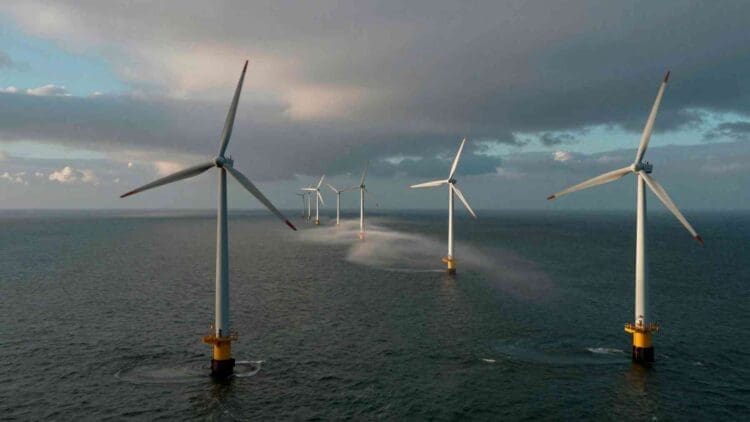

As Europe’s offshore wind buildout accelerates, its crowded seas are quietly generating a new kind of conflict. When a wind farm is built upwind of an existing one, its turbines can intercept the airflow and reduce the older project’s power output—a phenomenon the industry has come to call “wind theft.”
It is a tension that has grown alongside the boom itself, with dozens of projects now rising in close proximity across the North Sea and beyond. Until recently, no clear framework existed to settle who owes what to whom—or whether anyone does at all.
The hidden rivalry beneath the waves
When a wind turbine spins, it does not simply convert wind into electricity and leave the air unchanged. It extracts kinetic energy from the airflow, leaving a slower, more turbulent “wake” that can stretch for kilometers downwind. A wind farm sitting in that wake receives degraded wind—and generates measurably less power as a result.



This aerodynamic reality has always existed. What has changed is the scale. European waters are filling up with offshore wind projects at a pace that makes proximity conflicts almost inevitable, and the North Sea alone hosts dozens of operational and under-construction farms, many positioned within range of each other’s wakes.
Developers use the term “wind theft” deliberately. It captures the financial stakes: a project whose output drops because a newer neighbor intercepted its wind could lose millions in annual revenue. The loss is real, even if no law currently recognizes it as a harm.
A problem without a playbook
Despite the growing frequency of wake-effect conflicts, Europe has no unified legal or regulatory framework for handling them. No standard exists to determine whether an upstream developer owes compensation to a downstream one or how losses should be calculated and verified.
The absence of rules has created a chilling effect on investment. Developers facing potential wake impacts must navigate legal uncertainty before committing capital, and some disputes have already triggered delays, renegotiations, or quiet side agreements—none of which provide the predictability that large infrastructure projects require. The problem is only expected to deepen as governments license new projects in maritime zones that are already partially occupied.
France’s proposed solution
France has moved to address this directly. The French government has put forward a proposal in which the state would step in to compensate offshore wind farm operators whose output is measurably reduced by a neighboring project. Rather than leaving affected developers to pursue legal claims against each other, the mechanism would route verified losses through a structured government intervention.
The core logic is straightforward: if a new wind farm causes a quantifiable reduction in a neighbor’s power generation, the affected operator would qualify for compensation calculated against that measured output loss. What industry observers have called radical is that the proposal does not require the upstream developer to admit fault or pay directly. It treats wake-effect losses as a systemic consequence of dense development policy—and assigns the state a compensating role. That framing is a significant departure from the ad hoc arrangements that have characterized the issue until now.
Could other European countries follow suit?
France’s proposal is already drawing attention beyond its borders. Countries with dense offshore wind zones — particularly North Sea nations such as the Netherlands, Germany, Denmark, and the United Kingdom — face the same underlying problem. If the French model proves workable, it could serve as a template for broader European adoption.
The conditions for that to happen are not trivial. Any compensation system requires a technically credible method for measuring wake losses, and distinguishing the impact of a neighboring farm from normal wind variability is genuinely difficult. Establishing that methodology in a way that satisfies developers, regulators, and auditors would be a prerequisite for any functioning scheme. Cross-border scenarios add a further layer of complexity: when an upstream farm in one country affects a downstream farm in another, no single national framework can resolve the dispute alone.
Political will is another variable entirely. Governments already under fiscal pressure may be reluctant to take on open-ended compensation obligations for private energy projects—and the diplomatic dimensions of transnational wake disputes have not yet been seriously tested.
Still, the French proposal represents the clearest attempt yet to treat “wind theft” as a policy problem rather than a legal afterthought. Whether it advances through France’s regulatory process — and whether other governments study it seriously — will signal how committed Europe is to managing the conflicts its offshore ambitions are creating.
Kelly is an experienced writer with 15 years of experience exploring the big stories that shape our world, from tech breakthroughs and space exploration to climate, energy, and the fascinating quirks of science. She has a talent for turning complex ideas into sharp, memorable insights that stay with readers long after they’ve finished reading.