
Virginia community farm grows vegetables beneath 42 elevated solar panels that generate enough electricity to power it
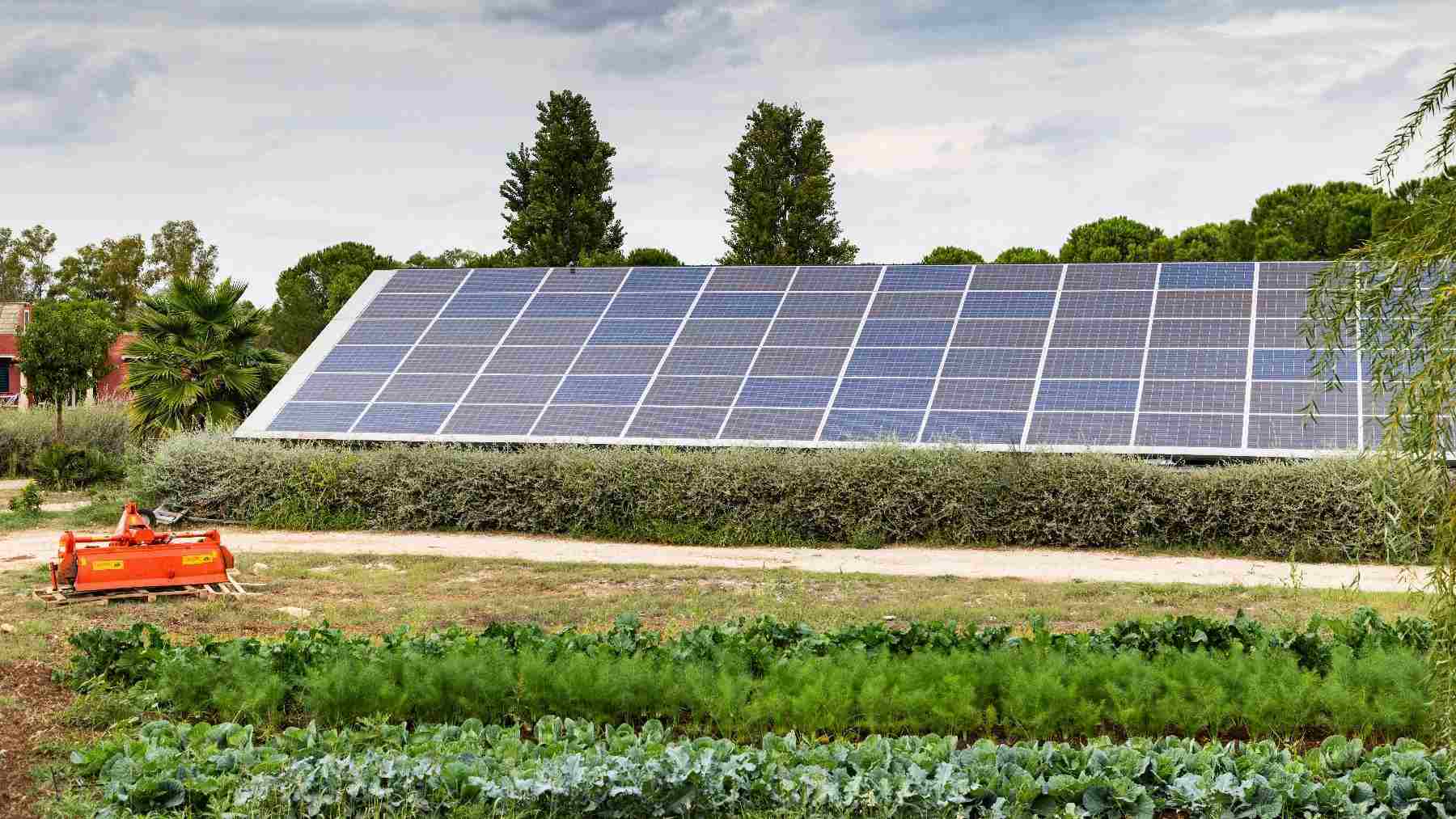
Rows of kale, lettuce, beets, and broccoli stretch across a community farm in the Virginia Piedmont — not under open sky, but in the measured shade of solar panels mounted six feet overhead. On a sunny morning, light filters through the gaps between the panels in shifting patterns, landing on crops that, by most conventional farming logic, shouldn’t be thriving here.
What’s growing at this small farm is more than vegetables.
A farm unlike any other in Virginia
The Piedmont Environmental Council’s Community Farm at Roundabout Meadows sits in the Virginia Piedmont, but it doesn’t look like most farms in the region. Tiger Solar installed 42 solar panels arranged in three rows of 14, mounted on six-foot-high racks and spaced 12.5 feet apart — wide enough for sunlight to filter through and reach the crops planted beneath.
Four rows of vegetables grow directly in the ground, mimicking a traditional farm setup, and four more grow in raised beds to reflect smaller or urban operations.
Two people drove the project from idea to installation. Farm coordinator Teddy Pitsiokos manages what grows in the ground, while senior energy advisor Ashish Kapoor designed the system and handled the permitting, insurance, and engineering decisions that took three full iterations to get right. Together, they built Virginia’s first crop-based agrivoltaics project — a designation that carries real weight in a state where this kind of farming had never been attempted.
Why solar and farming were once seen as enemies
The tension between solar energy and agriculture isn’t hard to explain. The same flat, open, sun-drenched land that makes a field productive for growing also makes it attractive for large solar installations. For years, that meant the two uses competed directly — one displacing the other.
Agrivoltaics offers a different answer. The term describes the intentional co-location of solar energy generation and agricultural production on the same land, so neither has to give way. It’s not a new concept globally, but in Virginia it had barely been tested. A handful of projects involving livestock grazing or pollinator habitat existed in the state before Roundabout Meadows, though their results were unclear.
Crop-based agrivoltaics — actually growing vegetables beneath panels — was entirely new territory. That distinction matters, because farmers are far more likely to try something unfamiliar when they can point to a working example nearby.
Crops in the shade — and the science behind the choice
Pitsiokos designed the planting layout with replication in mind. Four rows of vegetables grow directly in the ground, mimicking a traditional farm setup, and four more grow in raised beds to reflect smaller or urban operations. That combination makes the model transferable to large farms, small plots, wineries, breweries, and even parking lots.
The crops themselves are a mix of the practical and the experimental. Shade-tolerant varieties like lettuces, brassicas, and root vegetables are expected to perform well under the panels. Pitsiokos is also trialing economically important staples like tomatoes and potatoes, where the outcome is far less certain. “We have a feeling we know what’s going to do well,” he says, “but we want to make data-based decisions. And that means trialing a variety of crops.”
The farm includes a smart panel to monitor energy usage and an on-site battery storage system — and that battery backup is more than a convenience. It keeps the farm running when the grid goes down, protecting well pumps, produce coolers, and greenhouse heat mats. Many farms sit at the end of power lines and are among the first to lose electricity during outages. Energy independence, Kapoor notes, is a compelling argument on its own.
More power than the farm can use
The system generates approximately 130% of the farm’s energy needs. In the year since it became operational, the farm has had no electric bill.
Pitsiokos is already thinking about where the surplus could go. Adding cold storage is one option; replacing gas-powered tools with electric versions is another. “If anyone wants to buy us an electric tractor,” he laughs, “I’m only half kidding.”
The battery storage system also hints at something larger. When multiple farms, businesses, and homes store and share energy together, they can function as a “virtual power plant” — reducing strain on the grid and potentially compensating owners for their contributions. Kapoor has run the numbers on scaled adoption: if just 10% of Virginia’s 39,000 farms installed a one-megawatt agrivoltaics project, the combined output would equal four nuclear power plants.
From one farm to a statewide law
On June 17, 2026, Governor Abigail Spanberger held a ceremonial bill-signing at Roundabout Meadows itself — standing in front of the panels and the crops growing beneath them. The legislation she signed, SB 340/HB 508, officially defines agrivoltaics in Virginia law for the first time, according to the Piedmont Environmental Council.
The definition does specific work. It requires that agrivoltaics projects prioritize agricultural productivity, keep land in production for the life of the solar array, and remain part of an existing farm business. “We are protecting farmers,” Spanberger said at the signing. “We are making clear that the use of agrivoltaics prioritizes agricultural productivity.” The bill drew bipartisan support and reflected months of collaboration between PEC, the Virginia Farm Bureau, legislators, and state officials.
Roundabout Meadows — originally conceived as a proof-of-concept — is now a living demonstration site where farmers, developers, and policymakers can see agrivoltaics working in real conditions, with real data behind it. With the legal definition in place and a stakeholder group expected to develop future incentives, the next question isn’t whether Virginia will expand agrivoltaics — it’s how fast, and how many farms will be ready when the opportunity arrives.

Kelly is an experienced writer with 15 years of experience exploring the big stories that shape our world, from tech breakthroughs and space exploration to climate, energy, and the fascinating quirks of science. She has a talent for turning complex ideas into sharp, memorable insights that stay with readers long after they’ve finished reading.
