
China deploys the world’s largest floating wind turbine in deep water — and it’s built to survive Category 5 hurricanes
 Credits: China Three Gorges Corporation
The wind industry is moving into deeper waters with the world’s biggest and most durable offshore wind turbine.
Nations worldwide are embracing a shift toward electrification as part of their climate goals.
This transition, along with global digitalization, is skyrocketing energy demand and straining grids. Existing shallow-water wind infrastructure may no longer be enough to keep up.
Her work focuses on making complex topics accessible, informative, and relevant for readers across different areas of interest.
Will China’s new deep-sea innovation help overcome the bottlenecks of traditional offshore wind turbines?
How electrification is essential for decarbonization
As the effects of climate change worsen, electrification has become the core element for global decarbonization.
Transport, heating, and power will have to be driven by clean electricity. This could displace up to 70% of energy-related carbon emissions.
It would eliminate nearly 25 gigatons of carbon dioxide each year by mid-century.
To ensure a safe energy transition, the massive process should be managed through digitalization.
The goal for the transportation sector is to become highly advanced and integrated.
This can be achieved by implementing smart digital networks.
Electric vehicles can then be directly synced with power grids using AI and real-time data tracking.
Direct synchronization will ensure optimal charging times and prevent grid overloads.
Furthermore, it will balance intermittent renewable energy supplies.
However, this dual shift will require an unprecedented amount of electricity.
Offshore wind is the answer to this high demand, but the shallow waters are not.
Traditional offshore wind versus the power consumption crisis
The electric transport sector will have a global annual demand of 1,100 TWh by 2030.
Simultaneously, digital infrastructure to support this shift is equally energy-intensive.
Global AI networks and data centers are predicted to double consumption to nearly 950 TWh by 2030.
The combined consumption will significantly strain existing grids.
Renewable energy is key to meeting this high demand.
However, consumption is currently significantly outpacing new green energy generation.
Unfortunately, conventional offshore wind farms fall short of filling this supply gap.
In general, turbine installation requires a carefully planned framework.
Traditional fixed-bottom turbine deployments are limited to shallow coastal waters of less than 164 feet deep.
The near-shore sites are crowded, triggering conflicts with shipping lanes and commercial fishing grounds.
Furthermore, winds are typically weaker and less consistent than open-ocean gusts.
To prevent a dead end for volume scalability and protect fragile existing infrastructure, the sector must seek deeper waters.
The Three Gorges Pilot floats scaled-up innovation
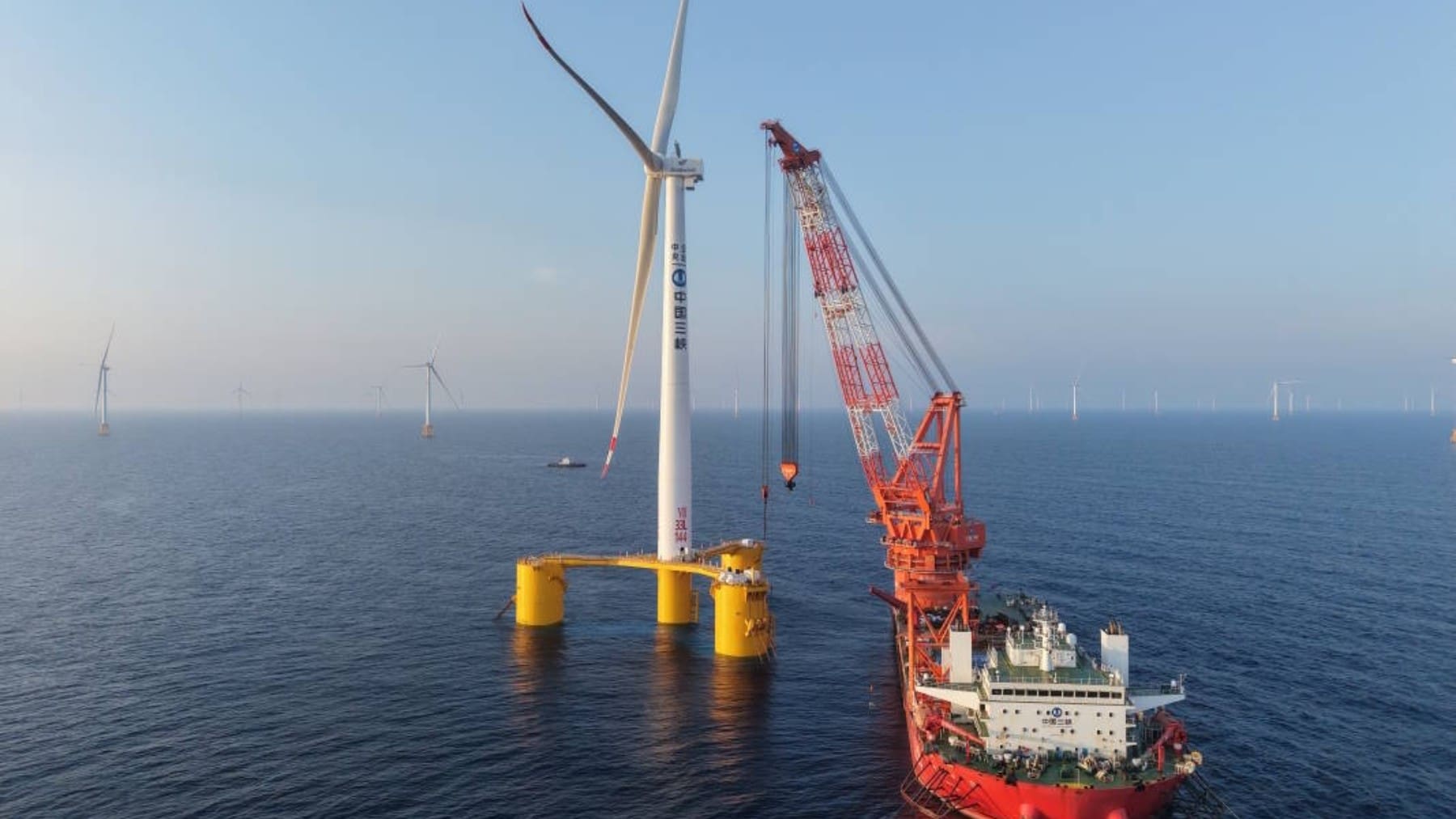
China is breaking records by deploying the world’s largest offshore wind turbine.
Additionally, its “Three Gorges Pilot” is also the answer to deep-sea wind power demand.
The historic single-unit turbine has been installed in the South China Sea.
It is located approximately 43 miles off the coast of Guangdong province and operates in depths exceeding 164 feet.
The entire mechanism is buoyant
A specialized triangular platform enables the 16 MW turbine to float.
The semi-submersible steel foundation provides heavy-duty stability needed to harvest extreme deep-sea wind gusts. This is done with a rotor diameter spanning 827 feet and blade tips reaching 886 feet above the ocean.
The Three Gorges Pilot has a design that thrives in extreme weather events.
It has been engineered to easily survive turbulent seas with waves of 66 feet high.
Its design also withstands Category 5 hurricane-force winds up to 164 miles per hour.
This high durability will unlock new frontiers for secure, uninterrupted, clean power production.
China’s floating deep-sea offshore wind turbine systems prove that the clean energy supply gap can be resolved.
Access to powerful, consistent, open-ocean wind will ensure massive, reliable volumes of carbon-free electricity.
As transport electrification and AI infrastructure demands surge, this immense output could help satisfy them.
Scaled-up floating technology worldwide secures fragile power grids and overcomes near-shore limitations. The world’s transition to an integrated, carbon-free future will be significantly accelerated.
Anke Maree is a writer with a clear and engaging editorial style. Her work focuses on making complex topics accessible, informative, and relevant for readers across different areas of interest.
