
Energies Media
  • Magazine
    • Energies Media Magazine
    • Oilman Magazine
    • Oilwoman Magazine
    • Energies Magazine
  • Upstream
  • Midstream
  • Downstream
  • Renewable
    • Solar
    • Wind
    • Hydrogen
    • Nuclear
  • People
  • Events
  • Subscribe
  • Advertise
  • Contact
    • About Us
No Result
View All Result
No Result
View All Result
Energies Media
No Result
View All Result

California spent $20 million covering canals with solar panels and got back far more than electricity

Anke by Anke
June 3, 2026 at 8:40 AM
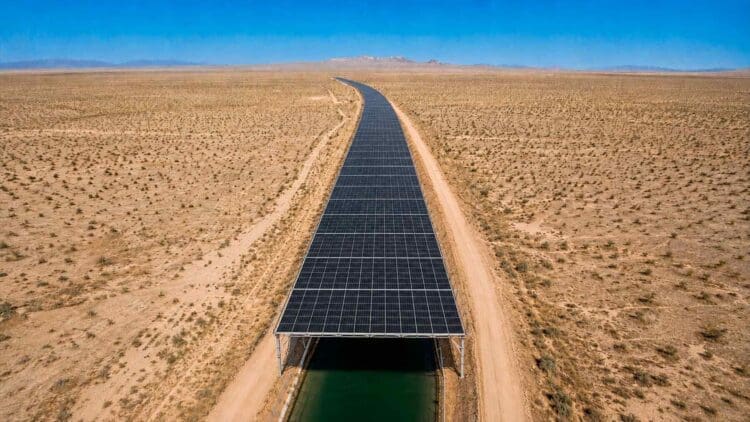
water canal covered with solar panels

Credits: Edited, representative image

Gastech

An innovative solar panel project in California addresses clean energy and water supply concerns.

Climate change is worsening, with its dire, complex effects felt globally. This has encouraged international climate mandates to become stricter.

As nations rush to expand their green infrastructure, some must now also face rapidly depleting water resources.

Scientists at Wind Energy Science journal build deep learning models that slash the computing time needed to assess regional wind farm layouts 1 1

Scientists at Wind Energy Science journal build deep-learning models that slash the computing time needed to assess regional wind farm layouts

June 2, 2026
offshore wind turbine being installed

RWE just installed an offshore turbine with a low-carbon steel tower and recyclable blades at the same time, and the wind industry has never done that before

June 1, 2026
Sami petting reindeer with wind turbine background

They wanted to build 278 wind turbines until they realized the land already belonged to migrating reindeer and the Sami who follow them

June 1, 2026
KNF

Will California’s successful pilot program inspire other drought-stricken countries to take a similar approach to their canals?

How tighter climate mandates are pressuring the world

As international mandates become stricter, nations worldwide are forced to lower carbon emissions much faster.

This added pressure has led to a total global green energy capacity increase to 5,149 GW.

Solar power is the primary driver behind this movement. The cumulative global capacity has reached 2,392 GW.

However, adhering to tightened climate frameworks means drastically expanding the solar network.

Experts estimate that nearly 735 GW of new solar infrastructure must be added annually.

This creates a major logistical headache for infrastructure planners.

Suitable real estate is becoming scarce, significantly limiting installation space.

Consequently, developers are pushed to explore rural communities and undeveloped natural environments instead.

Conflict with local communities and agricultural stakeholders increases due to this geographic expansion.

Conservation groups are increasingly concerned about the displacement of thousands of acres of nature.

Yet, without these developments, mitigating the effects of climate change will be significantly slowed down.

From land scarcity to rising demands

In progressive states like California, space limitations are a compounding challenge.

The state’s population has substantially grown alongside a rapid increase in energy-intensive industries.

However, the highest regional electricity consumption is attributed to generative AI and power-hungry data centers.

Across California, data centers consume nearly 5,580 GWh of power annually.

It accounts for almost 2.6% of the state’s total electrical demand. Experts predict that this particular power load could double or triple by 2028.

Without installing utility-scale solar plants, the grid faces an increased risk of instability.

In addition to the growing power crisis comes the altered regional environment. Atmospheric patterns have changed so much that heatwaves and drought periods have become prolonged.

California’s open water systems are experiencing accelerated evaporation rates due to higher average temperatures.

The California State Portal highlights the innovative approach the state has taken to address this severe dual crisis.

Project Nexus: Saving water with solar panels

The state funded a $20 million pilot project known as Project Nexus to overcome these overlapping crises.

It is a combined public-private-academic venture aimed at proving the feasibility of installing solar panels over water canals.

Large solar canopies were engineered and placed directly over existing public irrigation canals.

Construction took place at two separate sites and finished in August 2025. Performance evaluation took place thereafter and concluded in the spring of 2026.

The in-field performance results

Initially, a combined capacity of 1.6 MW of clean electricity was generated.

The panels’ shadows directly blocked sunlight and wind. This significantly lowered water evaporation rates during severe droughts.

The installations also halted photosynthesis, reducing aquatic weed and algae growth. It decreased maintenance costs for the canal operators.

Cooler water created a natural cooling effect for the panels, increasing power conversion output.

75 kW iron-flow batteries were added to the narrow-span canal site to test long-term grid storage and stability.

Project Nexus is a highly innovative solution to overcome multiple environmental challenges simultaneously.

A 2021 UC Merced study was positive about the project’s scalability. Covering 4,000 miles of exposed canals in California could supply clean power to two million homes annually.

Additionally, 63 billion gallons of valuable water will be saved from evaporation every year. It will also overcome land limitations while adhering to stricter climate mandates.

The pilot proves that covering canals with solar panels is a smart, scalable approach for drought-prone nations.

Author Profile
Anke

Anke Maree is a writer with a clear and engaging editorial style. Her work focuses on making complex topics accessible, informative, and relevant for readers across different areas of interest.


Author Articles
  • Anke
    Saving a “ghost fish” from the Grand Canyon is quietly draining power from millions of American homes
  • Anke
    Limestone pellets heated to 1,000°F: the thermal battery turning excess wind power into campus heat in rural Minnesota
  • Anke
    Solar panels that disguise themselves as roof tiles and brick walls just got one step closer to reality
  • Anke
    RWE just installed an offshore turbine with a low-carbon steel tower and recyclable blades at the same time, and the wind industry has never done that before
  • Anke
    They wanted to build 278 wind turbines until they realized the land already belonged to migrating reindeer and the Sami who follow them
  • Anke
    Europe nearly lost one of its most promising wind farms before it even began—all because a herd of reindeer refused to move
RE+

Energies Media Winter 2026

ENERGIES (Winter 2026)

IN THIS ISSUE


Pumping Precision: Solving Produced Water Challenges with Progressive Cavity Pump Technology


Kellie Macpherson, Executive VP of Compliance & Security at Radian Generation


Infrastructural Diplomacy: How MOUs Are Rewiring Global Energy Cooperation


The Vendor Trap: How Oil And Gas Operators Can Build Platforms That Scale Without Losing Control


Energies Cartoon (Winter 2026)


The Importance of Innovation in LWD Technologies: Driving Formation Insights and Delivering Value


Letter from the Editor-in-Chief (Winter 2026)


Why Lifecycle Thinking Matters In FPSO Operations


Protecting Critical Infrastructure and Operations in the Digital Age


The Duality of Landman’s Andy Garcia

Reuters
RE+
  • Terms
  • Privacy

© 2026 by Energies Media

No Result
View All Result
  • Magazine
    • Energies Media Magazine
    • Oilman Magazine
    • Oilwoman Magazine
    • Energies Magazine
  • Upstream
  • Midstream
  • Downstream
  • Renewable
    • Solar
    • Wind
    • Hydrogen
    • Nuclear
  • People
  • Events
  • Subscribe
  • Advertise
  • Contact
    • About Us

© 2026 by Energies Media