
A geothermal well was losing heat five times faster than expected, so someone drilled deeper and discovered the underground system was behaving nothing like experts thought
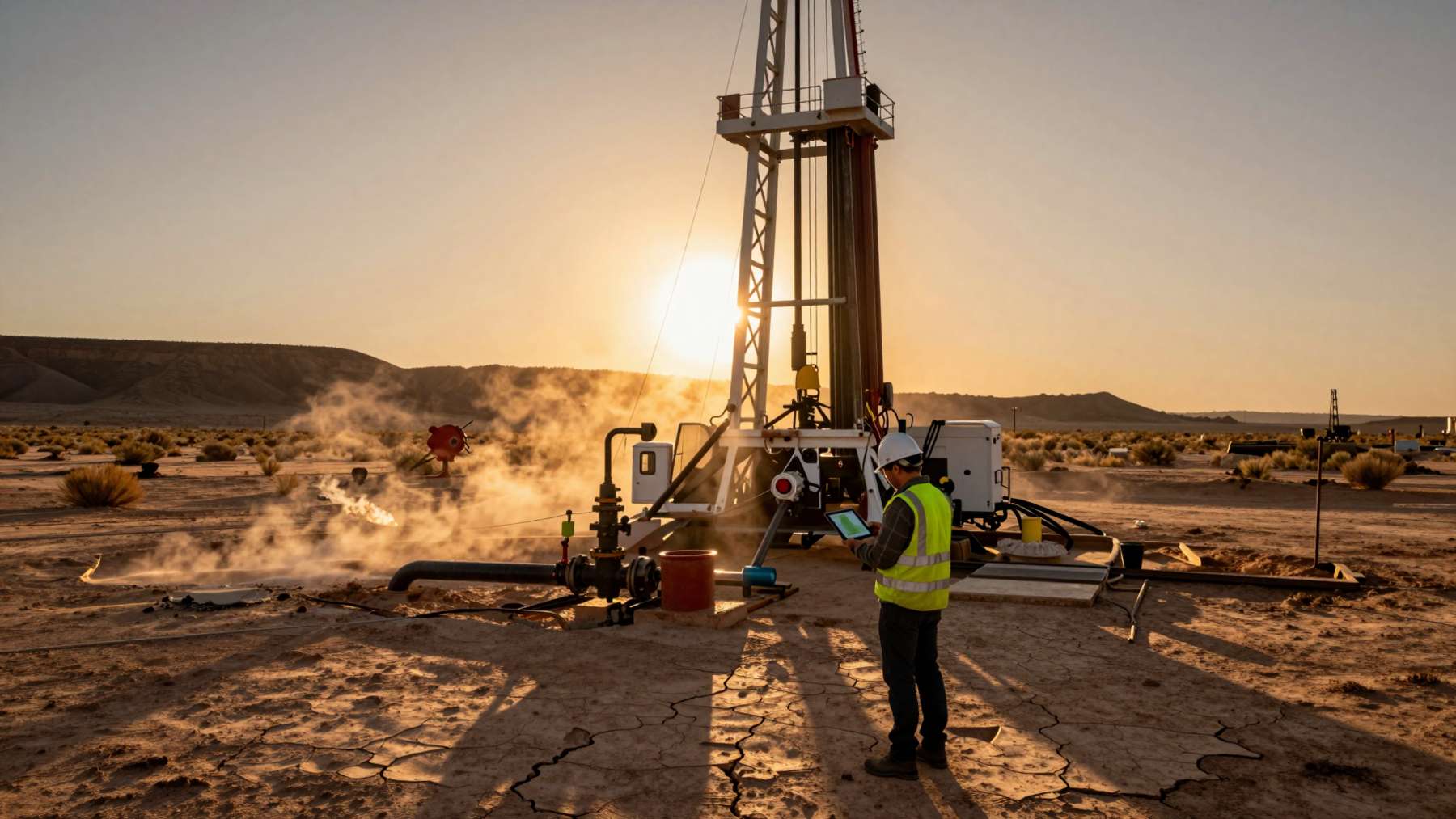 Image generated with artificial intelligence
At the Lightning Dock geothermal plant in New Mexico, heat was disappearing fast.
The shallow wells feeding the 15-megawatt facility had cooled at five to ten times the rate of a typical geothermal site, dropping 50°F below turbine operating thresholds.
By the time AI-driven startup Zanskar acquired the property in 2024, it looked like an unsalvageable write-off. The question was whether anyone had the technology—or nerve—to find out if it could be saved.
pumped well and proving that dozens of “exhausted” geothermal fields across the American West are sitting on top of massive, untapped heat reservoirs.
A power plant running out of heat
Lightning Dock’s problem wasn’t subtle. The original wells—drilled under 2,500 feet deep—lost heat rapidly, settling near 250°F by 2024. That drop was catastrophic because the plant required temperatures above 300°F to generate usable power.
The stakes were high: the facility supplies electricity to New Mexico’s largest utility, making it critical grid infrastructure.
Zanskar knew the risks before buying. Co-founder Joel Edwards noted the team committed to drilling deeper before closing the deal, wagering that a fix lay further underground.
Why drilling deeper is harder than it sounds
Conventional geothermal wells reach depths of 3,000 to 5,000 feet. Below that, rock tightens, equipment wears down quickly, and costs surge.
Stanford Precourt Institute fellow Roland Horne notes that drilling twice as deep costs four times as much due to non-linear cost curves. “Whether or not to drill deeper is basically a question of economics,” Horne says.
Zanskar held one major advantage: a deep 2022 exploratory well provided crucial geologic reference data for its models. Inheriting an existing plant and surface infrastructure also slashed upfront costs compared to a greenfield project.
AI models and oil-industry drill bits point the way
Zanskar uses artificial intelligence to identify “hidden systems”—geothermal sites with strong subsurface heat but minimal surface markers. The startup applied its predictive AI models to pinpoint the optimal target for a new deep well, building on a successful discovery in Nevada.
Execution was equally critical. Zanskar deployed specialized drill bits borrowed from the oil and gas industry, drilling 35% faster than standard geothermal methods at a competitive cost.
The resulting well reached 8,000 feet—more than triple the depth of the original wells—penetrating rock previous operators never reached.
One year later: Too much heat
A full year into operation, the 8,000-foot well occasionally produces more heat than the existing plant can handle. Thermal output has blown past pre-decline levels, fully restoring baseline generation capacity.
Horne reviewed Zanskar’s data and confirmed that, measured by fluid flow rate, Lightning Dock now ranks among the highest-performing pumped geothermal wells in the United States. “It’s a really good well,” Horne confirmed.
Edwards expects the well attributes could support continuous, productive generation for decades.
A revival signal for the broader geothermal industry
Lightning Dock’s turnaround reflects a sector-wide investment surge, with geothermal startups securing $432 million in funding through the first half of 2026.
Zanskar’s $115 million funding round in early 2026 highlighted growing institutional confidence in data-driven exploration. BloombergNEF analyst Stephanie Díaz notes that AI modeling de-risks development, attracting private capital to clean firm power.
Yet the true revelation behind Lightning Dock’s rapid decline was revealed only after drilling deeper. Geologists long assumed the site was a standard shallow field suffering from natural thermal exhaustion. In reality, the shallow wells were merely tapping cold, diluted run-off from a completely different structure.
By drilling to 8,000 feet, Zanskar discovered a massive, deep-seated convective hydrothermal plume that had been entirely invisible to traditional geological modeling—setting a new record for thermal output from a western U.S. pumped well and proving that dozens of “exhausted” geothermal fields across the American West are sitting on top of massive, untapped heat reservoirs.

Kelly is an experienced writer with 15 years of experience exploring the big stories that shape our world, from tech breakthroughs and space exploration to climate, energy, and the fascinating quirks of science. She has a talent for turning complex ideas into sharp, memorable insights that stay with readers long after they’ve finished reading.
