
A giant rolling cylinder is turning ocean waves into electricity in France while an electromagnetic shield keeps dolphins and seals safe
 Credits: Seaturns
The power of ocean waves could soon become an eco-friendly alternative using a giant rolling cylinder device.
The world is currently facing two major problems, and solving both simultaneously is extremely difficult.
Global energy demand rises rapidly each year, which complicates meeting international climate mandates on time.
However, the ocean’s severely corrosive saltwater and frequent stormy conditions present major obstacles to this technology.
Experts believe that turning to the untapped potential of the vast seas could offer a feasible solution.
Can mankind harness this immense power while protecting delicate marine ecosystems?
How global targets are conflicting with the rising demand
Several nations worldwide have adopted international climate mandates to decarbonize their economies.
Renewable energy sources such as wind, solar, and hydropower have been key to these regulations.
Initially, it seemed as if the globe was on track to achieve net-zero.
Over the past decade, clean power installations have increased to provide over 30% of global electricity.
Then came the digital revolution, disrupting this progress.
Generative AI and cloud computing have become essential across several sectors.
Consequently, electricity consumption began to surge, despite major structural expansion.
Now, green capacity expansion is being outpaced by overall energy demand.
Regional grids are pushed to their limits, resulting in a continued fossil fuel reliance.
These carbon-heavy fuels still represent 86% of the world’s power supply.
As demand rises, climate goals become less likely to be met on time.
That is why energy developers are now looking beyond the shoreline.
The vast untapped potential of the ocean’s wave energy
The need to replace highly intermittent renewable energy sources is greater than ever before.
Offshore options have become of high interest, as the open ocean has immense benefits compared to land-based renewables.
Ocean waves overcome the reliance on adequate weather conditions.
As global weather patterns have become more unpredictable, this resource is more ideal.
The constant movement of waves generates highly reliable, predictable electricity needed by grids.
Additionally, water’s kinetic density is significantly higher than that of air.
Since this immense power is packed within tight spaces, the technology has a much smaller physical footprint.
This addresses the land-use conflicts often faced by onshore renewable sources.
However, the ocean’s severely corrosive saltwater and frequent stormy conditions present major obstacles to this technology.
Mechanical degradation occurs rapidly, necessitating specialized, but costly, maintenance more regularly.
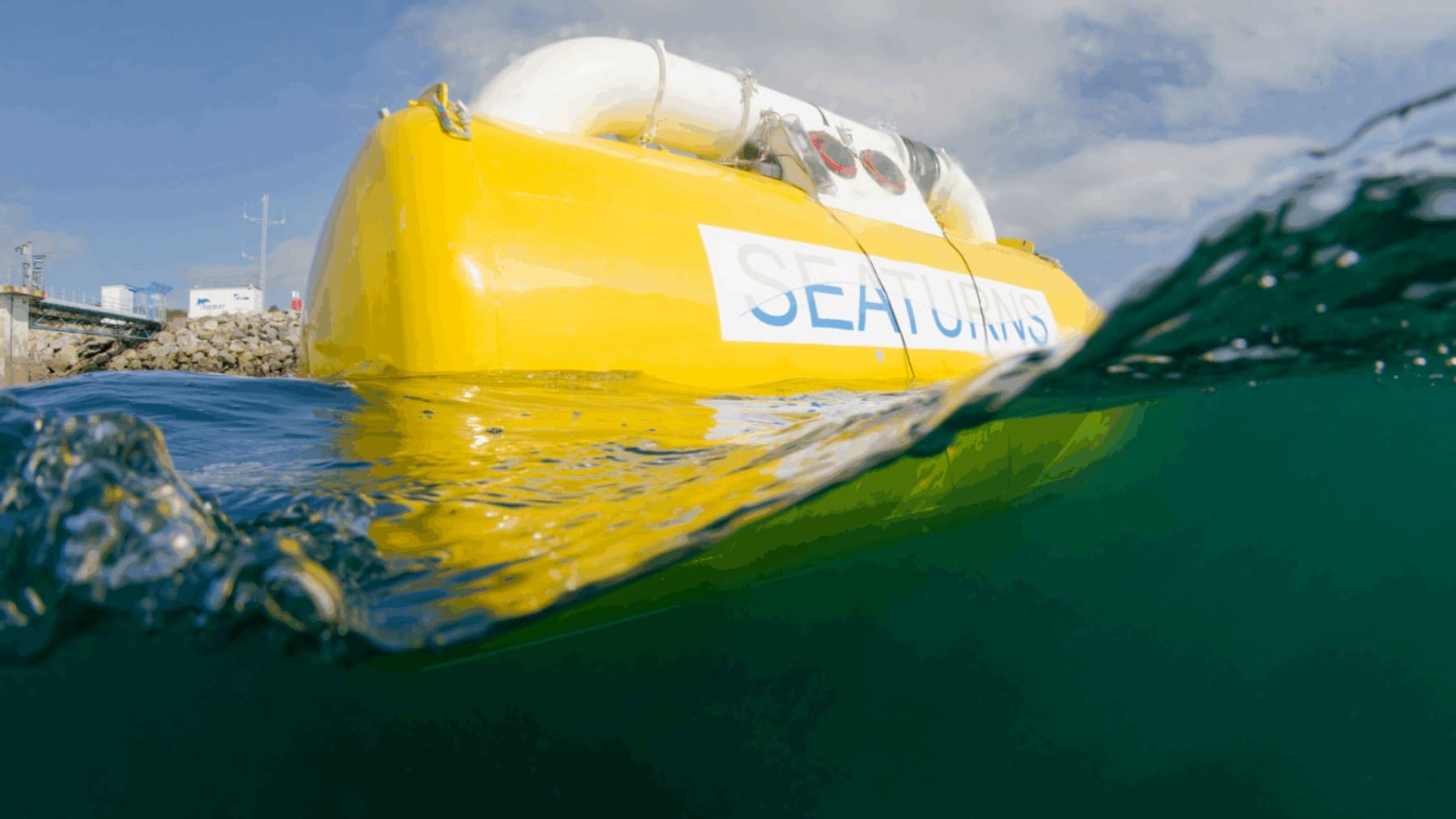
The French startup, Seaturns, created a unique “rolling cylinder” device that could overcome these challenges.
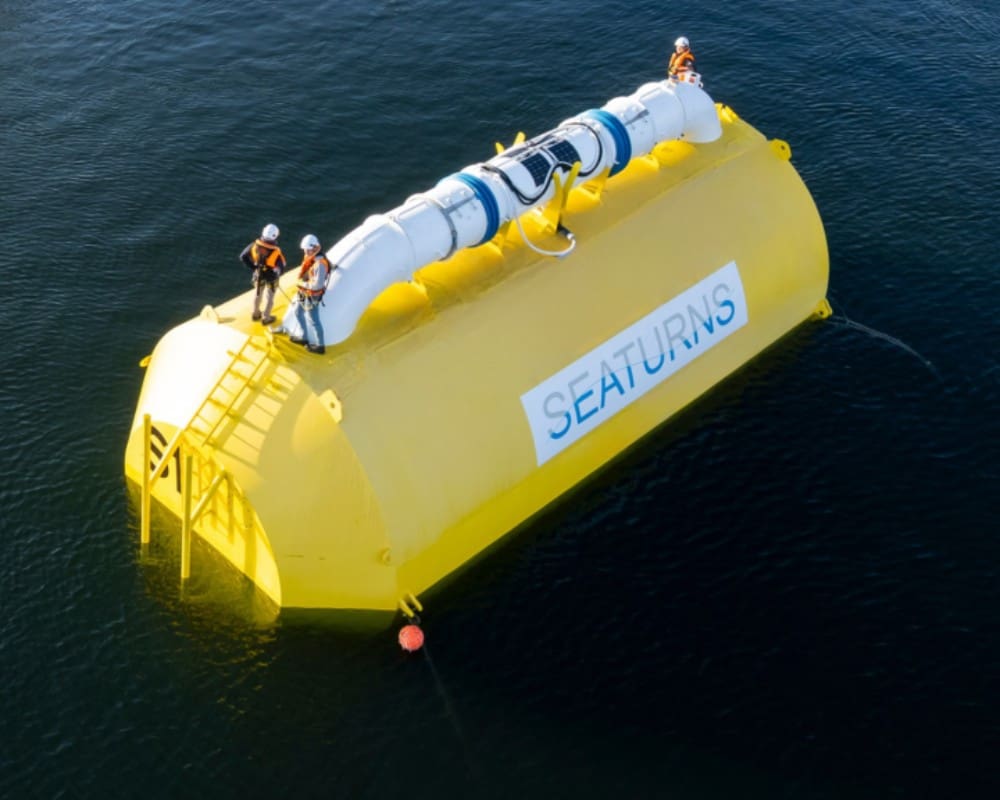
A giant floating buoy harnessing ocean waves for electricity
Unlike typical floating wave energy converters, the Seaturns device has a different configuration.
The cylindrical buoy sits horizontally on the ocean surface, safely shedding the harsh forces of giant waves.
The structure is held in place by a lightweight mooring and anchoring setup.
Passing ocean swells push against the hull, converting horizontal wave energy into a rocking motion.
The internal water pendulum
The device has a large interior water ballast at the bottom.
The outer movement swings internal water like a pendulum.
The swinging water acts as a piston, trapping compressed air within one chamber.
Meanwhile, a vacuum is created in the opposite chamber.
An imbalanced pressure forms, forcing the air to blast through a connecting upper pipe.
Inside the pipe is a turbine, which rapidly spins, driving the embedded generator to produce clean electricity.
France’s Atlantic coast is currently used for open-sea trials of the Seaturns buoy.
It was deployed at the Sainte-Marguerite test site of Pornichet. The tests will validate the rolling cylinder’s durability and power generation capacity.
Once everything has been verified, the developers will move on to full-scale commercialization.
The giant buoy also has an integrated electromagnetic shield, which will protect dolphins and seals from the mooring lines.
Successful deployment will pave the way toward an eco-friendly, highly predictable, clean energy future.
Anke Maree is a writer with a clear and engaging editorial style. Her work focuses on making complex topics accessible, informative, and relevant for readers across different areas of interest.
