
Maritime surveillance is transforming into a more sustainable and economic practice with wave energy.
Historically, manned ships, expensive aircraft, and vulnerable subsea cables were the norm for ocean monitoring.
Now, these traditional systems are being replaced by autonomous technologies worldwide.

They present a more eco-friendly, self-sustaining alternative for oceanic perimeters.
Will these wave-powered buoys help shift to a new era for global maritime security and deep-sea data collection?
How the vast blue border has grown vulnerable
For the U.S., protecting the oceans is a staggering logistical challenge.
The Department of Homeland Security and the U.S. Coast Guard are responsible for more than 95,000 miles of coastline.
The U.S. Exclusive Economic Zone (EEZ) also falls within their responsibilities.
This adds 4.5 million square miles of the ocean that must be monitored to prevent illicit activity.
Nearly 90% of U.S. commerce is handled on this vast domain’s critical trade routes. This is why proactive tracking of potential threats is vital.
However, traditional monitoring systems are no longer sufficient.
Manned ships face severe limitations, including weather constraints and crew fatigue.
Furthermore, these vessels require vast amounts of carbon-heavy fuels. High fuel consumption and maintenance render operations extremely expensive.
Traditional radar and satellite systems also pose risks for data “blind spots.”
As maritime threats become more advanced, a different approach is needed to close the unsustainable defensive gap.
Legacy systems are difficult to replace
Innovators are testing crewless vessels and autonomous technologies to address this growing gap.
Yet, the transition away from conventional surveillance systems has been incredibly difficult.
The main obstacle is the harsh conditions of the open ocean.
Worsening climate change has triggered significant changes to atmospheric patterns. These phenomena are leading to more frequent and extreme marine storms.
Destructive waves and high winds easily damage standard electronic equipment.
Creating an autonomous platform that can withstand these intensifying weather events and deep-sea environments has been challenging.
Furthermore, advanced surveillance systems are data-heavy.
These platforms require a substantial and continuous supply of energy.
Traditionally, buoys are battery-powered. This increases the frequency of costly maintenance trips.
They also face the environmental challenges tied to battery production and disposal.
Turning to solar energy alone will not address the intermittency hurdle.
To solve this, Ocean Power Technologies (OPT) created an innovative solution.
A wave-powered autonomous surveillance buoy
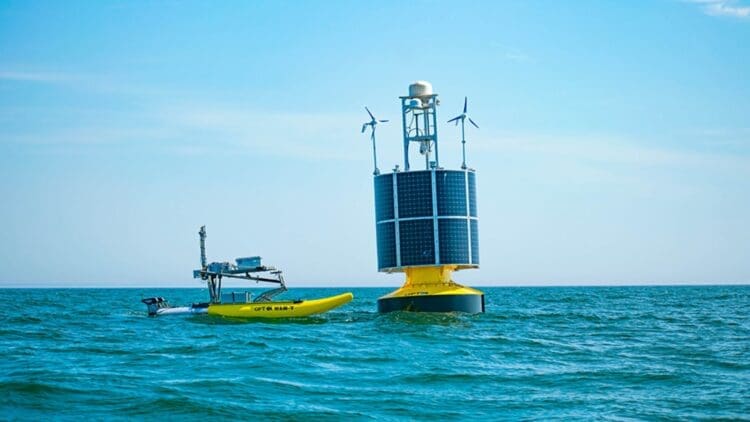
The U.S.-based company bridged the operational gap by deploying three PowerBuoy systems off the coast of California.
These floating buoys turn wave energy into reliable electrical power.
The continuous supply of clean energy ensures that the platform remains operational despite advanced payloads.
These buoys operate as a synchronized network. Real-time surveillance data is captured and directly streamed to the U.S. Department of Homeland Security.
Deep-sea smart autonomy operations that streamline maritime surveillance
One offshore system can operate in ocean depths exceeding 3,280 feet.
Each buoy is equipped with an AI-capable decision-making software. For this, OPT made use of its Merrows suite.
The network also fully integrates with Anduril Industries’ Lattice platform.
Merging persistent green wave energy with smart tracking software marks a major shift for the sector.
This combination ensures that round-the-clock maritime surveillance is executed entirely autonomously across vast oceans.
The ultimate maritime challenge is finally solved with these wave-powered buoy systems.
Nations can now secure their ocean perimeters without incurring carbon costs or human risks.
Overcoming the harsh conditions of the deep-sea while supplying reliable, clean power successfully closes critical security gaps.
The deployment in California has proven that self-sustaining intelligence is now a feasible concept. Global ocean monitoring will be permanently altered as this wave technology scales.
Anke Maree is a writer with a clear and engaging editorial style. Her work focuses on making complex topics accessible, informative, and relevant for readers across different areas of interest.