
Four floating wind turbines were installed off Japan, and mysterious DNA samples revealed an unexpected sea creature gathering around them
 Credits: AI-made
Floating wind turbines in Japan are tapping deeper waters, which are now also impacting marine life.
Major coastal hubs are struggling to meet rising energy demands while meeting net-zero targets.
This is why offshore wind capacity growth has rapidly accelerated worldwide.
Their study, “Floating Offshore Wind Farms Attract Japanese Horse Mackerel,” was published in Aquatic Conservation: Marine and Freshwater Ecosystems.
As giant man-made structures increase in the oceans, they tend to create hidden environmental side effects.
What are these unexpected ecological changes, and will they end up reshaping offshore deployment?
How coastal communities struggle to strike a balance
More people are settling near coastal regions, often attracted by the relaxed, outdoor-oriented lifestyle.
This influx is why these areas are so densely populated.
Over 40% of the global population lives within 60 miles of a coastline.
This, along with major industrial ports and expanding data centers, is driving regional electricity consumption to new heights.
To preserve the unique ecosystems and biodiversity of these communities, strict mandates require phasing out fossil fuels.
This can be achieved by increasing renewable energy capacity to reach net-zero emissions.
However, installation space for land-based green sources is limited near coastal load centers.
Dense urban development and high real estate expenses are primary restrictions.
While clean energy can be imported, it also faces severe bottlenecks.
Across the U.S. and Europe, over 1,500 GW of renewable energy capacity is caught in transmission queues.
That is why offshore wind has become an attractive alternative.
Seeking clean energy beyond the shoreline
Governments realized that offshore wind has major power potential right off the coast.
Maritime winds are significantly stronger and more consistent than onshore breezes.
Offshore wind infrastructure can thus achieve capacity factors exceeding 50%.
Now, the goal is to achieve hundreds of gigawatts by 2040. This can be done, as offshore wind turbines have scaled significantly.
However, the nearshore ocean is crowded with commercial fishing grounds and shipping lanes.
That is why developers are seeking out deeper waters for development.
Over 80% of global offshore wind potential lies in depths greater than 200 feet.
Traditional fixed-bottom wind turbines fall short here, which is why floating wind technology is increasingly adopted.
These platforms offer major benefits to coastal communities, primarily by supplying zero-carbon power directly to the grid.
Yet, researchers remain concerned about the hidden ecological impacts.
Fortunately, a recent study in Japan indicated that these structures offer unexpected positive effects.
The impact of floating wind turbines on marine life
Researchers at Nagasaki University analyzed the marine impact of the floating wind turbines off the Goto Islands.
Their study, “Floating Offshore Wind Farms Attract Japanese Horse Mackerel,” was published in Aquatic Conservation: Marine and Freshwater Ecosystems.
The site consists of four hybrid floating wind turbines anchored deep in the open ocean. There, net fishing and diver surveys are nearly impossible.
Instead, 115 seawater samples were collected to analyze environmental DNA.
The samples included skin, scales, and waste shed by marine life into the water.
The revelation of the genetic tracking method
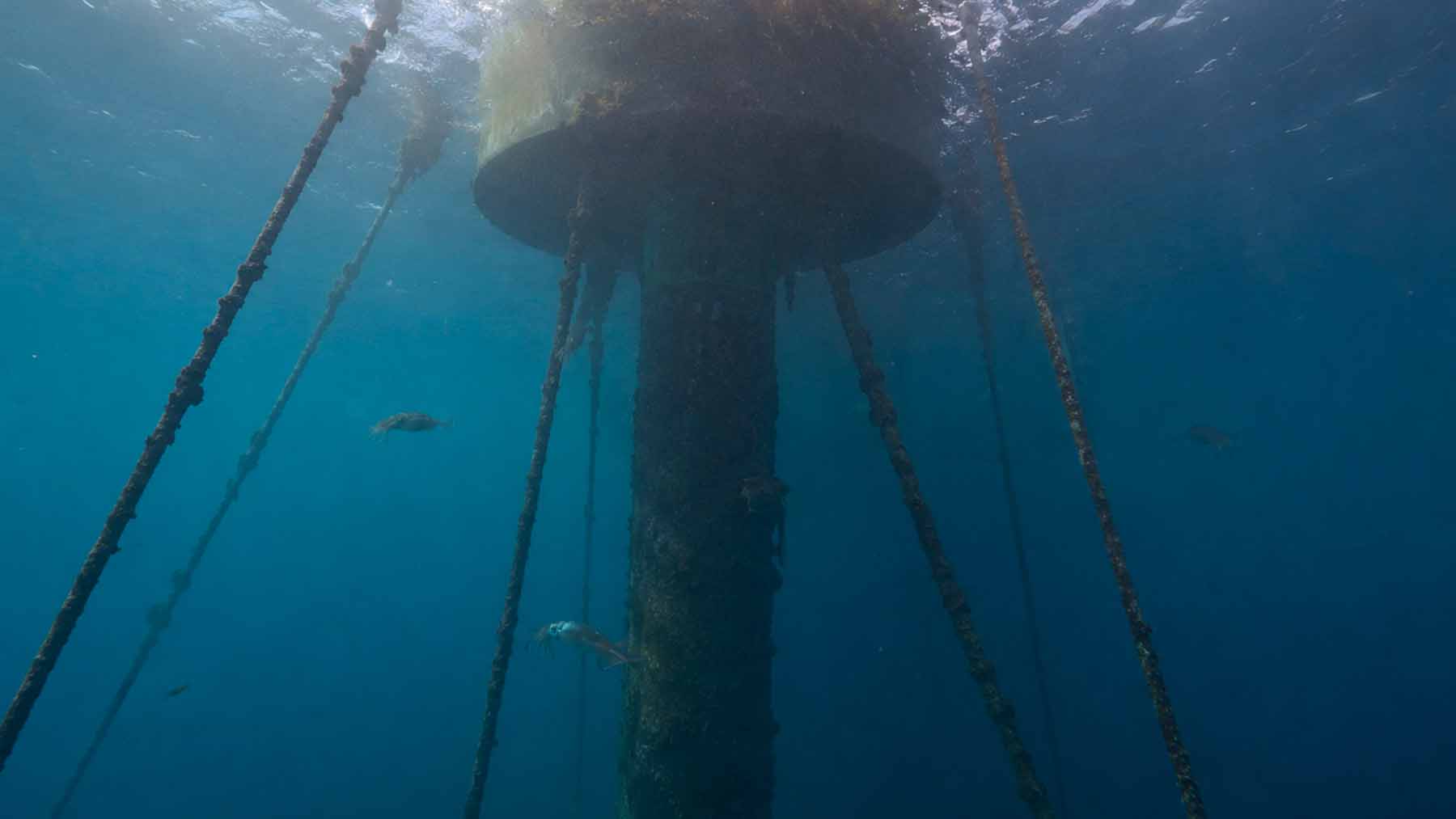
The researchers found that great numbers of Japanese horse mackerel gathered around the floating wind turbines.
83% of horse mackerel environmental DNA appeared in the samples.
Control sites from miles away were used for comparison.
Near the platforms, the genetic concentrations peaked. It was nearly triple that of the control sites.
Statistical modeling confirmed the turbines drove these high fish numbers by acting as artificial reefs.
Since the fish population began increasing due to protection from predators, safety exclusion zones had to be implemented.
The mandatory maritime zones ban fishing vessels near the floating wind turbines.
While these turbines boost ocean biodiversity, this restriction created new friction with commercial fishing.
Regardless, the floating wind turbines will ensure a sustainable ocean energy transition. Ultimately, the structures will help coastal communities meet electricity demand while working toward net-zero.
Anke Maree is a writer with a clear and engaging editorial style. Her work focuses on making complex topics accessible, informative, and relevant for readers across different areas of interest.
