
Floating wind turbines learned to “feel” the wind without sensors, and the method powering this breakthrough is far simpler than anyone expected
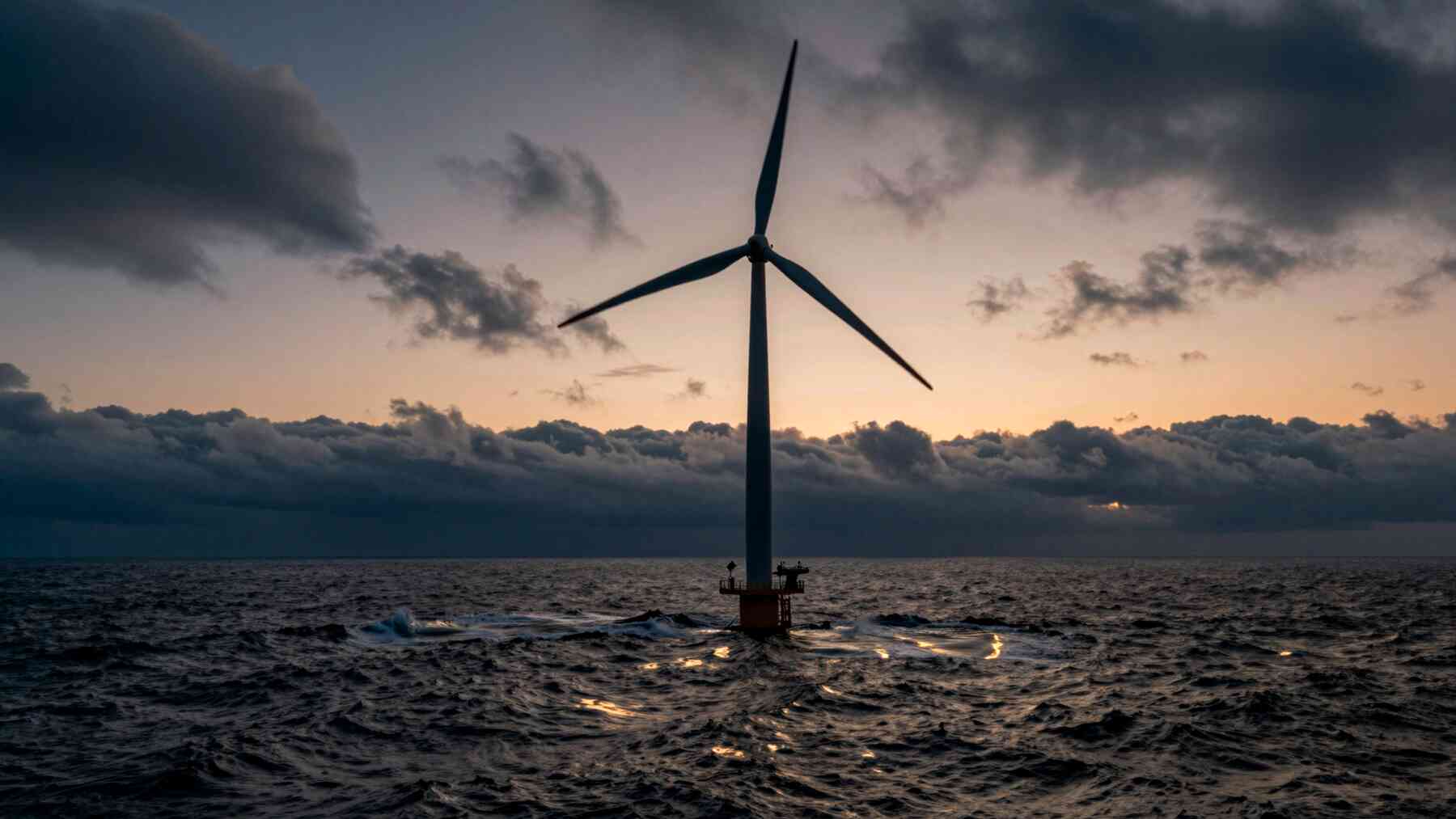
Floating offshore wind turbines can reach some of the strongest, most consistent winds on the planet — but those same winds are also among the hardest to measure. Out in deep water, knowing the exact wind speed hitting the rotor at any given moment is essential. It shapes how the turbine is controlled, how stable the platform stays, and how efficiently power gets generated.
The problem is that reliable wind measurement at sea is expensive, technically demanding, and prone to error. For years, engineers have compensated with sophisticated mathematical filters — but these tools need careful tuning that doesn’t always hold up under the unpredictable conditions offshore turbines actually face.
A European research team now suggests there may be a fundamentally different path forward — one that sidesteps many of those complications from the start.
Across all of them, the sliding-mode observers matched the CD-EKF in estimation accuracy — without requiring noise covariance tuning or dynamic linearization.
Why knowing the wind speed matters so much — and why it’s so hard
Floating offshore wind turbines access roughly 80% of the global offshore wind potential, according to the Global Wind Energy Council. That resource sits in deep water, far beyond the reach of conventional fixed-bottom structures.
Wind speed isn’t just a background variable — it’s the central input for control decisions. In lower-wind conditions, turbines adjust to capture as much energy as possible. When winds climb above rated speed, the priority shifts to protecting equipment by capping power output. Getting that transition wrong costs energy or risks damage.
Floating platforms compound the difficulty. Unlike fixed offshore turbines, FOWTs pitch, roll, and surge in response to waves and wind simultaneously. Sensors like lidar can sample the upstream wind field, but they’re expensive, demand heavy maintenance, and remain vulnerable to motion-induced measurement errors.
The standard tool and its limits: why the Kalman filter falls short at sea
For years, the go-to solution has been the extended Kalman filter — specifically, a continuous-discrete variant known as the CD-EKF, embedded in widely used open-source turbine controllers. It combines a dynamic turbine model with sensor measurements to estimate wind speed in real time.
The approach has real strengths, but persistent limitations. EKFs require nonlinear dynamics to be linearized around operating points, and that approximation degrades when conditions shift rapidly — exactly what happens on a floating platform. Choosing noise covariance matrices also depends on manual tuning, with no systematic method to get those values right.
Neural-network alternatives have been proposed, but they require large training datasets, behave as black boxes, and offer no formal guarantees of stability — a significant concern for systems operating in unpredictable offshore conditions.
A different mathematical approach: sliding-mode observers explained
Sliding-mode observers take a fundamentally different approach. Rather than relying on statistical noise models, they force estimation errors to converge by driving system states toward a chosen constraint surface — the sliding manifold — in finite time. The key property is robustness: disturbances are rejected through the system’s own structure, not by modeling them precisely.
Earlier sliding-mode designs suffered from “chattering” — high-frequency switching that made them impractical. The research team avoided this by building their framework on the supertwisting algorithm, a second-order sliding-mode technique that generates a continuous observer signal while still achieving finite-time convergence. The result is a cleaner signal without sacrificing the method’s core advantages.
Two versions were developed: a constant-gain SOSMO and an adaptive-gain ASOSMO that adjusts parameters automatically online. Both use only rotor speed as input — no wind sensor required.
Putting it to the test: simulations under realistic storm conditions
The observers were validated inside OpenFAST, a high-fidelity aero-hydro-servo-elastic simulator. All 24 degrees of freedom were activated — far more complex than the simplified model used to design the observers. That gap was intentional, testing whether the observers stay robust when the real world is messier than the math.
Conditions were deliberately demanding: turbulent wind with a mean speed of 18 m/s and irregular waves with a significant wave height of 3.25 m — a realistic offshore storm scenario.
Both the SOSMO and ASOSMO achieved wind speed estimation errors (RMSE) of approximately 0.66 and 0.67, respectively. The CD-EKF benchmark came in at 0.77 — roughly 13 to 14% worse. Computation time told a similar story: the SOSMO finished in 9 milliseconds, versus 18 milliseconds for the CD-EKF, with the adaptive ASOSMO requiring 11 milliseconds.
From simulation to wave tank: experimental proof at a French laboratory
The team then tested their observers on a scaled semi-submersible FOWT model in the wave tank at LHEEA/École Centrale Nantes, using a software-in-the-loop architecture. The physical model reproduced real hydrodynamic forces — wave excitation, mooring loads, platform motions — while aerodynamic loads were computed numerically in real time.
Four test scenarios covered above-rated operation with strong pitch activity, the critical transition zone between control regions, and a broad sweep from low to high wind speeds. Across all of them, the sliding-mode observers matched the CD-EKF in estimation accuracy — without requiring noise covariance tuning or dynamic linearization.
What this means for the future of offshore wind control
An observer that matches or beats the standard benchmark while being simpler to implement and lighter to run is attractive for real-time embedded controllers on commercial turbines. Reduced computational load matters when processing resources are shared across multiple control loops.
The adaptive ASOSMO stands out in particular. The researchers describe it as a first in the wind turbine literature — an observer that tunes itself online with minimal system knowledge, opening a path toward estimation tools that don’t need expert calibration for every new turbine configuration.
Next, the team plans to develop a fully integrated adaptive-observer-based controller, moving from estimation alone toward a comprehensive robust estimation and control framework for FOWTs. As the offshore wind industry pushes into deeper waters and larger machines, tools that are both theoretically sound and practically deployable will matter more, not less.

Carlos is an engineer with strong expertise in technical and industrial topics. He previously worked at international companies such as Siemens and is multilingual.
