
EIA forecasts record U.S. natural gas output of 122.5 Bcf/d in 2026, led by Permian and Haynesville growth
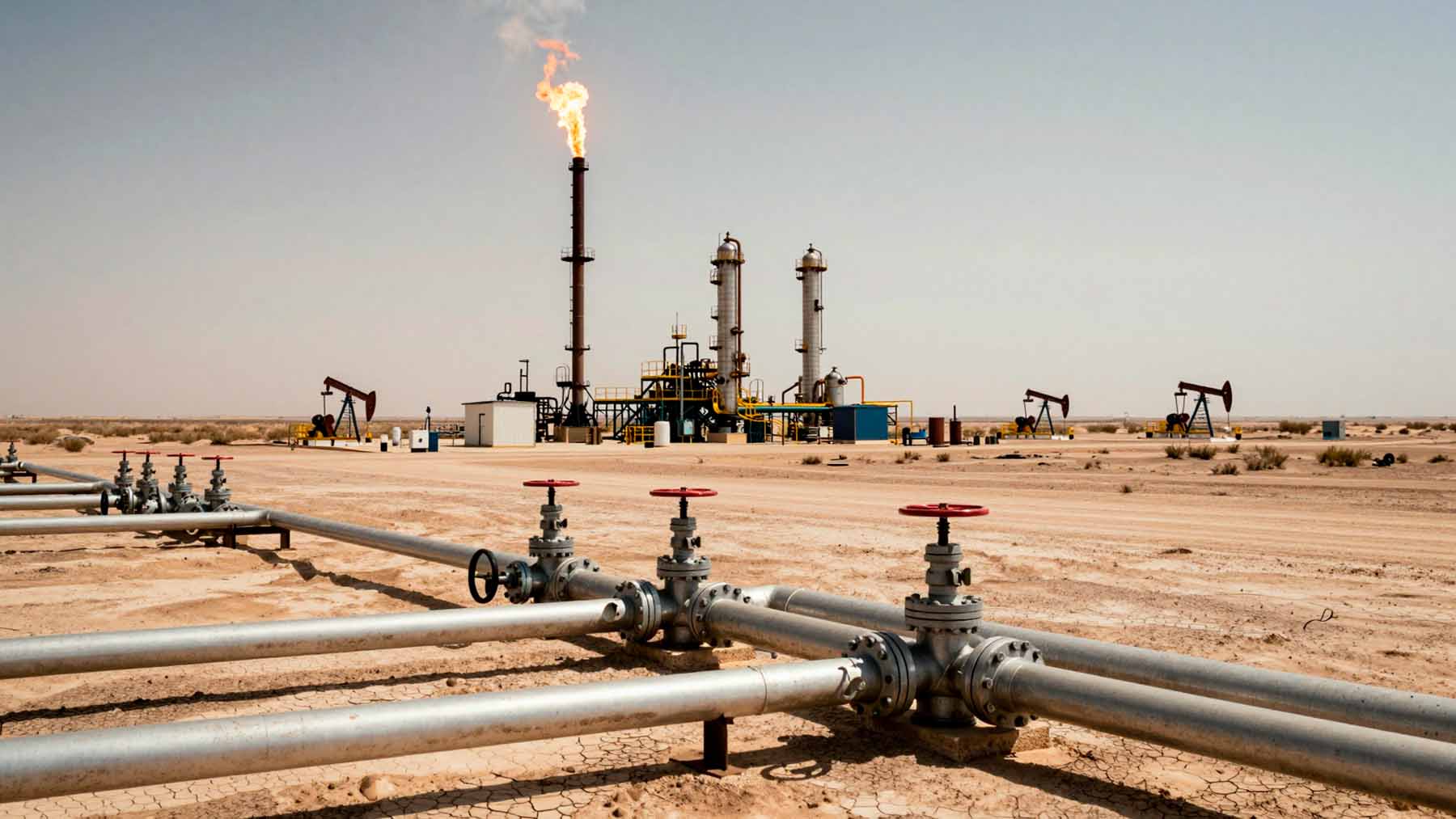 Image generated with artificial intelligence
U.S. natural gas production is on pace to shatter its own record. The Energy Information Administration’s August 2026 Short-Term Energy Outlook projects marketed output will average 122.5 Bcf/d this year—up from the 118.5 Bcf/d record set just last year. The gains are concentrated in two regions: the Permian Basin, spanning Texas and New Mexico, and the Haynesville formation across Louisiana and Texas.
EIA projects record natural gas output for 2026
The numbers behind that forecast deserve a closer look. The EIA’s August 2026 Short-Term Energy Outlook puts full-year marketed production at 122.5 Bcf/d — nearly 4 Bcf/d above the record set just twelve months earlier. That’s not a marginal revision. In a sector where single-digit percentage moves carry enormous economic weight, a jump of that size matters.
Production didn’t wait for year-end to make its case. In the first half of 2026, marketed natural gas output already averaged 121.3 Bcf/d — 4% higher, or 4.6 Bcf/d more, than the same period in 2025. That early momentum gives the full-year forecast a solid foundation rather than a speculative one. The August STEO is the source for all projections cited here, reflecting the EIA’s most current modeling as of that report date.
That associated gas gets captured and marketed, so when oil drilling activity rises, gas output rises too—even if nobody’s specifically targeting gas.
Rising oil prices and reservoir dynamics fuel Permian expansion
The Permian Basin is doing a lot of the heavy lifting. The EIA forecasts the region will average 29.2 Bcf/d in 2026—a 6% increase over 2025 levels. That growth isn’t coming from a gas-focused drilling campaign. It’s mostly a byproduct of oil production.
When Permian operators drill for crude, natural gas comes up with it. That associated gas gets captured and marketed, so when oil drilling activity rises, gas output rises too—even if nobody’s specifically targeting gas. Oil prices have made that drilling attractive. WTI crude averaged $84 per barrel through July 2026, well above what Permian operators need to stay profitable. According to the Dallas Fed Energy survey, executives reported breakeven prices of $69/b in the Midland Basin and $63/b in the Delaware Basin—leaving a comfortable margin at $84/b.
A second, less obvious factor is amplifying Permian gas output: a rising gas-to-oil ratio, or GOR. As reservoirs are produced over time, pressure inside them drops. Natural gas flows more easily at lower pressure than oil does, so the proportion of gas in each barrel of production gradually increases. Existing wells are generating more gas without any additional drilling—a structural tailwind that compounds quietly over time.
Haynesville output climbs on LNG export demand and stable gas prices
The Haynesville story is different. Operators are drilling primarily for natural gas, not oil, which makes the economics more directly tied to the Henry Hub benchmark price.
In the first half of 2026, Haynesville production rose 1.1 Bcf/d, or 7%, compared to the same period in 2025. The EIA forecasts a full-year increase of 9%, or 1.3 Bcf/d, for 2026 as a whole. The Henry Hub spot price is forecast to average $3.44 per million British thermal units this year—a slight decline of about 2% from the prior year, but apparently sufficient to keep drilling economical even accounting for the formation’s unusually high development costs.
Those costs are real. Haynesville wells reach depths of 10,500 to 13,500 feet—among the deepest in the Lower 48 states—requiring more time, more equipment, and more capital than shallower formations. Operators absorb those costs partly because of where the Haynesville sits. Its proximity to Gulf Coast LNG export terminals and major industrial consumers gives producers a built-in market, and as U.S. LNG export capacity has expanded, demand for feedstock gas from nearby sources has grown with it.
United States has led global natural gas production since 2009
A 2026 record wouldn’t surprise anyone who’s tracked U.S. production over the past decade and a half. The U.S. has been the world’s largest natural gas producer continuously from 2009 through 2024—the most recent year for which global data is available. Another record in 2026 would simply extend that streak.
The Permian and Haynesville are central to that dominance, though they operate under very different economic logics. One runs on oil prices; the other runs on gas prices. That distinction matters: together, they cover a broad range of market conditions rather than depending on a single driver.
The depth and cost profile of Haynesville wells also signal something about the industry’s longer-term confidence. Operators don’t sink capital into 13,000-foot wells without a clear view of where the gas will go and what it’ll fetch.
Permian Basin energy projects are growing
The U.S. Energy Information Administration‘s August 2026 outlook is straightforward on the headline: U.S. marketed natural gas production is forecast to hit 122.5 Bcf/d this year, breaking the 2025 record of 118.5 Bcf/d. First-half production of 121.3 Bcf/d already puts that target within reach.
The Permian is growing on the back of strong oil prices and a rising gas-to-oil ratio. Haynesville expansion is being pulled by stable gas prices and proximity to LNG export infrastructure. Because these two regions are adding supply through entirely different mechanisms, the overall production trend is more durable than it would be if everything hinged on a single variable. If the forecast holds, 2026 will mark another year in which the U.S. extended its position as the world’s top natural gas producer.
Kelly is an experienced writer with 15 years of experience exploring the big stories that shape our world, from tech breakthroughs and space exploration to climate, energy, and the fascinating quirks of science. She has a talent for turning complex ideas into sharp, memorable insights that stay with readers long after they’ve finished reading.
