
Ohio built a floating solar farm on its drinking water reservoir and saved nearly 10 acres of land while cutting $10 million in energy costs
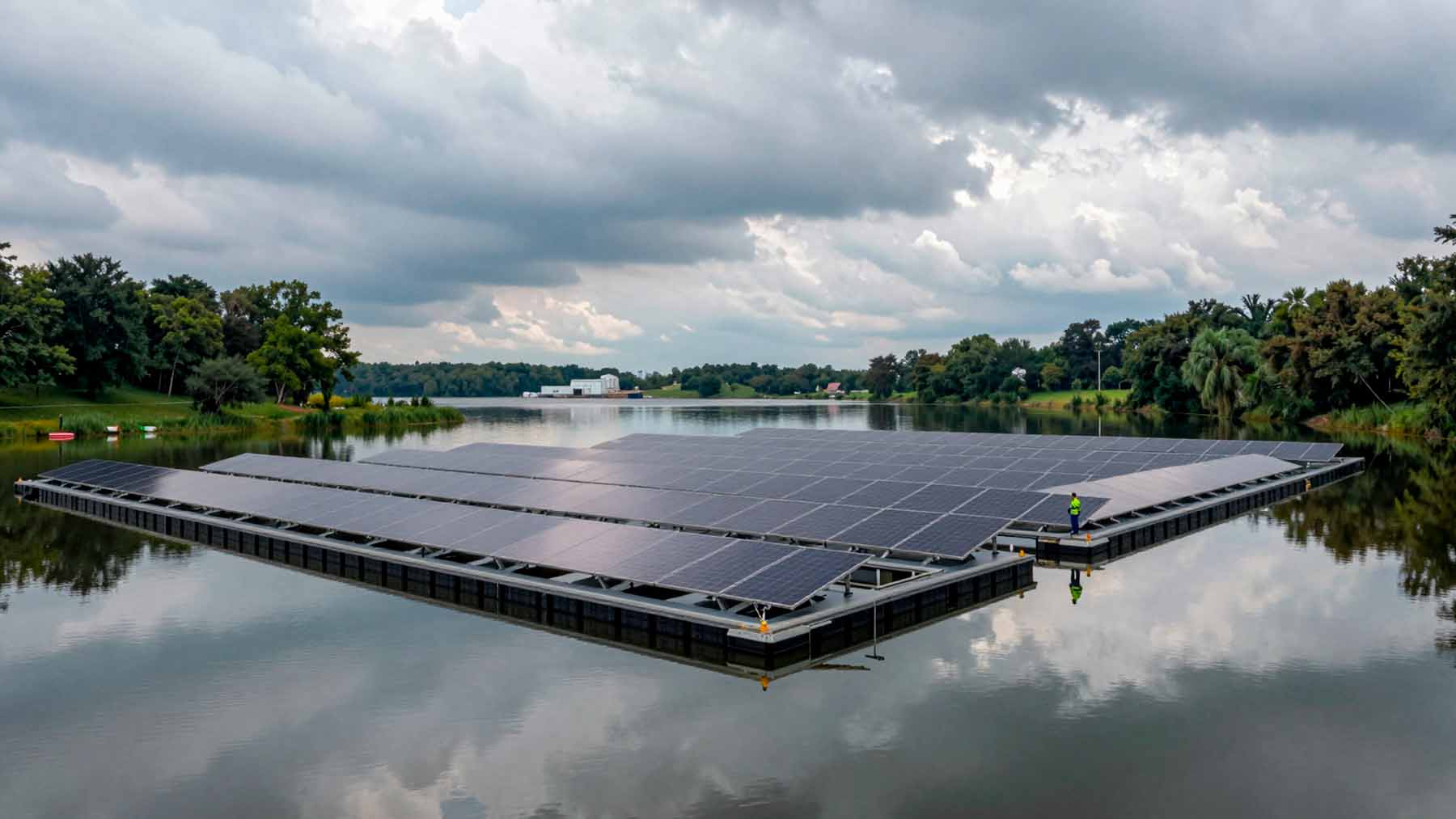 Image generated with artificial intelligence
While severe storms recently knocked out power to 135,000 Ohio homes, one Northwest Ohio community stepped into the rain to celebrate a solar installation that thrives in water.
Lima, Ohio, has completed a 2-megawatt floating solar array on the Twin Lake Reservoir—the city’s main drinking water source.
Marking Ohio’s third floating solar development, the facility solves a critical dilemma: generating clean, low-cost electricity for the city’s water plant without consuming valuable municipal land.
Engineered specifically for water environments, the array provides a smart alternative in a state where land-based solar frequently faces local political headwinds.
A solar farm that floats—and why that matters
The Twin Lake array occupies just four acres of reservoir surface.
A traditional ground-mounted solar system with the same 2-megawatt output would require at least 10 acres for panel spacing and service access. Saving six acres of land isn’t an afterthought—it is the core premise of the project.
The installation features over 3,100 bifacial solar panels mounted on Ciel & Terre Hydrelio floating platforms, securely anchored to the reservoir’s banks and floor.
Engineered specifically for water environments, the array provides a smart alternative in a state where land-based solar frequently faces local political headwinds.
Developer D3Energy and contractor ARP Solar built the system, expanding their established track record in Ohio‘s emerging floating solar market.
Powering the plant that keeps 35,000 people hydrated
The Twin Lake Reservoir supplies drinking water to 35,000 Lima residents. The neighboring treatment plant processes 14 million gallons daily, running continuous pumps and filtration systems that make it the city’s single largest energy user.
Operating costs accumulate rapidly, making the array’s projected $10 million in lifetime electricity savings a major win for local taxpayers.
“This project allows us to take an asset we already have—our reservoir—and use it in a new way to support the critical work happening at our water treatment plant every day,” said Lima Utilities Director Michael Caprella. “When you are treating approximately 14 million gallons of water each day, energy efficiency matters.”
The logic is simple: the reservoir existed, the massive energy demand existed, and floating solar linked them together.
Engineering on water: How the system holds up
The timing of Lima’s celebration—during a week of severe storms—served as an unplanned stress test. The floating array remained fully operational while conventional power grids struggled.
That durability stems from adaptive engineering.
Specialized mooring lines and anchors adjust automatically to shifting water levels, allowing the platforms to move smoothly with rising waves rather than fighting them.
To protect high-voltage equipment, electricity travels to eight shore-mounted Yaskawa Solectria XGI inverters on dry land. Furthermore, bifacial panels capture sunlight reflected off the water, boosting overall energy yield compared to standard land-based arrays.
Five years in the making: Funding, politics, and persistence
Reaching completion required five years of careful planning, policy persistence, and intergovernmental funding. Initial planning began five years ago, with formal authorization approved by the Lima City Council in 2023.
The project secured $2.4 million in U.S. Department of Energy grants—championed by former U.S. Senator Sherrod Brown—alongside nearly $1 million in direct-pay tax credits that significantly lowered net costs.
“This project is a great example of what can happen when leadership carries forward across administrations,” said Lima Mayor Sharetta Smith. “Today, we aren’t celebrating one person or one moment. We’re celebrating the many people who believed in this project and brought it across the finish line.”
A model for land-strapped communities across Ohio — and beyond
D3Energy Managing Director Stetson Tchividjian frames the installation as a repeatable model for land-constrained municipalities nationwide. “This project shows that clean energy doesn’t have to come at the cost of land,” Tchividjian noted. “By building on water the city already owns, Lima is generating 2 MW of clean power while preserving nearly 10 acres.”
The project joins a growing statewide trend, following a 1.5-megawatt system completed in Delaware in 2024 and a 6-megawatt array arriving in Monroeville later this year.
For communities seeking lower energy bills without sacrificing real estate, Lima offers a compelling blueprint. Ultimately, Lima proves that the smartest energy solutions don’t require buying new land—they simply require reimagining the surface of existing water assets.
Kelly is an experienced writer with 15 years of experience exploring the big stories that shape our world, from tech breakthroughs and space exploration to climate, energy, and the fascinating quirks of science. She has a talent for turning complex ideas into sharp, memorable insights that stay with readers long after they’ve finished reading.
