
A Swiss railway installs 48 solar panels between active tracks, testing whether passing trains can share space with electricity generation

There are over a million kilometers of open railway tracks across the globe.
Conventional solar farming requires large tracts of unused land.
Even then, developers have to take into consideration the ecological factors before starting to build anything.
According to Sun-Way’s calculations, railway solar production has the potential to contribute another 70 TWh to the continent’s solar resources.
Well, a Swiss solar pilot project decided to take a different route.
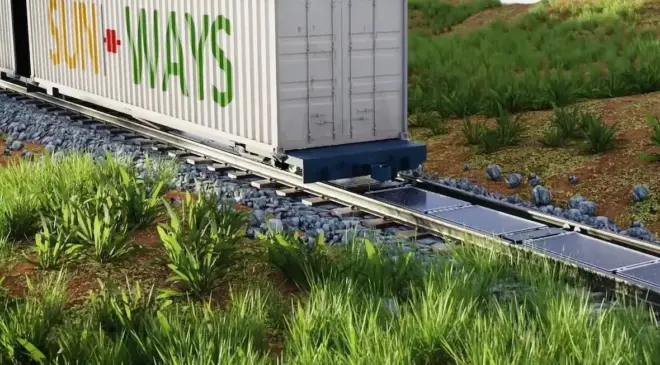
It installed solar panels in between a 100-meter section of active railway line in Buttes, Switzerland.
Can active train tracks double as high-output solar power plants?
The underutilized public infrastructure problem
When public infrastructure sits idle or is not being used to its full capacity, it causes a number of issues.
It requires massive capital investment to build it and ongoing expenditure to maintain.
So when spaces like railway tracks and airport borders serve only a single purpose, they lose out on efficiency gains.
Sun-Ways, founded in 2021, recognised this problem and wanted to solve it.
The company’s ethos sought to tackle two issues.
They wanted to help reduce the carbon emissions causing climate change.
In addition, they also wanted to contribute to the solar energy generation that is much needed, especially in Europe.
Based in Switzerland, Sun-Ways specifically targeted underused railway lines and created a pilot program.
The pilot project, located in Buttes, fitted solar panels between the railway tracks.
It has a live dashboard where anyone can view the amount of energy produced since it started.
The potential for solar energy growth in Europe
While the whole world has about a million kilometers of railways, a quarter of that amount is in Europe.
Today, around a third of all of Europe’s energy still relies on fossil fuels.
That is followed closely by Nuclear Energy, which is a cleaner source, accounting for around 23%.
Solar energy generation only accounts for around 10% of Europe’s energy sources.
According to Sun-Way’s calculations, railway solar production has the potential to contribute another 70 TWh to the continent’s solar resources.
The company is working on new pilot projects emerging in France, as well as in Belgium.
However, the company is not limiting itself to Europe only.
Sun-Way is also in talks with partners in Canada and South Korea because of the demonstrated success of its pilot project.
The 48 solar panels installed on the Swiss railway pilot
The Sun-Way pilot project installed 48 solar panels on active railway tracks in Butte, Switzerland.
The company designed and patented a removable system that allows installation of standard solar panels without hindering train traffic.
The 48 solar panels cover a distance of around 100 meters.
They are estimated to produce approximately 16000 kWh per year.
The installation launched in April 2025.
Since launch, the installation has already prevented 11.54 tons of carbon emissions and saved 9.72 tons of coal.
This environmental impact is equivalent to the benefits of planting 16 trees.
The solar energy produced can feed directly into public distribution networks or overhead train traction lines.
Best of all, Sun-Way’s system does all the above without a negative impact on the visual or environmental resources.
As the pilot project continues to show results, discussions are underway with potential partners in China, Mexico, and the United States.
Going forward, the company remains focused on optimizing its technology and strengthening its collaborations.
A concrete contribution to the energy transition
The million kilometers of open railway tracks across the globe have the potential to double up as solar energy generators.
Sun-Way’s patented pilot project shows that, with a bit of innovation, the limitations of conventional solar farming can be bypassed.
The company’s ability to install solar panels without restricting train rides is a stroke of genius.
In addition, its zero impact on visual and environmental resources is truly a concrete contribution to the globe’s energy transition.

