
Underwater ice shut down all seven turbines at Newfoundland’s Bay d’Espoir Dam until divers cleared frozen intake gates

A large island off the coast of mainland Canada experienced an unexpected hydro dam shutdown in January 2026.
This island is Newfoundland, and its energy grid depends on hydropower for residential heating during cold winters.
Legacy infrastructure has provided a reliable electricity supply for decades, until unusual freezing conditions struck.
In the mid-twentieth century, Newfoundland constructed a network of dams and generating stations, harnessing abundant rivers and reservoirs.
This event required rapid emergency responses, dedicated crisis management, and unique maintenance efforts.
Can Newfoundland protect its energy security should disaster strike again?
How legacy hydropower remains a primary source in an island region
Newfoundland has one of the smallest energy carbon footprints in North America.
This is because clean hydroelectric power generates more than 95% of the island’s electricity.
Water drives almost the entire grid, releasing only about 0.04 to 0.07 pounds of carbon dioxide per kilowatt-hour.
This is a fraction of the Canadian national average.
The island’s clean energy advantage stems from decades of strategic development.
In the mid-twentieth century, Newfoundland constructed a network of dams and generating stations, harnessing abundant rivers and reservoirs.
Today, 13 hydroelectric stations are operating across the province.
Its flagship Bay d’Espoir hydro facility opened in 1967 and serves as the backbone of the island’s grid.
This generating station delivers more than 600 MW of electricity, providing about 40% of the winter power supply.
Despite being decades old, legacy hydroelectric infrastructure remains essential for meeting surges in electricity demand.
It helps maintain a low carbon footprint while keeping the provincial grid stable.
Achieving strict climate targets amid a rapidly changing environment
Canada enforces stringent federal climate targets to reach net-zero emissions by 2050.
Yet achieving these goals is more complex due to steadily climbing national electricity demand.
Cold winters and the electrification of transport and residential heating continue to push peak power consumption higher.
Hydropower satisfies both by delivering reliable, clean electricity at large scale.
However, climate change and atmospheric shifts have introduced unpredictable weather extremes, threatening legacy dam infrastructure.
Decades ago, aging hydropower stations rarely encountered issues.
Now, drought-stricken Canada faces record-low reservoirs, raising immediate concerns over grid reliability.
But sudden, erratic weather events also present unique challenges to Canadian dams.
These events include extreme winter temperatures, unexpected severe storms, and changing freeze-thaw cycles.
As a result, vigilance and rapid crisis management become crucial.
In January 2026, in Newfoundland, Crown utility Newfoundland and Labrador Hydro had to put this crisis management to the test.
During this period, extreme winter weather struck, triggering an immediate emergency.
Shutting down dam operations as damage control
Unexpected changes in weather can force urgent shifts in energy usage, as experienced in Newfoundland at the start of 2026.
When extreme winter weather struck the remote interior, the Bay d’Espoir hydro dam was directly affected.
Sudden sub-zero temperatures, mild winter conditions, and strong westerly winds changed the open reservoir into a thick underwater slush.
This churning slush, known as frazil ice, is an exceptionally rare occurrence on still reservoirs.
It has occurred only once before in the dam’s 59-year operating history.
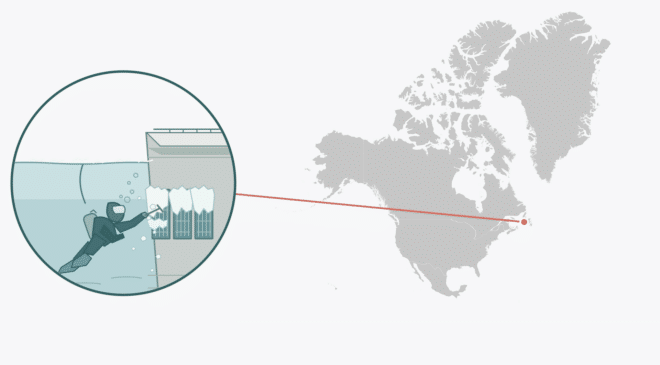
This time, however, the frazil ice coated the intake gates 30 feet below the water’s surface.
Water flow stopped, forcing all generating units to go offline simultaneously.
Over 604 MW of the grid’s power was lost during the coldest week of the winter.
The intensive, round-the-clock emergency response
A remotely operated vehicle had to inspect the blocked gates, but the ice was too thick to penetrate.
Specialized commercial divers had to tackle the freezing conditions, breaking up to three feet of frazil ice in pitch-black water.
Industrial air compressors pumped air overnight to loosen stubborn ice blocks.
By January 24, the intake gates could be cleared, and every turbine successfully restarted.
A formal Advance Notification Protocol was also activated, alerting islanders to conserve power.
Ultimately, these emergency measures helped protect energy security and will help should this happen again.
Anke Maree is a writer with a clear and engaging editorial style. Her work focuses on making complex topics accessible, informative, and relevant for readers across different areas of interest.
