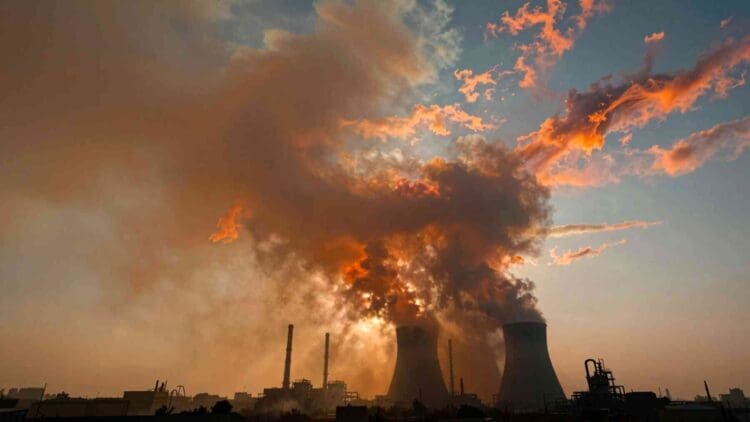

A study submitted to Nature Communications suggests that pollution and wildfire aerosols do not cool the atmosphere right away — they may actually warm it first. Led by Professor Guy Dagan of Hebrew University of Jerusalem, the research found that sudden spikes in aerosol concentrations can trap heat for up to 48 hours before the particles’ well-known cooling effect begins to take hold.
Study finds aerosols warm the atmosphere before cooling it
The preprint directly challenges the assumption that aerosols begin lowering temperatures the moment they enter the atmosphere. Professor Guy Dagan and his team at Hebrew University of Jerusalem ran a series of climate simulations, tracking atmospheric conditions across multiple days following sudden increases in aerosol concentrations.
The results were unambiguous. Heat remained trapped for roughly the first 48 hours after a pollution spike, with peak warming reaching approximately 20 watts per square meter—concentrated almost entirely on that opening day. Only after that initial window did the particles’ cooling properties begin to assert themselves.

That sequence — warming first, cooling second — is not what most climate models are built to expect.
Cloud changes at high altitude drive the short-term warming
The mechanism behind this temporary warming comes down to how aerosols interact with clouds. When particle concentrations rise sharply, they suppress light rain, pushing more water vapor higher into the atmosphere than would otherwise occur. At those altitudes, the extra moisture promotes the formation of additional ice crystals and high-altitude clouds — structures that act as a thermal blanket, trapping outgoing heat that would normally escape into space.
Once the cloud response fades after roughly 48 hours, the picture shifts. The aerosols’ reflective properties, which bounce incoming sunlight back away from Earth’s surface, become the dominant force, and the net atmospheric effect moves toward cooling.
The warming phase is not a minor footnote. At 20 watts per square meter, it represents a meaningful forcing signal packed into a very short window.
Findings challenge how climate models and satellite data are interpreted
Aerosols are already among the most difficult variables in climate science, and their interactions with clouds introduce substantial uncertainty into forecasting models. This study suggests that uncertainty may run deeper than previously understood.
Timing is the core issue. Many climate models and satellite observation methods rely on measurements taken at a single moment. If the atmosphere needs days — not minutes — to fully respond to a pollution event, a snapshot captured too early could reflect only the warming phase, while one taken too late might show only cooling. Neither would tell the whole story.
Dagan addressed this directly in a university news release: “The atmosphere has a memory.” That framing carries real weight for how researchers design observational studies and interpret what they collect. Tools that scientists currently rely on to assess aerosol effects may be producing results that are accurate for a specific moment but misleading about the full picture.
Frequent pollution fluctuations may prevent the full cooling cycle from completing
Pollution levels do not spike once and then stabilize. They shift constantly, driven by traffic, industry, wildfires, and changing weather patterns — and that variability matters for how the atmosphere actually responds over time.
If a new pollution spike arrives while the atmosphere is still working through its response to the previous one, the system never fully reaches the cooling phase. The warming window resets before the cooling window opens. When these fluctuations occur every few days, the net climate impact of aerosols could differ significantly from what current estimates assume.
That would mean pollution’s net effect on the climate is less cooling — and more warming — than models currently account for. It is a potentially significant revision to how scientists understand one of the atmosphere’s most complex variables.
Study status and implications for future research
It is worth being clear about where this research stands. The paper has completed peer review and is officially published, establishing these findings within the scientific record, and independent scrutiny may refine or qualify the conclusions. That is a normal and necessary part of the scientific process.
Even so, the study raises substantive questions that researchers and climate modelers will likely need to engage with. It introduces a temporal dimension to aerosol assessment—the idea that when you measure matters as much as what you measure—that current models largely do not account for. Single-moment satellite or model measurements may systematically misrepresent aerosols’ climate role depending on when they are taken relative to a pollution event.
Incorporating time-resolved approaches, ones that track how the atmosphere evolves across days rather than capturing a single snapshot, could change how scientists interpret both historical data and future projections.
A few things emerge clearly from this research. A sudden aerosol spike can warm the atmosphere for up to 48 hours before cooling begins, driven by high-altitude cloud formation. Frequent real-world pollution fluctuations may prevent that cooling from fully occurring. And the tools scientists use to measure aerosol effects may be capturing only part of the story, depending entirely on when those measurements are made.
Kelly is an experienced writer with 15 years of experience exploring the big stories that shape our world, from tech breakthroughs and space exploration to climate, energy, and the fascinating quirks of science. She has a talent for turning complex ideas into sharp, memorable insights that stay with readers long after they’ve finished reading.